






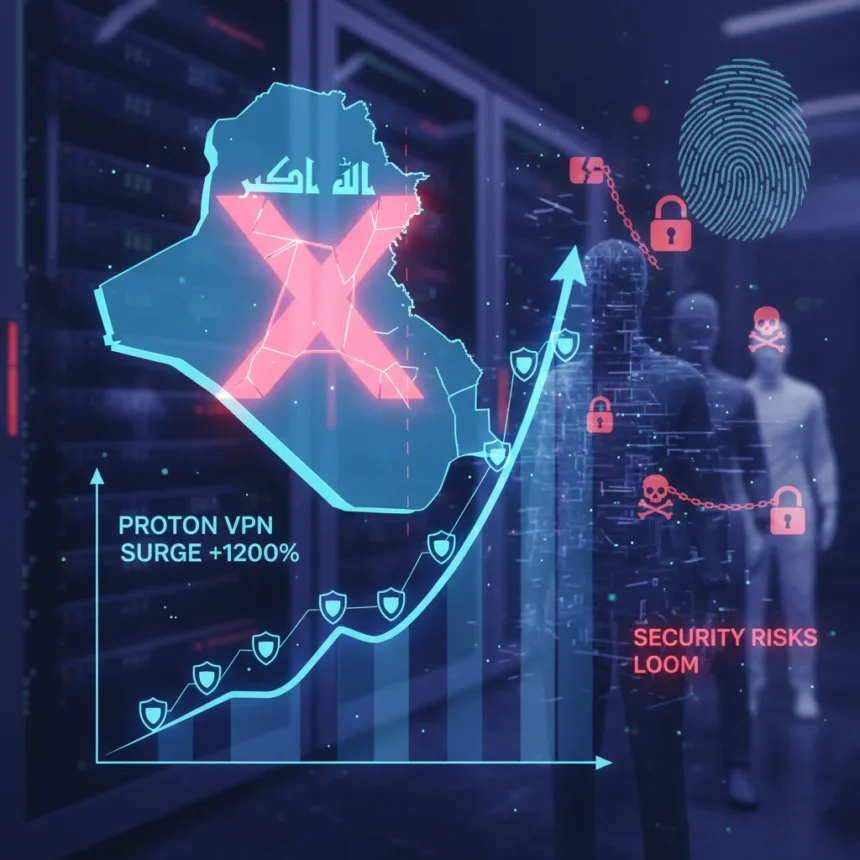
Telegram ban VPN security became a critical concern when Iraq’s government blocked the messaging platform, triggering a 1,200% surge in Proton VPN sign-ups as citizens scrambled for workarounds. The spike reveals a dangerous pattern: when governments restrict access, users often turn to unvetted VPN services that expose them to data theft and surveillance—the very threats they were trying to escape.
Key Takeaways
- Iraq blocked Telegram on August 6, 2023, citing national security and user data protection concerns.
- Proton VPN sign-ups surged 1,200% following the ban, far exceeding the general 72% VPN demand spike.
- Security experts warn against “sketchy” free VPN apps that harvest user data instead of protecting it.
- Similar bans in Turkey and Iran drove comparable VPN demand spikes, establishing a global pattern.
- A 2026 outage in federal Iraq (Kurdistan unaffected) suggests either technical failure or renewed restrictions.
Why Iraq Blocked Telegram in the First Place
Iraq’s telecoms ministry blocked Telegram on August 6, 2023, citing four reasons: national security concerns, threats to social stability, personal data mishandling by the platform, and violations involving storage of sensitive user information like addresses and family ties. The government implemented the block through TCP/IP interference, with internet service providers either rendering Telegram’s IP addresses unreachable or injecting TCP reset packets to sever connections. This technical approach made the block circumventable—which is precisely why VPN demand exploded.
The ministry later lifted the ban within days, issuing a statement that acknowledged support for freedom of expression but insisted that social media companies comply with national laws and protect user data. This framing—security and data protection as justifications for restriction—has become standard across governments seeking to control digital communication. Whether those concerns were genuine or pretextual, the outcome was identical: millions of users suddenly needed ways to access a blocked service.
The 1,200% VPN Surge and the Danger It Masks
When the Telegram ban took effect, general VPN demand in Iraq jumped 72% compared to the prior 30-day average. But Proton VPN specifically reported a 1,200% surge in sign-ups—a vastly steeper climb that suggests users were actively seeking a trusted VPN provider rather than grabbing whatever was free or convenient. This distinction matters because it hints at a bifurcation: some users made informed choices, while many others likely installed whatever VPN app promised the fastest download or lowest price.



Proton VPN’s public warning against “sketchy apps” underscores the real threat. Free or unregulated VPN services often harvest user data themselves, defeating the entire purpose of circumventing government surveillance. A user might bypass Telegram’s block only to hand their browsing history, location, and credentials to a malicious VPN operator. In a country where government surveillance is already a concern, this trade-off is catastrophic.
Global Pattern: Telegram Ban VPN Security Emerges Across Regions
Iraq’s experience is not isolated. When Turkey banned Telegram alongside Facebook, Instagram, YouTube, and TikTok in October 2023, VPN demand surged 100%. Iran’s demonstrations triggered even more dramatic spikes: a 2,164% surge on September 22, 2023, and a peak of 3,082% on September 26, 2023. These numbers reveal a global pattern: whenever governments restrict messaging or social platforms, citizens immediately seek VPNs—and often without evaluating whether the VPN they choose is trustworthy.



This creates a perverse incentive structure. Scammers and malicious operators know that censorship events trigger panic-driven downloads. They release free VPN apps with attractive branding, promise instant access to blocked services, and collect data in bulk. Legitimate VPN providers like Proton find themselves competing not just on security and privacy, but on speed and simplicity—because panicked users in a blocked country are not reading security audits; they are looking for the fastest download button.
The 2026 Outage: Telegram Ban VPN Security Concerns Resurface
In April 2026, Telegram experienced an outage or block that hit Baghdad, Basra, Najaf, Saladin, Kirkuk, and Diyala—but spared Kurdistan. The cause remains unclear; it could be technical failure or a renewed government restriction. Kurdistan’s immunity suggests the block was not global, but rather a federal Iraqi decision, pointing to either deliberate government action or technical limitations that prevented the government from blocking Telegram across all regions simultaneously.
This 2026 incident echoes the 2023 ban and raises the same security questions. If Telegram is blocked again, users will likely repeat the same behavior: downloading VPNs without vetting them, trusting apps based on download counts rather than security certifications, and inadvertently exposing themselves to data harvesting. The cycle repeats because the underlying problem—government censorship—remains unresolved.
Why Free VPNs Are Dangerous During Circumvention
When users circumvent government blocks, they are already in a high-risk posture. They are accessing restricted content, which governments may monitor or penalize. Adding an untrusted VPN to this scenario compounds the danger exponentially. Free VPN apps often contain malware, sell user data to third parties, inject ads into encrypted traffic, or log browsing activity despite privacy claims. For an Iraqi user trying to access Telegram discreetly, a malicious VPN is worse than no VPN at all—it creates a second surveillance vector.


Telegram itself responded to the 2023 ban by stating: “Please remain calm, all user data are very safe and we will do all we can to return our services. We are in talks with the government”. But that assurance does nothing for users whose VPN provider is harvesting their data. The messaging platform’s security is irrelevant if the tunnel carrying that traffic is compromised.
What Users Should Know About Circumvention
The 1,200% Proton VPN surge suggests some Iraqi users made the right choice: selecting a reputable, audited VPN provider with a documented no-logs policy. But this outcome is not guaranteed in future blocks. Users facing censorship should prioritize VPN providers with transparent security audits, published privacy policies, and a track record of defending user data against government requests. Choosing based on brand recognition, free trials, or download rankings is a recipe for data exposure.
Governments justify platform blocks using security and data protection language, yet their restrictions often push users toward less secure alternatives. This paradox—that censorship creates the exact conditions for the data breaches governments claim to prevent—is rarely acknowledged in official statements. Iraq’s telecoms ministry cited user data protection as a reason for blocking Telegram, but the ban itself drove millions of users to unvetted VPN services that expose far more data.
Does the Telegram ban affect VPN demand globally?
Yes. Telegram blocks in specific countries trigger massive VPN spikes in those regions, but do not significantly affect global VPN demand. Turkey’s 2023 ban drove a 100% surge in Turkish VPN usage, while Iran’s demonstrations peaked at 3,082%. These are regional phenomena, not worldwide trends. Global VPN adoption is driven by privacy concerns and content access, not individual country blocks.
Why did Iraq’s 2023 Telegram ban last only days?
Iraq’s telecoms ministry lifted the ban within days, stating it supports freedom of expression but requires social media companies to comply with national laws and protect user data. The exact reason for the rapid reversal is unclear, but it may reflect backlash from users, business impact on e-commerce and marketing, or diplomatic pressure. The ban’s brevity did not prevent the 1,200% VPN surge, as users downloaded VPNs during those critical days and retained them afterward.
What happened to Telegram in Iraq in April 2026?
Telegram experienced an outage or block affecting federal Iraqi cities like Baghdad, Basra, and Najaf, while Kurdistan remained unaffected. The cause—technical failure or government restriction—has not been officially confirmed. The geographic split suggests either a federal government action or technical limitations preventing blanket coverage. This echoes the 2023 ban pattern and will likely trigger another VPN demand surge if it represents a deliberate block.
The Telegram ban VPN security dilemma reveals a fundamental flaw in how governments approach digital restrictions: they create urgent demand for security tools, but that urgency often overrides users’ ability to make informed choices. As long as governments block messaging platforms, users will seek VPNs. The question is not whether they will circumvent—it is whether they will do so safely. Proton’s 1,200% surge shows some users chose well. But for every user who selected a trusted VPN, others likely installed something far more dangerous than the censorship they were trying to escape.
Edited by the All Things Geek team.
Source: TechRadar