





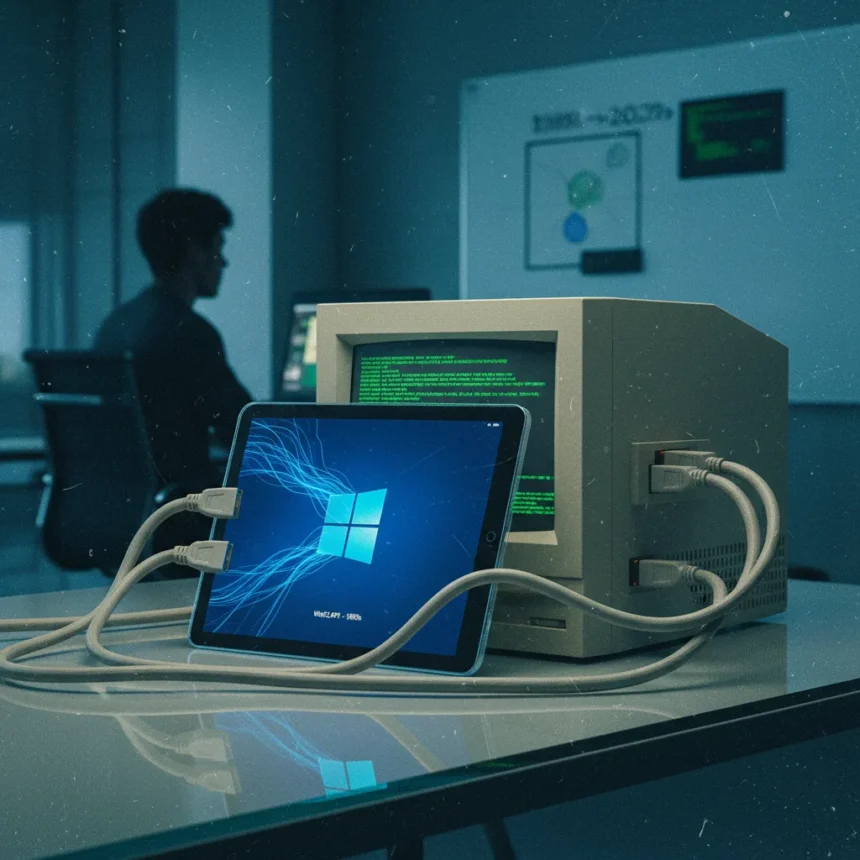
Windows 11 Win32 API, the foundational technology layer introduced during the Windows 95 era roughly 30 years ago, remains the bedrock of Microsoft’s flagship operating system in 2026. When you right-click a file or interact with a traditional desktop application on Windows 11, you are executing code that predates the commercial internet. Microsoft’s Chief Technology Officer Mark Russinovich recently acknowledged this uncomfortable truth: the company never expected Win32 to still be a first-class API surface three decades later.
Key Takeaways
- Win32 API from the mid-1990s remains Windows 11’s fundamental architectural layer
- Microsoft’s CTO admits no one expected the 30-year-old API to survive to 2026
- Multiple internal replacement attempts have failed due to the massive ecosystem built on Win32
- The API’s staying power stems from decades of app dependencies and backwards compatibility
- Russinovich frames Win32’s persistence as a strength, not a weakness
The Unexpected Longevity of Windows 11 Win32 API
Russinovich’s candid confession reveals the gap between 1990s predictions and 2026 reality. “Did anyone in the 90s expect Win32 to be a first-class API surface in the year 2026? And I think I can safely answer, no,” he stated. The CTO elaborated: “Nobody, I think, would have expected that because we were thinking flying cars and, you know, moon stations by the year 2026, not Win32 that was designed back in Windows 95 days.” This admission underscores how technological forecasting routinely misses the staying power of foundational infrastructure.
The Windows 11 Win32 API’s survival is not a bug—it is an architectural necessity. When Russinovich explained why the ancient API persists, he pointed to ecosystem lock-in: “I think that one of the reasons it’s got the staying power is it’s just a fundamental layer inside of Windows that so many apps have built on… it’s kind of bedrock”. Decades of software dependencies, hardware drivers, and enterprise applications have crystallized around Win32. Removing or replacing it would break compatibility with countless programs that organizations and users rely on daily.
Why Replacement Attempts Have Failed
Microsoft has tried multiple times to move beyond the Windows 11 Win32 API architecture. Each attempt has collided with the same immovable object: the ecosystem. The company explored web-based alternatives and modern frameworks, but the sheer volume of legacy code and institutional dependencies makes a clean break impossible. Any replacement would require persuading millions of developers to rewrite applications, convincing enterprises to retrain staff, and guaranteeing that no existing functionality would break—an unrealistic expectation for any large-scale migration.


This contrasts sharply with the recent industry pivot toward web applications and cloud-based tools. For years, the trend favored RAM-heavy Electron apps and browser-based software, which promised platform independence and easier updates. Yet Windows 11 Win32 API’s persistence signals a quiet recognition that native code, despite its age, often outperforms bloated alternatives. The API’s relevance in 2026 reflects a broader realization: sometimes the oldest solution is the most efficient one.
Windows 11 Win32 API’s Unexpected Relevance in 2026
Russinovich framed the situation positively, suggesting that Windows 11 Win32 API is “more relevant than ever in 2026”. This statement might seem counterintuitive given the API’s antiquity, but it acknowledges a practical truth: the architecture works. It is battle-tested, performant for its intended use cases, and deeply integrated into both consumer and enterprise workflows. Rather than fight the ecosystem, Microsoft has accepted Win32 as a permanent fixture and focused on modernizing the layers above it.



The staying power of Windows 11 Win32 API reveals something important about technology infrastructure: the oldest code is often the most critical code. It becomes invisible through familiarity, embedded in millions of applications, and economically impossible to replace without massive disruption. The mid-1990s engineers who designed Win32 inadvertently created a system so durable that it would outlast their own career expectations by decades.
What Does This Mean for Windows Users and Developers?
For end users, the persistence of Windows 11 Win32 API is largely invisible—and that is by design. Applications continue to work. Compatibility is maintained. The OS remains stable. Developers, however, face a more complex landscape. Those building new applications can leverage modern frameworks, but anyone supporting legacy software or integrating with enterprise systems must contend with Win32’s quirks and conventions. The API’s continued relevance means learning it remains a valuable skill for Windows-focused developers, even as newer technologies emerge.
Microsoft’s public acknowledgment of Windows 11 Win32 API’s role signals a shift in how the company talks about legacy technology. Rather than treating 30-year-old code as technical debt to be eliminated, leadership frames it as foundational infrastructure that has earned its place through utility and reliability. This pragmatic stance reflects maturity in systems design: sometimes preserving what works matters more than pursuing what is fashionable.
Is Windows 11 still built on Win32 code?
Yes, Windows 11 relies heavily on Win32 API as a fundamental architectural layer. Microsoft’s CTO confirmed that the 30-year-old API from the Windows 95 era remains a first-class API surface and the bedrock of the operating system.



Why hasn’t Microsoft replaced Win32 with something newer?
Multiple internal replacement attempts have failed because the ecosystem built on Win32 is too large and interconnected. Millions of applications, drivers, and enterprise systems depend on the API. A replacement would require unprecedented coordination across the industry and guarantee of perfect backwards compatibility, which is economically and technically unfeasible.
Is the Windows 11 Win32 API going away in the future?
There is no indication that Windows 11 Win32 API will be abandoned. Microsoft’s CTO framed it as “more relevant than ever in 2026,” suggesting the company has accepted Win32 as a permanent part of Windows architecture rather than a problem to be solved.
The Windows 11 Win32 API story is ultimately a lesson in the power of installed bases and network effects. A technology that was never meant to last three decades has become unkillable because so much depends on it. Microsoft’s candid admission that no one saw this coming is refreshingly honest—and it hints at a broader truth about infrastructure: the most important code is often the oldest code.
Edited by the All Things Geek team.
Source: Tom's Hardware




