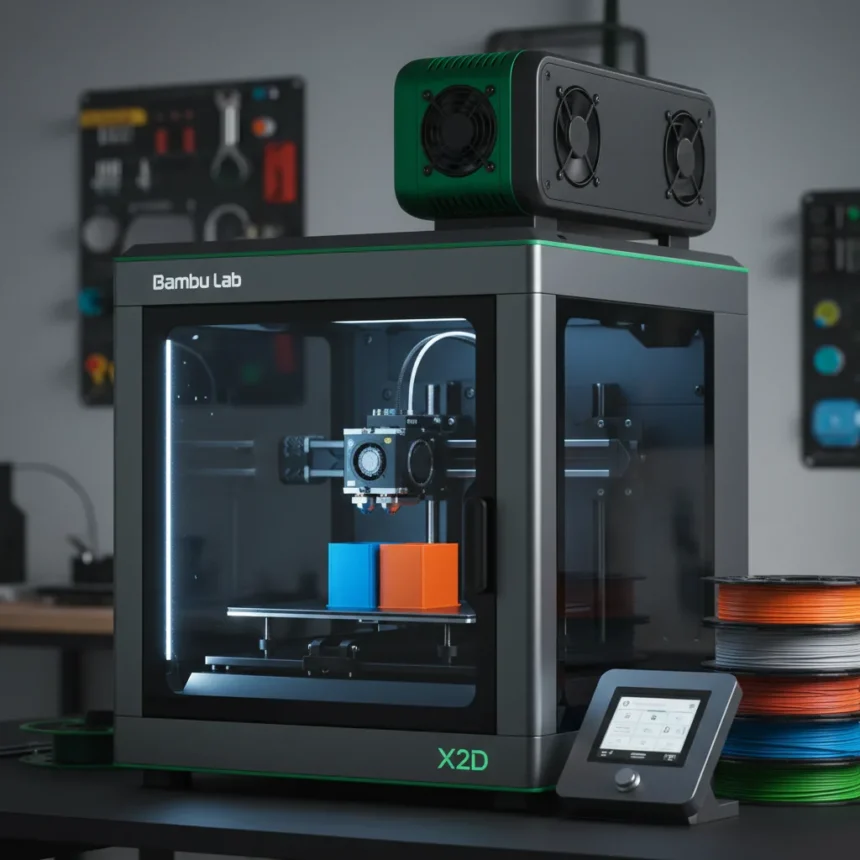
The Bambu Lab X2D is a significant overhaul of Bambu Lab’s popular X1 Carbon, introducing a larger build volume, dual hotend with offset nozzles, heated Automatic Material System (AMS), and optional laser, blade cutter, and pen plotter attachments that transform it into a multi-tool craft machine.
Key Takeaways
- Dual hotend with Z-axis offset nozzles reduces filament waste and enables multi-color printing in single layers
- Vision encoder plate uses 1080p camera for 50µm XY-axis motion accuracy without manual calibration
- Heated AMS and larger build volume address the two most-requested X1C improvements from the community
- Optional laser, blade, and pen plotter turn the printer into a crafting hub for cutting boards and vinyl projects
- Slightly slower than X1C due to size, but faster AMS and dual nozzles compensate for most workflows
What Makes the Bambu Lab X2D Different
The X2D is not just a bigger X1C. The dual-nozzle hotend is the machine’s defining feature. Unlike single-nozzle printers that require tool changes or complex purge towers, the X2D’s two nozzles are offset on the Z-axis, allowing them to print aligned multi-color or multi-material layers without waste. Each nozzle supports temperatures up to 350°C, making it possible to print dissimilar materials—including TPU—in the same print. The nozzle-switching mechanism mirrors the approach Bambu Lab uses on its A1 printer, so users familiar with that system will recognize the workflow.
The heated AMS is the second major upgrade. Where the X1C required external heat, the X2D’s integrated heated chamber means serious materials like PETG-HF print reliably without babysitting the printer. Combined with the larger build volume, this opens the door to bigger projects: full-sized helmets, custom stands, and detailed miniatures are now single-print possibilities rather than multi-part assemblies.
Precision and Calibration: The Vision Encoder Advantage
The vision encoder plate is where the X2D’s precision engineering shines. A high-resolution 1080p camera mounted on the toolhead scans a tiny calibration grid, enabling XY-axis accuracy to within 50µm—tight enough for functional parts and detailed surface finishes. Setup and calibration are described as a breeze, with auto bed leveling handling the tedious alignment work that typically frustrates newcomers. Users with thousands of hours on the X1C report the experience is noticeably smoother and faster.


The active torque detection system monitors filament pressure in real time, flagging clogs, slippage, or grinding before they ruin a print. This is not a novelty—it is a practical safety net for unattended printing sessions, especially when running expensive materials.
Speed, Noise, and Build Quality Trade-offs
The X2D is slightly slower than the X1C due to its larger footprint and dual-nozzle complexity. However, the faster AMS 2 integration and dual-nozzle efficiency compensate for most workflows, particularly multi-material prints where a single-nozzle machine would waste hours on tool changes. The enclosure is sealable with filtered exhaust or external extractor support, giving users flexibility in workshop setup. Motor noise cancellation makes it noticeably quieter than its predecessor.



Build quality is described as crazy impressive by users who have logged 3000+ hours on the X1C and switched to the X2D. The interior is brighter, the mechanical tolerances are tighter, and the overall feel is more refined. For a machine in this price tier targeting serious makers and small businesses, the construction quality justifies the investment.
The Multi-Tool Ecosystem: Laser, Blade, and Beyond
What sets the X2D apart from competitors like the Prusa XL is the optional add-on ecosystem. A laser engraver module, blade cutter, pen plotter, and vision encoder plate transform the base printer into a mini craft factory capable of cutting boards, engraving leather, and plotting vinyl designs. This modularity targets makers who want one machine to handle multiple tasks rather than maintaining separate tools. For small businesses and elite crafters, this flexibility is a significant shift. The full kit with deluxe laser combo is priced out of hobbyist range, positioning the X2D as a tool for professionals rather than casual tinkerers.
How Bambu Lab X2D Compares to the X1 Carbon
The X1C remains a solid printer, but the X2D addresses nearly every complaint the community raised over the past two years. It is bigger, the nozzles are easier to swap, the AMS is heated, and the dual-nozzle hotend seriously cuts down on filament waste. Users with extensive X1C experience report preferring the X2D for its speed, quietness, and precision. The X2D is backward compatible with current AMS hardware, so existing users can upgrade gradually without scrapping their ecosystem. Against budget alternatives like the Elegoo Carbon at under $300, the X2D sits in a different market entirely—you really do get what you pay for.
Real-World Print Quality and Reliability
After 300+ hours of testing, the X2D delivers incredibly sharp print quality with impressive speed that does not sacrifice accuracy. The overall user experience is smooth and beginner-friendly, though the machine is really aimed at makers with some experience. PETG-HF prints beautifully, and the dual nozzles make multi-color prints a pleasure rather than a chore. The active ventilation system keeps the chamber clean, and the filtered exhaust option is a relief for makers working in shared spaces.



Is the Bambu Lab X2D Worth Upgrading From the X1C?
If you have an X1C and you print multi-material projects, large parts, or work with temperature-sensitive materials, the X2D is a clear upgrade. The dual nozzles alone save hours on every multi-color print, and the heated AMS removes a major friction point. If you are printing simple single-material parts, the speed difference is marginal enough that the upgrade is not essential. For new buyers, the X2D is the obvious choice—it is the current flagship and it checks off every box the community has been asking for.
Should I buy the Bambu Lab X2D if I am new to 3D printing?
The X2D is beginner-friendly in terms of interface and automation, but it is priced for serious makers, not hobbyists testing the waters. If you are new to 3D printing and want to learn, start with a budget machine. Once you understand your workflow and need multi-material capability or larger prints, the X2D becomes the logical upgrade.
Can the Bambu Lab X2D print TPU and other flexible materials?
Yes. The dual-nozzle hotend and independent nozzle control allow the X2D to print TPU and other flexible materials without the purge tower waste that single-nozzle printers require. The offset Z-axis design keeps aligned layers clean and precise.
What is the difference between the Bambu Lab X2D and the Prusa XL?
Both machines feature dual extruders with nozzle swapping, but the X2D integrates a heated chamber, vision encoder calibration, and optional laser/blade/pen add-ons. The Prusa XL is more modular in terms of build volume expansion. The X2D is faster and quieter, while the Prusa ecosystem has deeper community support. For multi-tool crafting, the X2D wins. For pure print quality and community resources, opinions diverge.
The Bambu Lab X2D is the X1 Carbon successor fans have been waiting for. It is bigger, smarter, and more capable. The dual nozzles cut filament waste. The vision encoder eliminates calibration headaches. The heated AMS unlocks new materials. For makers ready to step up from hobbyist printing, it is a machine worth the investment.
Where to Buy
Edited by the All Things Geek team.
Source: Tom's Hardware