





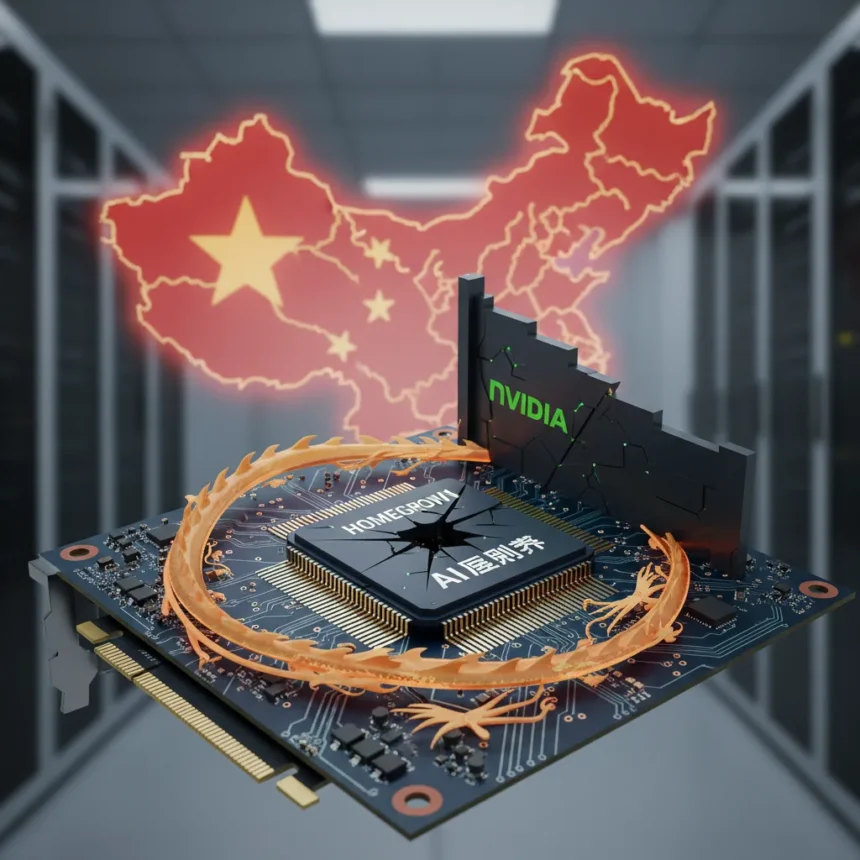
The China Nvidia GPU ban represents a significant escalation in Beijing’s push to move its artificial intelligence industry away from foreign hardware. According to reports, China has blocked sales of Nvidia’s GeForce RTX 5090D V2, a graphics processor specifically engineered to comply with U.S. export controls and designed exclusively for the Chinese market. The timing is striking: the ban reportedly occurred while Nvidia CEO Jensen Huang was in the country, suggesting the move carries symbolic weight beyond mere regulatory mechanics.
Key Takeaways
- China has reportedly banned Nvidia’s RTX 5090D V2, a China-specific GPU built to meet U.S. export restrictions.
- The GPU serves gaming and 3D animation but is widely adopted by AI developers for model training.
- The ban signals Beijing’s intensified pressure on domestic AI firms to abandon foreign chips.
- The reported move occurred during Nvidia CEO Jensen Huang’s visit to China.
- China is actively promoting homegrown semiconductor alternatives to reduce dependence on U.S. technology.
Why China banned the RTX 5090D V2 despite its U.S. compliance design
Nvidia designed the RTX 5090D V2 specifically to navigate U.S. export restrictions. The GPU was engineered as a China-exclusive variant, intended primarily for gaming and 3D animation workflows. Yet its raw computational power made it attractive to AI developers, who repurposed it for model training and inference tasks. This gap between intended use and actual adoption created vulnerability. Beijing’s reported ban suggests that even a compliant foreign chip is now considered a threat to China’s semiconductor sovereignty if it enables continued reliance on Nvidia technology. The message is unambiguous: compliance with U.S. rules is insufficient if the alternative is building indigenous capabilities.
The ban is not simply about blocking a single product. It reflects Beijing’s broader strategy to redirect AI investment toward domestic chip manufacturers. By removing a viable foreign option, even one designed to sidestep export controls, China forces its AI companies to commit to homegrown solutions. This creates market demand for Chinese semiconductors and accelerates the domestic industry’s development cycle. It is a blunt instrument, but effective: if you cannot buy Nvidia, you must build or buy Chinese.
The geopolitical calculus behind the timing
Jensen Huang’s presence in China during the reported ban adds diplomatic theater to what might otherwise be a quiet regulatory decision. Whether intentional or coincidental, the timing sends a message. It signals that Beijing is willing to restrict foreign technology even when a U.S. company’s leadership is actively engaged in the market. This is not a negotiation; it is a statement of intent. Huang’s visit underscores the paradox: Nvidia has bent over backward to comply with U.S. export rules, created a China-specific product, and still faces exclusion. The lesson for other foreign tech firms is stark. Compliance alone does not guarantee market access in China. Political will and strategic alignment matter more.


The broader context is intensifying U.S.-China competition over AI dominance. Washington has tightened export controls on advanced semiconductors, and Beijing is responding by severing dependence on U.S. suppliers. China’s reported ban on the RTX 5090D V2 is not an isolated incident but part of a coordinated strategy to build a self-sufficient AI ecosystem. By blocking foreign GPUs, Beijing creates urgency for its own chip designers and guarantees them a captive market of domestic AI companies desperate for alternatives.
What this means for Nvidia, Chinese AI firms, and the global chip market
For Nvidia, the ban represents a loss of a carefully carved niche market. The RTX 5090D V2 was a compromise product, designed to maintain a foothold in China despite U.S. export restrictions. Its prohibition signals that even compromise is no longer acceptable to Beijing. Nvidia’s long-term China strategy now faces existential questions: without a compliant consumer GPU option, the company’s influence over Chinese AI development shrinks further. The company may pivot to data center products or higher-margin enterprise solutions, but the consumer and mid-market AI development segment in China is effectively closing.



For Chinese AI companies, the ban forces a transition. Developers accustomed to Nvidia hardware must now retrain on domestic alternatives or accept reduced performance and capability. This is painful in the short term but strategically beneficial to Beijing. It accelerates the maturation of Chinese chip ecosystems and reduces the gravitational pull of Nvidia’s software stack. Chinese startups that have built their entire infrastructure around CUDA, Nvidia’s programming framework, now face pressure to diversify or migrate. The ban is a tool for decoupling, and decoupling is China’s stated priority.
Globally, the ban reinforces a troubling trend: the fragmentation of the semiconductor market along geopolitical lines. Where once a single GPU could serve global markets, we are now seeing region-locked variants and strategic exclusions. This benefits neither innovation nor consumers. Chinese AI development will proceed, but potentially at a slower pace and with less interoperability with global standards. The world loses the efficiency of a unified chip ecosystem and gains instead a patchwork of competing standards and incompatible platforms.
Is China’s ban on the RTX 5090D V2 permanent or a negotiating tactic?
The reported ban could be permanent policy or a temporary pressure tactic. If Beijing’s goal is to force Chinese AI companies toward domestic chips, the ban serves that purpose indefinitely. If the goal is to negotiate better terms with Nvidia or signal resolve to the U.S., the ban might be reversible. Without formal government statements or enforcement mechanisms disclosed in reports, the ban’s true nature remains ambiguous. What is clear is that Beijing has the leverage to enforce such a ban and the strategic motivation to do so.
What happens to Chinese AI development if homegrown chips cannot match Nvidia’s performance?
Chinese chip makers are improving rapidly, but performance gaps versus Nvidia hardware remain real. If domestic alternatives cannot deliver equivalent throughput or efficiency, Chinese AI companies face a difficult choice: accept slower development cycles or find workarounds. Some may turn to older Nvidia hardware still in circulation, others may optimize their models for lower-power chips, and some may simply invest more heavily in research to overcome hardware limitations. The ban does not eliminate the problem; it redistributes the cost of solving it.



Conclusion
The China Nvidia GPU ban is a watershed moment for the global semiconductor industry. It demonstrates that even products designed specifically to comply with export restrictions can be excluded if they conflict with strategic priorities. For Nvidia, it closes a door that was already narrowing. For Chinese AI companies, it accelerates an uncomfortable but inevitable transition toward domestic technology. For the world, it signals that the era of unified global chip markets is over. Geopolitics now trumps engineering, and fragmentation is the price of great power competition.
Edited by the All Things Geek team.
Source: Tom's Hardware




