





What Is the MacBook Neo NAND Swap and Why Does It Matter?
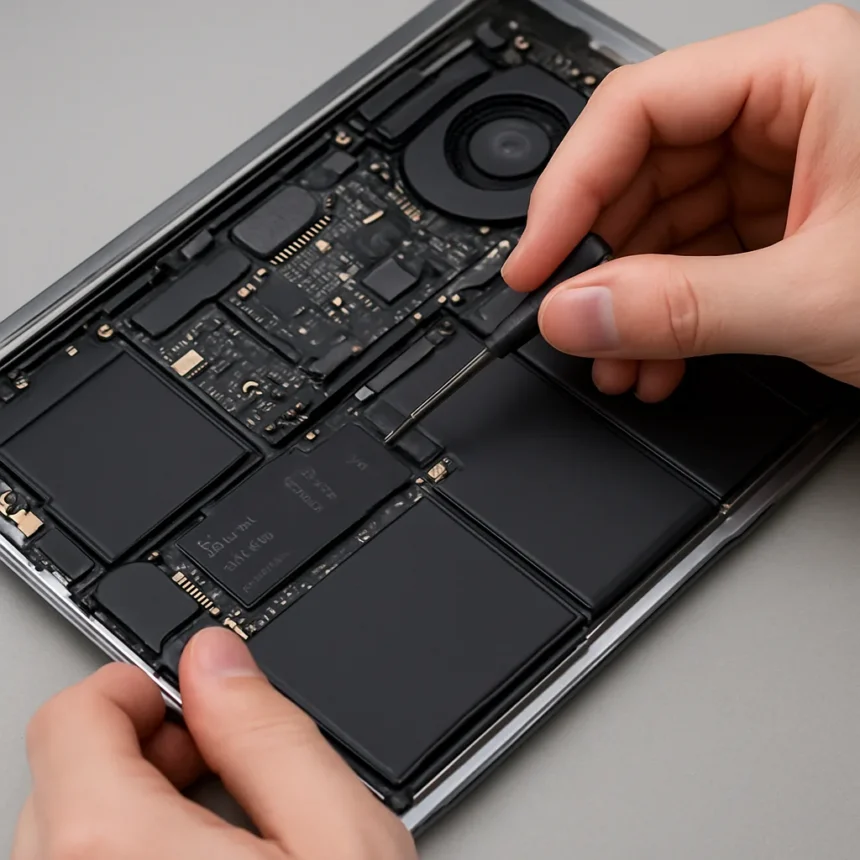
The MacBook Neo NAND swap refers to a hardware modification in which the NAND flash memory chips soldered to the logic board are physically removed and replaced with higher-capacity alternatives. Technician DirectorFeng in China performed what is described as likely the first mod of its kind on the MacBook Neo, taking a base 256 GB model and pushing it to 1 TB — a capacity Apple does not offer on this machine at any price.
Apple’s MacBook Neo launched at $599 for the base configuration, featuring an Apple A18 Pro chip, 8 GB of LPDDR5 unified memory, and a 256 GB SSD. The only official storage upgrade is a step to 512 GB at $699, which also adds Touch ID. That is the ceiling Apple set. DirectorFeng’s mod blows straight past it.
How the MacBook Neo NAND Swap Actually Works
This is not a straightforward upgrade. The MacBook Neo’s SSD is not a removable module — it is soldered directly to the logic board, and the NAND controller is embedded in the A18 Pro SoC itself. As noted in forum discussion around the mod, the board provides only the NAND chips, with the controller living inside the processor. That architectural choice is precisely what makes a chip-level swap both possible and brutally difficult.
The process requires removing the original NAND chips from the logic board, installing higher-capacity NAND chips in their place, and then using a second MacBook to assist in rebooting and recovering the modified device after the swap. There is no software shortcut here. One wrong move during the physical chip removal and the logic board is dead. This is the kind of work that belongs in a professional repair lab, not on a kitchen table.


A safety note is essential: this procedure involves working directly on live logic board components and requires specialist soldering equipment. Anyone attempting this without professional-grade tools and training risks permanent, irreversible damage to the device. The modification almost certainly voids the MacBook Neo’s one-year warranty.
Why Apple’s Storage Lock-In Has Always Been the Problem
The MacBook Neo NAND swap is a symptom of a broader frustration. Apple has soldered storage across its Mac lineup for years, removing any path for users to upgrade after purchase. The consequences are real: a corrupted or failing soldered SSD can render an otherwise functional machine completely unbootable, with no user-serviceable fix available. The mod DirectorFeng performed addresses exactly this scenario — it is not just about wanting more space, it is about long-term repairability.



Compare this to the broader PC ecosystem, where M.2 slots on motherboards allow straightforward SSD replacement and upgrades. A user with an MSI B450 motherboard, for example, can swap storage in minutes without touching a soldering iron. Apple’s approach trades that flexibility for a thinner chassis and tighter integration. Whether that trade-off is worth it depends entirely on how long you plan to keep the machine.
The MacBook Air with M5, Apple’s next step up, starts at $1,099 for the 13-inch model and offers storage configurations from 512 GB up to 4 TB. That flexibility exists at a price premium. For buyers who want an affordable Apple laptop and need more than 512 GB, no official option currently exists below that $1,099 entry point — which is precisely what makes this mod newsworthy.
MacBook Neo Repairability: Better Than You Think
The irony is that the MacBook Neo is actually Apple’s most repairable laptop in recent memory. A teardown by Tech Nu-Ru showed the bottom lid is held by just eight pentalobe screws, the full disassembly takes roughly six minutes using Torx screws, and the battery is secured by 18 screws with no adhesive. USB-C ports, speakers, and the headphone jack are all modular and can be swapped individually. Apple even provides a repair manual that allows keyboard replacement without swapping the entire top case.
That repairability makes the NAND swap at least physically accessible in a way it would not be on older MacBook designs. The challenge is not getting inside the machine — it is the microsurgery required once you are there.



Is the MacBook Neo NAND Swap Worth Attempting?
For the vast majority of MacBook Neo owners, the answer is no. The mod requires expert-level soldering skills, specialist equipment, a second MacBook to complete the recovery process, and a willingness to accept that any mistake destroys the device permanently. The cost of the required NAND chips plus professional labour — if you could even find a technician willing to attempt it — would likely approach or exceed the price difference between the Neo and a higher-spec MacBook Air.
What makes DirectorFeng’s work significant is not that it is a practical upgrade path. It is proof that Apple’s storage ceiling is a commercial decision, not a technical impossibility. The NAND controller in the SoC can handle higher-capacity chips. The hardware supports it. Apple simply does not sell it that way.
Can a regular user perform the MacBook Neo NAND swap at home?
No. The mod requires professional-grade soldering equipment, expert skills in chip-level board repair, and a second MacBook to complete the recovery process after the swap. Attempting this without the right tools and training will permanently destroy the logic board. This is strictly expert territory.
Does the MacBook Neo support standard M.2 SSD upgrades?
No. While some modding projects have created slot-in SSD modules for MacBooks, these are proprietary solutions — the NAND controller is embedded in the Apple SoC, so the slot carries only NAND chips, not a standard M.2 drive. Standard M.2 upgrades are not compatible with the MacBook Neo’s architecture.
What storage options does the MacBook Neo officially offer?
Apple offers the MacBook Neo in two storage configurations: 256 GB at $599 and 512 GB at $699. The 512 GB model also includes Touch ID. Both configurations include 8 GB of LPDDR5 unified memory and the Apple A18 Pro chip. There is no official 1 TB option.
DirectorFeng’s MacBook Neo NAND swap is a remarkable technical achievement, but its real value is as a statement: Apple’s budget laptop is capable of more than Apple sells. Until Apple expands its official storage options or lowers the price of higher-capacity configurations, the 512 GB ceiling will remain a genuine frustration for buyers who want an affordable Mac without storage compromises.
Edited by the All Things Geek team.
Source: Tom's Hardware




