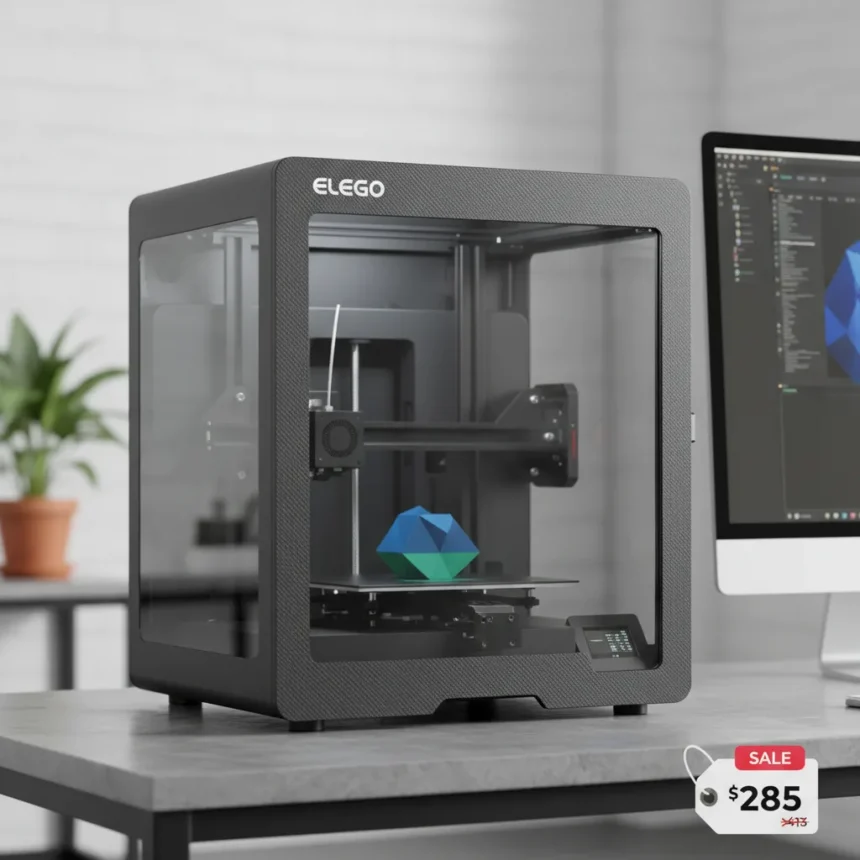
The Elegoo Centauri Carbon 3D printer just dropped to $285 in a limited-time sale, slashing $128 off its regular price and making advanced CoreXY printing accessible for the first time at this price point. This fully enclosed, high-speed model arrived in April 2025 and has already proven itself as one of Tom’s Hardware’s all-time favorite 3D printers—and at this sale price, it is hard to argue against the value.
Key Takeaways
- Sale price of $285 USD saves $128 from the regular $413 asking price, available for a limited time only.
- Fully enclosed CoreXY design with 500 mm/s velocity and 20,000 mm/s² acceleration for rapid printing.
- 256 × 256 × 256 mm build volume with plug-and-play setup and full-auto calibration out of the box.
- Features chamber camera monitoring, filament runout sensor, and multiple connectivity options including USB and Ethernet.
- Excellent entry-level CoreXY or secondary printer for anyone stepping up from budget models.
What Makes the Elegoo Centauri Carbon Stand Out
The Elegoo Centauri Carbon 3D printer combines speed with accessibility in a way few sub-$300 models manage. The CoreXY architecture—a dual-motor gantry system that synchronizes movement across the X and Y axes—delivers velocity up to 500 mm/s and acceleration hitting 20,000 mm/s². That matters because it means less waiting around between prints. The fully enclosed design keeps ambient temperature stable and filament dry, two factors that separate reliable prints from failed ones.
Setup is where this printer shines for beginners. Plug it in, and the auto-calibration handles bed leveling without manual intervention. No fiddling with paper and nozzles. The chamber camera lets you monitor prints remotely, and the onboard storage lets you transfer files directly from your computer without needing an SD card. For users jumping from budget open-frame printers to their first enclosed CoreXY, this removes the intimidation factor.
Build Volume and Practical Printing Capability
A 256 × 256 × 256 mm build platform is modest compared to larger industrial machines, but it is sufficient for most prototyping, functional parts, and decorative prints. The PEI flexi print bed sheet makes part removal painless—a detail that sounds minor until you are trying to pry a warped part off a standard surface. The printer handles various filaments and supports high-speed performance with advanced materials, though the brief does not specify exact material compatibility beyond the general CoreXY capability.


The open steel frame with linear rail slide rails and synchronized lead screws keeps the motion system robust while keeping weight and cost down. This is the engineering choice that separates a $285 CoreXY from a $1,000 one—not complexity, but reliability in the fundamentals.
How This Deal Compares to Alternatives
At $285, the Elegoo Centauri Carbon undercuts most fully enclosed CoreXY competitors. A Qidi Tech sub-$500 enclosed CoreXY offers similar features but costs significantly more. The Flying Bear S1 and Infimech TX sit in the same category but do not offer the same savings. If budget is the constraint, a DIY CoreXY under $200 exists, though it lacks the enclosure and arrives as a kit requiring assembly. On the premium end, the Tronxy Veho 1000-16A fully enclosed CoreXY starts at $6,999 and targets industrial users, not hobbyists.



The non-Carbon ELEGOO Centauri is an entry-level open-frame CoreXY alternative, but the Carbon’s enclosure justifies the price difference for anyone serious about print consistency. ModBot’s YouTube review noted that at the $299 price point, the Centauri Carbon represents excellent value for someone seeking their first CoreXY printer or needing an additional machine in a multi-printer setup.
Connectivity and User Experience
The Elegoo Centauri Carbon 3D printer includes Ethernet, twin USB rear ports, and HDMI, giving you flexibility in how you feed files to the machine. A full-size USB port lets you print directly from a USB drive if your computer is not nearby. The filament runout sensor prevents mid-print failures, and the spool holder on the right side keeps loaded filament accessible and organized.
Tom’s Hardware confirmed in April 2025 that the Centauri Carbon has proven itself as an excellent CoreXY 3D printer in its short time on the market. For beginners stepping up from budget FDM printers, the combination of speed, enclosure, and automation removes the learning curve that typically frustrates newcomers.
Is This Sale Price Legit?
The regular price sits at $413 USD on the official Elegoo site, making the $285 sale price a genuine $128 discount. Other sources mention it at $299, so the current $285 deal is competitive even against those figures. The sale is limited-time, meaning this price will not last—if you have been considering a CoreXY printer, this is the moment to commit.



Should You Buy the Elegoo Centauri Carbon at $285?
Yes, if you want your first enclosed CoreXY printer or need a reliable secondary machine without spending $500 or more. The auto-calibration and chamber camera remove friction for beginners, while the CoreXY speed appeals to anyone tired of waiting for prints. The only caveat: if you need a larger build volume, this 256 mm cube will feel cramped. For standard prints, prototypes, and functional parts, it is plenty.
What is the build volume of the Elegoo Centauri Carbon?
The Elegoo Centauri Carbon 3D printer has a 256 × 256 × 256 mm build platform, enough for most hobby and prototyping work. It is not the largest, but the enclosed design and CoreXY speed compensate for the footprint.
Does the Elegoo Centauri Carbon require calibration setup?
No. The Elegoo Centauri Carbon 3D printer includes full-auto calibration, so the bed levels itself out of the box. This removes one of the biggest frustrations for 3D printing newcomers and gets you printing within minutes.
At $285, the Elegoo Centauri Carbon 3D printer represents the rare convergence of affordability, speed, and ease of use. CoreXY architecture was once the domain of expensive machines and DIY tinkerers. This sale brings it within reach of anyone serious about 3D printing without the premium price tag. If the price holds and stock lasts, this is the deal to act on.
Edited by the All Things Geek team.
Source: Tom's Hardware