





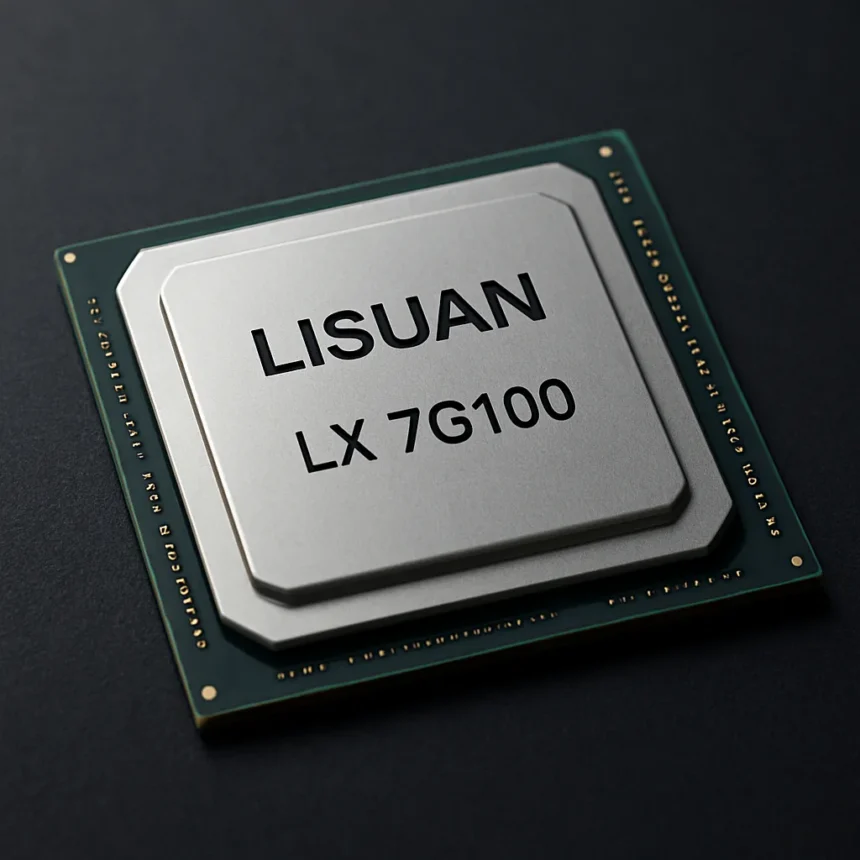
What Is the Lisuan LX 7G100?
The Lisuan LX 7G100 is a domestically developed 6nm GPU made by Lisuan Technology, a Shanghai-based company founded five years ago by three former S3 Graphics employees, entering mass production after four years of development and scheduled for retail launch on June 18, 2026, exclusively via JD.com in China. It is the most technically ambitious GPU to emerge from China’s push for semiconductor self-sufficiency, and it arrives at a moment when US export restrictions have made access to Nvidia and AMD hardware increasingly difficult for Chinese buyers. Whether it can actually compete is a different question entirely.
Lisuan LX 7G100 Specs: What the Numbers Say
The gaming-focused variant, the LX 7G106, carries 12 GB of GDDR6 VRAM on a 192-bit memory bus, 192 texture units, 96 ROPs, and a rated FP32 throughput of up to 24 TFLOPs at a 225W TGP. It is a three-slot card with a three-fan cooler and outputs four DisplayPort 1.4a connectors — notably absent is HDMI, which will frustrate anyone plugging into a TV or older monitor. API support covers DirectX 12, Vulkan 1.3, OpenGL 4.6, and OpenCL 3.0, which is a credible modern software baseline.
The professional line sits alongside the gaming card under the unified LX branding. The LX Max carries 12 GB GDDR6, the LX Pro bumps to 24 GB GDDR6, and the flagship LX Ultra pairs 24 GB GDDR6 with ECC support and a blower-style cooler suited for dense server deployments. All cards are compatible with a broad sweep of CPU architectures, including Intel, AMD, Hygon, Loongson, Phytium, and Zhaoxin, and support Windows alongside Linux distributions including UOS, Ubuntu, and Kylinsoft — a deliberate signal that Lisuan is targeting China’s entire domestic computing ecosystem, not just gaming PCs.
How Does the Lisuan LX 7G100 Compare to Nvidia and AMD?
Lisuan claims the LX 7G106 delivers performance comparable to Nvidia’s RTX 4060 series, and early leaked benchmarks place it in a similar ballpark — though the picture is inconsistent. OpenCL scores from leaks suggest performance closer to an RTX 2080, RTX 3060 Ti, or Intel Arc A770, while some Geekbench results for configurations with 32 compute units point to performance nearer a GTX 660 Ti or AMD R9 370. That spread is enormous, and it almost certainly reflects different hardware configurations being tested rather than a single, stable retail product. Until independent reviewers get retail units in hand after the June 2026 launch, every performance claim should be treated with appropriate skepticism.


On the professional side, the bandwidth gap with Nvidia’s best is stark. The LX Ultra’s 384 GB/s memory bandwidth trails Nvidia’s H200 — which delivers 1.8 TB/s — by a factor of nearly five. For AI inference workloads at scale, that is not a competitive product; it is a domestic fallback for organizations that cannot access H200 hardware due to export controls. Lisuan supports AI models including Qwen3, DeepSeek, and OpenClaw, and claims compatibility with over 50 professional applications including AutoCAD, SolidWorks, Blender, and Maya. Those are the right names to drop, but software compatibility claims from Chinese GPU vendors have historically been optimistic on paper and inconsistent in practice.
TrueGPU Architecture: Built From Scratch, For Better or Worse
The 7G100 series runs on Lisuan’s self-developed TrueGPU architecture, branded internally as Tiantu, manufactured on TSMC’s 6nm process node. Lisuan describes TrueGPU as built entirely in-house — instruction set, compute core, and software stack — which is either an impressive engineering achievement or a warning flag depending on how mature that software stack actually is. A clean-sheet GPU architecture is extraordinarily difficult to execute, and the software layer — drivers, compiler toolchains, game compatibility shims — is where Chinese GPU efforts have historically collapsed. Lisuan’s claim that the card can handle over 100 Steam games including Cyberpunk 2077, Black Myth: Wukong, and Resident Evil 4 Remake is ambitious, but playable framerates at unspecified settings and resolutions is not the same as a polished, driver-stable gaming experience.



The launch timeline adds context. The 7G100 entered mass production after four years of development, with first orders delivered in late 2025 and a public exhibition held on March 12, 2026. That is a long runway for a product that still does not have widely published independent benchmarks. Lisuan dropped the older 7G105 branding in favor of the unified LX product line, which suggests the company is maturing its go-to-market approach even if the hardware itself is still proving itself.
Is the Lisuan LX 7G100 available outside China?
As of the announced launch, the Lisuan LX 7G100 is available exclusively in China via JD.com starting June 18, 2026. There is no confirmed international availability. The card is positioned as a domestic alternative for Chinese buyers facing restricted access to Nvidia and AMD hardware, and Lisuan has made no public announcement about global distribution.
How does the Lisuan LX 7G100 handle AI workloads?
Lisuan claims the LX 7G100 supports AI inference for models including Qwen3, DeepSeek, and OpenClaw. However, the card’s 384 GB/s memory bandwidth is significantly lower than dedicated AI accelerators like Nvidia’s H200, which delivers 1.8 TB/s. For light inference tasks on consumer hardware, the LX series may be adequate; for serious AI server workloads, the bandwidth limitation is a meaningful constraint.
What CPU platforms work with the Lisuan LX 7G100?
The LX 7G100 series is compatible with a wide range of CPU architectures, including Intel and AMD processors as well as Chinese domestic platforms — Hygon, Loongson, Phytium, and Zhaoxin. This broad compatibility is a deliberate design choice, ensuring the card can slot into China’s diverse computing infrastructure. Operating system support covers Windows, UOS, Ubuntu, and Kylinsoft Linux distributions.



The Lisuan LX 7G100 is a genuine engineering milestone for China’s domestic GPU industry, and dismissing it entirely would be a mistake. But milestone and competitive product are not the same thing. Until independent reviewers publish results from retail hardware, the performance claims sit somewhere between promising and unverifiable — and the software maturity questions that have haunted Chinese GPU efforts for years have not been answered yet. Watch the June 2026 launch closely, but hold your conclusions until the benchmarks are real.
Edited by the All Things Geek team.
Source: Tom's Hardware




