





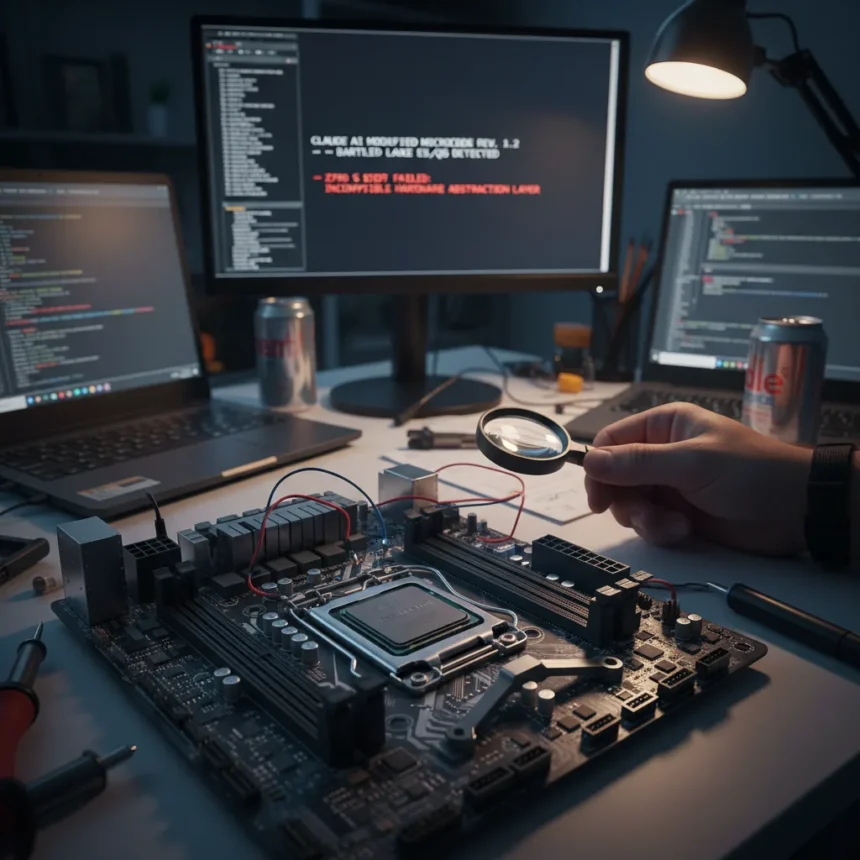
Unsupported CPU BIOS compatibility just got a practical demonstration when modder kryptonfly used Claude AI to rewrite an Asus Z790 BIOS, enabling an Intel Core Ultra 9 273QPE—a 12-core Bartlett Lake-S processor designed for OEM systems—to reach the POST screen on consumer-grade hardware. The CPU physically fits the LGA 1700 socket found on Z790 and Z600 boards, but Intel and motherboard vendors have never released BIOS updates to support it. By injecting missing microcode through AI-guided editing, the modder proved that vendor lock-in on socket compatibility is not absolute—though the path from POST to Windows remains blocked.
Key Takeaways
- Claude AI rewrote BIOS microcode to inject Bartlett Lake CPU support into a Z790 motherboard, enabling POST detection.
- The Core Ultra 9 273QPE is an OEM-only processor; no consumer Z790 BIOS officially supports it.
- System reaches POST and correctly identifies the CPU but fails to boot past that stage into Windows.
- LGA 1700 socket compatibility is hardware-level; BIOS support is the only barrier between OEM and consumer CPUs.
- Vendor BIOS updates could patch this workaround, making the mod temporary and fragile.
How AI Rewrote Hardware Compatibility Barriers
The Bartlett Lake-S CPU is Intel’s OEM-exclusive processor, shipped in pre-built systems and not sold as a retail chip. Despite sharing the LGA 1700 socket with Z790 consumer boards, the CPU lacks BIOS microcode on any consumer motherboard—the firmware does not recognize the processor’s instruction set or power delivery requirements. Kryptonfly bypassed this by asking Claude to analyze the Z790 BIOS and inject the missing microcode needed to detect and initialize the Bartlett Lake chip. The AI did not create the microcode from scratch; it extracted patterns from existing BIOS code and adapted them for the new CPU. The result: the motherboard now reaches the POST screen and displays the correct processor identification in BIOS menus.
This achievement highlights a critical gap between hardware capability and software permission. The Z790 chipset and power delivery circuitry were engineered to handle a range of 12th and 13th-generation Intel processors; Bartlett Lake uses the same socket and power standards. From a purely electrical standpoint, compatibility exists. Vendors withhold BIOS support not because of hardware limitations but because of business segmentation—OEM CPUs belong in OEM systems, and consumer boards are restricted to consumer SKUs. AI-guided BIOS editing exposes how thin that wall is.
Why the Mod Stops at POST
Reaching POST is not the same as booting Windows. The modder’s system displays the CPU name in BIOS, confirms hardware detection, and appears to initialize correctly. Then it halts. The screen goes black, error codes appear, and the boot sequence fails before the operating system loads. This suggests that while microcode injection solved the detection problem, deeper integration issues remain—possibly related to power management, thermal monitoring, memory controller configuration, or chipset driver communication. A full Windows boot would require not just BIOS recognition but also operating system and driver support for Bartlett Lake’s specific architecture.


The failure also hints at the scope of vendor lock-in. BIOS microcode is only one layer; Windows itself may lack drivers or power profiles for an OEM-only CPU. Even if the modder successfully edited the BIOS to full compatibility, Windows Update or Intel’s driver stack could reject the system as unsupported. The mod works as a proof of concept but collapses under real-world use.
The Fragility of AI-Assisted Hardware Hacks
Claude AI made this BIOS mod possible, but it also made it temporary. Any future BIOS update from Asus could patch the microcode injection, either by rewriting the BIOS structure to prevent manual editing or by validating microcode signatures to reject unauthorized additions. Intel could also release a consumer BIOS update that explicitly blacklists Bartlett Lake CPUs, treating them as invalid for Z790 boards. The modder’s solution works today because the BIOS is unpatched and the vendor has not prioritized closing this specific loophole. That will not last.



This pattern matters for the broader AI-in-hardware story. AI tools like Claude can analyze firmware, suggest edits, and accelerate reverse-engineering—tasks that would take humans weeks to debug manually. But AI cannot guarantee permanence or stability. It solves a problem at a moment in time, against a specific firmware version, on a specific board. Scale that across millions of users and thousands of motherboard revisions, and the fragility becomes obvious. The mod is a technical marvel and a business liability for Intel and Asus—it proves their restrictions are software-enforced, not hardware-mandated.
What This Means for CPU Socket Longevity
LGA 1700 was designed to support multiple processor generations, yet vendor BIOS support determines which CPUs actually work on which boards. The Bartlett Lake CPU is physically compatible with Z790 but functionally locked out by firmware. Kryptonfly’s mod demonstrates that users and enthusiasts will push back against artificial compatibility walls, especially when AI tools make the barrier easier to breach. If this becomes a trend—modders using Claude or similar AI to inject microcode for unsupported CPUs—vendors may respond by tightening BIOS security, implementing signed microcode, or restricting BIOS editing tools.
Alternatively, vendors could adopt a more permissive stance, releasing microcode updates for older boards to support newer CPUs, even if those CPUs were never officially intended for those boards. That would extend motherboard lifespan, reduce e-waste, and create goodwill. Instead, the current incentive structure pushes vendors to force users toward new hardware. The modder’s success is a small crack in that wall, but it will not widen without pressure from the market or regulators.
Can You Boot Windows with the Bartlett Lake Mod?
Not yet. The modder’s system reaches POST and BIOS detection but fails to progress beyond that stage into Windows. The black screen and error codes suggest missing driver support, power management configuration, or chipset integration that BIOS microcode alone cannot fix. Full Windows compatibility would require additional patches at the OS level, potentially including Intel chipset drivers and Windows Update support for the Bartlett Lake architecture.


Will a BIOS Update Patch This Exploit?
Yes, likely. Asus and Intel can patch this workaround through a future BIOS update that either restructures the firmware to prevent manual microcode injection or explicitly rejects Bartlett Lake CPUs during the boot sequence. The mod’s permanence depends on vendors choosing not to patch it—a gamble the modder is taking.
Is the Bartlett Lake CPU Physically Compatible with Z790?
Yes. The Core Ultra 9 273QPE uses the LGA 1700 socket, the same socket found on Z790 and Z600 motherboards. The physical fit is perfect. The barrier is purely software—BIOS microcode and driver support—not hardware.
Kryptonfly’s BIOS mod is a reminder that hardware compatibility and vendor support are not the same thing. Claude AI made it possible to inject the missing microcode, but it could not solve the deeper integration problems that prevent a full Windows boot. The mod works as a technical demonstration and a statement about the artificial nature of platform restrictions. Whether it sparks a broader movement toward AI-assisted hardware hacking or remains a one-off curiosity depends on how vendors respond—and whether they choose to patch or tolerate the workaround.
Edited by the All Things Geek team.
Source: Tom's Hardware




