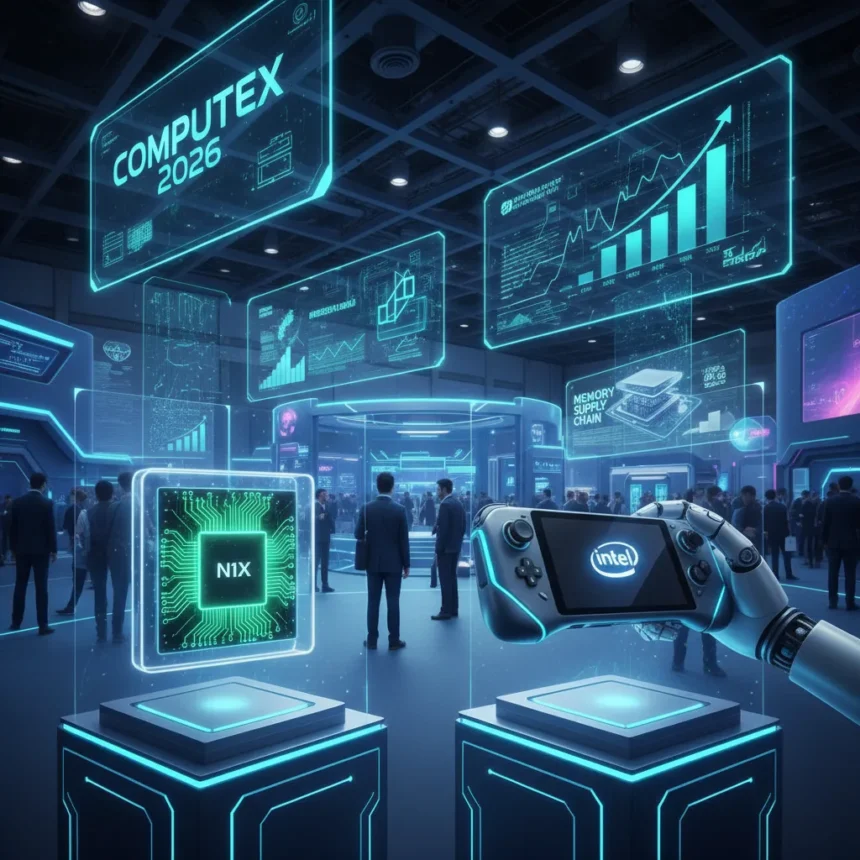
Computex 2026 is shaping up to be the most consequential hardware showcase in years, with the industry preparing to unveil solutions to existential challenges facing consumer computing. Scheduled for June 2 to June 5, 2026, in Taipei, the event will feature Nvidia’s consumer-focused N1X chip, Intel’s next-generation gaming handheld processors, and a coordinated response to the memory-price crisis threatening PC affordability.
Key Takeaways
- Computex 2026 runs June 2–5 in Taipei and is expected to be the largest show to date.
- Nvidia’s N1X represents the company’s first major push into consumer PC system-on-chip design.
- Intel’s next-gen gaming handheld chips promise a generational leap in portable gaming performance.
- The PC industry plans to address RAMageddon—severe memory cost and supply pressures.
- Arm-based PC platforms are becoming central to Windows and PC gaming strategy.
Computex 2026: Why This Show Matters Right Now
Computex 2026 arrives at a critical inflection point for consumer computing. The PC market has faced mounting pressure from elevated memory costs, supply chain instability, and the rise of Arm-based alternatives that are fragmenting the traditional x86 ecosystem. Tom’s Guide’s computing team will be on the ground in Taipei covering and testing announcements as they happen. This is not a routine trade show—it is the industry’s moment to demonstrate it has answers to the challenges that have dampened consumer upgrades and handheld gaming momentum.
The show’s significance lies in the convergence of three major themes: accelerated chip innovation, a direct challenge to AMD’s handheld dominance, and a coordinated effort to stabilize memory markets. Each of these threads pulls at the fabric of consumer computing in 2026.
Nvidia N1X: A Consumer PC Gamble
Nvidia’s N1X is expected to be the company’s first consumer-grade PC system-on-chip derived from its GB10 platform, marking a significant departure from Nvidia’s traditional reliance on Arm server and data-center architectures. The N1X is central to a broader Windows fightback against the growing market share of Arm-based laptops and the perception that PC gaming is being left behind by mobile and console platforms.


The strategic importance of N1X cannot be overstated. By bringing its own silicon to the consumer PC market, Nvidia positions itself not as a GPU vendor supplying Intel or AMD, but as a complete system provider. This move mirrors Apple’s strategy with the MacBook line and signals that Nvidia sees the future of computing as vertically integrated. Whether the N1X will resonate with consumers depends on software compatibility, thermal efficiency, and whether Nvidia can deliver gaming performance that justifies the transition from x86 processors.
Expect N1X to be positioned as a premium offering, targeting content creators and gamers willing to pay for performance and power efficiency. The chip’s Arm-based architecture will require software optimization, but the ecosystem is maturing faster than skeptics predicted.



Intel’s Gaming Handheld Chips: The AMD Challenge
Intel is expected to unveil its next-generation gaming handheld processors, including variants referred to as Arc G3 and G3 Extreme, that promise to be a generational leap in portable gaming performance. These chips will use architecture and process technology related to Panther Lake, giving Intel a significant manufacturing advantage over competitors still relying on older process nodes.
The timing is deliberate. AMD has dominated the gaming handheld market with its Ryzen chips, powering devices like the Steam Deck and ASUS ROG Ally. Intel’s new handheld silicon will surely make AMD nervous, particularly if the new chips deliver meaningfully better power efficiency and gaming frame rates without proportional cost increases. However, Tom’s Guide notes that these chips will not be cheap, so Intel’s strategy appears to be capturing the premium handheld segment rather than undercutting AMD’s value positioning.
What makes this announcement significant is not just raw performance, but the signal it sends about the handheld gaming category. Major chip manufacturers would not invest heavily in gaming handheld silicon if they believed the category was a niche. Intel’s commitment suggests the company sees portable gaming as a core growth market, validating years of investment by handheld device makers.
RAMageddon: The Memory Crisis Response
The PC industry is mobilizing to combat RAMageddon—a crisis of memory scarcity and pricing that has made PC upgrades economically unpalatable for many consumers. Computex 2026 will likely feature announcements around memory efficiency, new standards, and supply-chain initiatives designed to stabilize pricing and improve availability.


This fightback matters because elevated memory costs have cascading effects throughout the PC ecosystem. Systems become more expensive, upgrade cycles lengthen, and consumers delay purchases. If manufacturers can demonstrate progress on memory pricing and supply, it could unlock a new wave of PC sales and upgrades. Expect announcements around next-generation memory standards, manufacturing partnerships, and possibly pricing commitments from major DRAM suppliers.
What to Watch Beyond the Headlines
Beyond the headline announcements, Computex 2026 will reveal how aggressively the industry is pivoting toward Arm-based architectures and away from traditional x86 designs. The presence of both Nvidia’s N1X and Intel’s handheld focus signals a bifurcation: premium consumer PCs moving toward Arm, while gaming handhelds become a distinct category with their own specialized silicon.
The show will also clarify whether the industry has learned from past fragmentation. Too many incompatible platforms and software ecosystems have failed. Success for Nvidia N1X and Intel’s handheld chips depends on developer support, software optimization, and a user experience that justifies switching from proven alternatives.
Is Computex 2026 really the most important show ever?
Tom’s Guide frames Computex 2026 as the biggest and most important Computex ever, and there is merit to that claim. The announcements expected at the show—Nvidia’s consumer PC entry, Intel’s handheld challenge to AMD, and industry solutions to memory pricing—address fundamental challenges facing consumer computing. However, importance depends on execution. Announcements mean little if products fail to deliver or if the industry cannot sustain these initiatives.
Will Intel’s gaming handheld chips actually beat AMD?
Intel’s new handheld processors will likely offer competitive or superior performance compared to AMD’s current Ryzen handheld chips, particularly in gaming frame rates and power efficiency. However, beating AMD requires more than raw specs—it requires software support, device manufacturer adoption, and sustained driver updates. AMD’s handheld ecosystem is mature; Intel will need to move quickly to establish parity.
When will Nvidia N1X and Intel handheld chips launch?
Computex 2026 will feature announcements and likely demonstrations of both Nvidia N1X and Intel’s gaming handheld processors, but the research brief does not confirm specific consumer availability dates. Historically, announcements at Computex precede retail launch by several months. Expect more details on timing as the show approaches.
Computex 2026 will either validate or undermine the industry’s pivot toward Arm-based consumer computing and specialized gaming handheld silicon. The show arrives at a moment when consumer computing needs both innovation and stability. Nvidia’s N1X, Intel’s handheld ambitions, and the memory crisis response will determine whether 2026 marks the beginning of a PC renaissance or another false start in a market struggling to find direction.
Edited by the All Things Geek team.
Source: Tom's Guide