





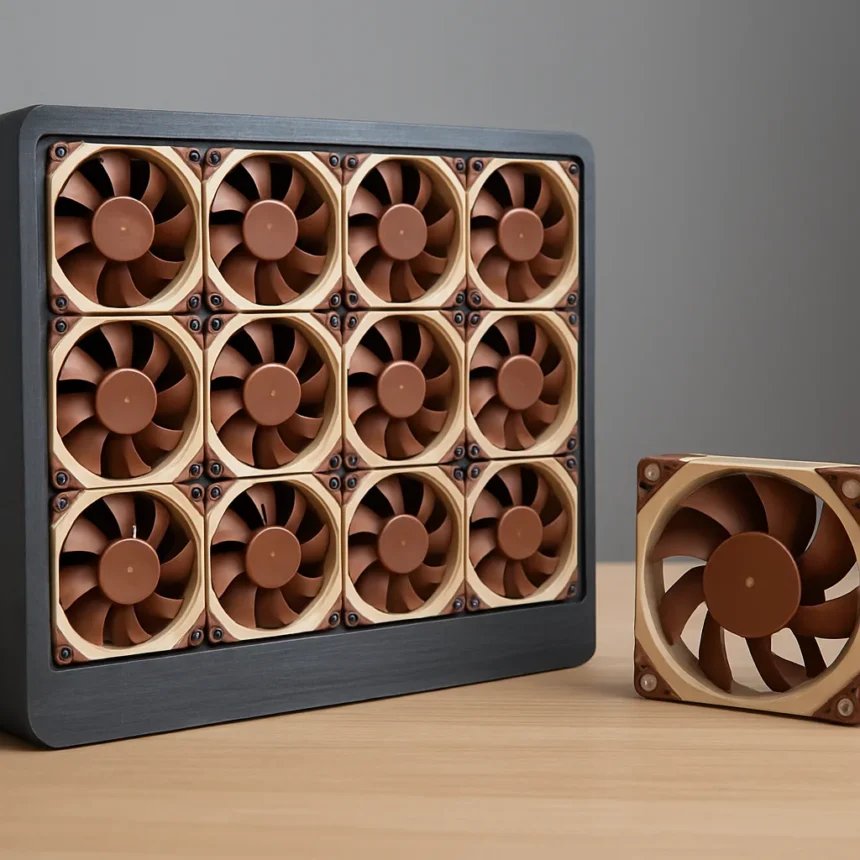
A custom 3D-printed fan design known as the ‘Fanhattan Project’ proves that engineering novelty and engineering sense are not the same thing. The project, created by a YouTuber, 3D-printed a custom 120mm fan frame modeled after the Noctua NF-A12x25, then packed 15 individual tiny fans inside a domed enclosure. The result: CPU cooling performance that matches a standard single Noctua NF-A12x25 fan, but at a noise level more than three times higher.
Key Takeaways
- Custom 3D-printed fan design houses 15 tiny fans in a Noctua-inspired 120mm frame
- Cooling performance equals a standard Noctua NF-A12x25 despite the added complexity
- Custom design produces more than three times the noise of a regular Noctua NF-A12x25
- Standard Noctua NF-A12x25 delivers 102.1 m³/h airflow at just 22.6 dB(A) maximum noise
- Fanhattan Project demonstrates that more fans don’t guarantee better results
What Makes This Custom 3D-Printed Fan Design So Loud?
The custom 3D-printed fan design sacrifices acoustic efficiency for sheer engineering ambition. Where the standard Noctua NF-A12x25 operates at a maximum of 22.6 dB(A), the Fanhattan Project exceeds 67.8 dB(A)—louder than a vacuum cleaner. That noise penalty exists because 15 small fans operating in parallel create turbulence and resonance that a single optimized fan avoids. Each tiny fan spins independently, creating overlapping pressure waves that amplify sound rather than cancel it.
The standard Noctua NF-A12x25 achieves its quiet operation through decades of blade aerodynamics research, a 0.5mm tip clearance, and Sterrox LCP material that dampens vibration. The custom 3D-printed fan design cannot replicate these refinements at miniature scale. The domed frame itself may also contribute to resonance—a sealed chamber with 15 spinning components is inherently noisier than a single blade moving air through an open shroud.
Performance Parity: Why the Fanhattan Project Cools Just as Well
Despite the noise disaster, the custom 3D-printed fan design achieves thermal performance equivalent to the standard Noctua NF-A12x25, which delivers 102.1 m³/h of airflow at maximum speed. This parity is the project’s most surprising finding. Fifteen smaller fans, working in concert, move the same volume of air as one larger, optimized fan. The domed enclosure channels airflow efficiently enough that the cumulative output matches the reference fan’s specifications.


This equivalence reveals something important: airflow volume is not the only variable in cooling performance. The Noctua NF-A12x25’s static pressure rating of 2.34 mm H₂O and its blade geometry allow it to push air through dense heatsink fins with minimal turbulence. The custom 3D-printed fan design achieves similar results through sheer numbers, but at a massive acoustic cost. It is a brute-force solution to a problem that has already been elegantly solved.
Custom 3D-Printed Fan Design vs. Stock Alternatives
The Noctua NF-A12x25 lineup offers several variants, each optimized for different priorities. The standard PWM model runs 0–2000 RPM and includes a Low-Noise Adaptor that reduces maximum speed to 1700 RPM, cutting noise to just 18.8 dB(A) while maintaining 84.5 m³/h of airflow. The newer NF-A12x25 G2 PWM offers slightly higher airflow at 107.3 m³/h and improved static pressure at 3.14 mm H₂O, still at 22.5 dB(A) maximum noise.



The Fanhattan Project beats none of these. It matches the stock fan’s cooling while losing the noise battle decisively. A user seeking quieter operation could simply use the Low-Noise Adaptor on a standard Noctua fan and gain 3.7 dB(A) of silence while sacrificing only 17.6 m³/h of airflow. That is a rational trade-off. The custom 3D-printed fan design offers no such flexibility—it is louder and delivers nothing extra in return.
Why This Project Matters (And Why It Doesn’t)
The Fanhattan Project is engineering theater. It demonstrates that 3D printing and creativity can produce functional cooling solutions, even unconventional ones. For hobbyists exploring fan aerodynamics or testing fluid dynamics theories, the project has value. It proves that cooling performance depends on aggregate airflow, not fan count or configuration.
But for anyone actually building a PC, the custom 3D-printed fan design is a cautionary tale. Complexity without benefit is noise pollution. The standard Noctua NF-A12x25 costs far less, sounds dramatically quieter, and cools just as effectively. It includes a 6-year warranty. The Fanhattan Project is a one-off experiment, not a product you can buy or replicate without significant 3D printing expertise and time investment.
Is the Fanhattan Project louder than a standard Noctua NF-A12x25?
Yes. The custom 3D-printed fan design produces more than three times the noise of a standard Noctua NF-A12x25, despite delivering identical cooling performance. A regular Noctua NF-A12x25 maxes out at 22.6 dB(A), while the Fanhattan Project exceeds 67.8 dB(A)—comparable to a vacuum cleaner.



Can you buy a Fanhattan Project fan?
No. The Fanhattan Project is a one-off custom creation by a YouTuber who 3D-printed the frame and assembled the 15 tiny fans. It is not a commercial product. If you want quiet, efficient 120mm cooling, the standard Noctua NF-A12x25 or its G2 variant are the practical choices.
What is the airflow of the standard Noctua NF-A12x25?
The standard Noctua NF-A12x25 PWM delivers a maximum airflow of 102.1 m³/h at 2000 RPM, with a maximum static pressure of 2.34 mm H₂O. With the Low-Noise Adaptor engaged, airflow drops to 84.5 m³/h at 1700 RPM while noise falls to just 18.8 dB(A).
The Fanhattan Project is a reminder that engineering is about solving real problems, not creating elaborate ones. Fifteen fans in a dome may turn heads on YouTube, but a single optimized fan in your case will keep your CPU cooler and your sanity intact. The custom 3D-printed fan design is a novelty. The Noctua NF-A12x25 is a tool.
Edited by the All Things Geek team.
Source: Tom's Hardware




