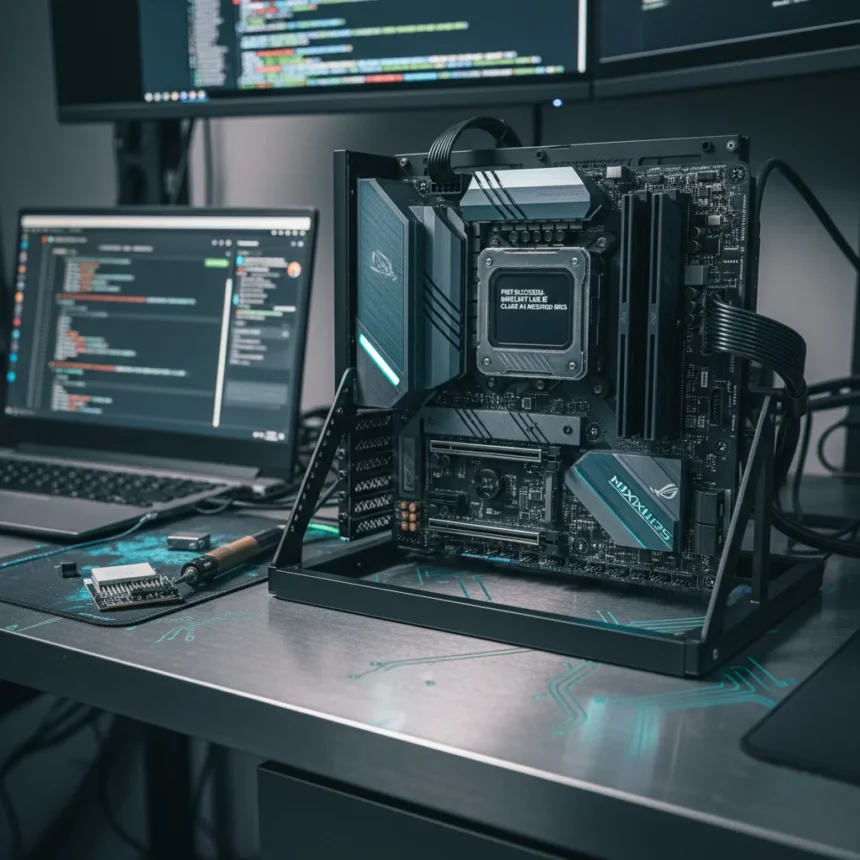
Intel Bartlett Lake CPU compatibility just took an unexpected turn. An enthusiast modder has successfully used Claude AI to edit the BIOS of an Asus Z790 motherboard, allowing Intel’s OEM-only Core Ultra 9 273QPE (Bartlett Lake) to detect and POST on consumer-grade hardware—a feat Intel explicitly designed to prevent.
Key Takeaways
- Modder used Claude AI to modify Asus Z790 BIOS for Bartlett Lake CPU detection and POST success.
- Core Ultra 9 273QPE features 12 P-cores, 5.9GHz boost, 36MB L3 cache, 125W TDP, designed for embedded/edge markets only.
- CPU successfully posted but remains stuck at boot errors; full stability unconfirmed.
- Hack proves LGA 1700 socket compatibility exists despite Intel’s OEM-only restrictions.
- Bartlett Lake targets edge servers and embedded systems, not consumer desktops.
What Is Intel Bartlett Lake and Why Does It Matter?
Intel Bartlett Lake refers to a series of embedded and edge processors launching under the Core Ultra Series 2 banner, designed exclusively for OEM and embedded-market deployment. The flagship Core Ultra 9 273QPE packs 12 P-cores running at a 3.4GHz base with a 5.9GHz single-core boost, paired with 36MB of L3 cache, 32 execution units for integrated graphics, and a 125W TDP. Unlike consumer chips, Bartlett Lake uses a P-core-only architecture—no efficiency cores—which Intel engineered for consistent latency in real-time and server workloads where predictable performance matters more than hybrid efficiency.
What makes this lineup notable is its socket compatibility. Bartlett Lake uses the same LGA 1700 socket as Intel’s Raptor Lake and Raptor Lake Refresh consumer processors, yet Intel has restricted these chips to OEM channels only, blocking retail availability and consumer motherboard support. The modder’s BIOS hack exposes a technical reality: the hardware compatibility exists; the restrictions are purely software-enforced through BIOS validation tables.
How the BIOS Hack Works and What It Reveals
The modder’s approach was straightforward in concept but technically demanding in execution. Rather than manually rewriting BIOS code, they enlisted Claude AI to identify and modify the CPU detection tables within an Asus Z790 BIOS image—specifically the microcode and CPU ID validation sections that normally reject non-whitelisted processors. By teaching the AI which sections to target and how to update them, the modder successfully tricked the motherboard into recognizing the 273QPE as a valid boot candidate.


The result? The CPU posted—meaning the motherboard detected it, initialized the cores, and began the boot sequence. This proves unambiguously that Bartlett Lake and consumer Z790 platforms are hardware-compatible at the electrical and logical level. However, the success stopped there. The modder has reported encountering various error codes and the system remains stuck at the POST screen, unable to progress to a full boot or operating system load. This suggests either secondary validation layers within the BIOS, missing firmware for secondary functions, or driver incompatibilities downstream of the initial POST phase.
Bartlett Lake Specifications vs. Consumer Alternatives
Compared to Intel’s consumer flagship, the Core i9-14900KS (Raptor Lake Refresh), the Bartlett Lake Core 9 273QPE trades hybrid flexibility for single-threaded performance and consistency. The 273QPE matches the 14900KS on core count (12 cores) but edges it with a 200MHz higher P-core turbo clock (5.9GHz vs. 5.7GHz) and larger L3 cache (36MB vs. 36MB on the 14900KS). Where they diverge is architecture: the 14900KS pairs 12 P-cores with 8 E-cores for 20 total cores, while the 273QPE is P-only, eliminating the context-switching overhead and variable latency that E-cores introduce.



For embedded and edge deployments—industrial automation, network appliances, autonomous systems—this P-core-only design is a strength. For consumer gaming and content creation, the 14900KS’s hybrid approach and larger ecosystem support remain the practical choice. Bartlett Lake’s other SKUs span wider power envelopes: the Core 9 273PE drops to 65W, the Core 7 253PQE offers 10 cores at 125W, and the Core 5 213PE provides 8 cores at lower wattage. This lineup suggests Intel’s strategy is tiered deployment across edge segments, not consumer market disruption.
Why Intel Locks Bartlett Lake to OEM Channels Only
Intel’s decision to restrict Bartlett Lake to OEM channels stems from market segmentation and supply chain control. These processors target specific embedded and edge applications—industrial IoT, network security appliances, medical devices—where volume is predictable and customer support requirements are different from consumer retail. By blocking retail availability, Intel ensures that system integrators maintain direct relationships and can provide certified firmware, driver support, and long-term availability guarantees that consumer channels cannot match.
The BIOS hack, while technically impressive, does not solve this underlying problem. Even if the modder eventually achieves stable boot, they would face missing or incompatible drivers for storage controllers, network adapters, and other platform features that Bartlett Lake’s firmware assumes are configured by OEM BIOS code. The hack is a proof-of-concept, not a viable consumer product path.
What This Means for the Modding Community and Intel
The successful POST demonstrates that enthusiast modders and AI-assisted tools are now capable of circumventing CPU validation at the BIOS level—a capability that will interest both the modding community and Intel’s product security teams. For modders, it proves that OEM-locked processors are not truly inaccessible; they require persistence and technical depth, but not impossible engineering. For Intel, it signals that software-only restrictions on socket-compatible hardware are porous and that future OEM-exclusive launches may face similar workarounds.


That said, the hack’s practical impact remains limited. The CPU has not achieved stable operation, and the modder is still troubleshooting error codes at the POST stage. Full boot, driver loading, and OS stability remain unproven. Without those milestones, this remains a technical curiosity rather than a usable platform.
Is the Bartlett Lake hack a threat to Intel’s OEM strategy?
Not immediately. The hack proves socket-level compatibility but does not overcome firmware, driver, and support gaps that make Bartlett Lake unsuitable for consumer use. Intel’s OEM restrictions remain effective for their intended market—embedded and edge systems where certified support and long-term availability matter more than consumer flexibility.
Can you buy Bartlett Lake CPUs for consumer builds?
No. Bartlett Lake is OEM-only and not sold through retail channels. Even if a modder successfully boots one on a consumer motherboard, you cannot legally purchase the CPU, and Intel provides no consumer drivers or support. The hack is a technical achievement, not a consumer product path.
How does Bartlett Lake performance compare to Raptor Lake Refresh in real workloads?
Real-world comparisons are limited because Bartlett Lake targets embedded systems with specialized workloads—industrial control, network appliances, real-time processing—rather than consumer benchmarks. The P-core-only design offers lower latency variance, which matters for deterministic systems, while Raptor Lake Refresh’s hybrid architecture excels at consumer tasks like gaming and content creation. Direct performance comparison would depend entirely on the workload.
The modder’s successful POST of an Intel Bartlett Lake CPU on a consumer Z790 motherboard is a technical milestone that proves socket compatibility and demonstrates how AI tools are lowering the barrier to BIOS-level hardware hacking. But it remains a proof-of-concept stuck at the POST screen, not a viable consumer platform. Intel’s OEM-only strategy for Bartlett Lake is more about market segmentation and support guarantees than technical lock-in, and this hack does not change that calculus. For enthusiasts, it is a fascinating window into how BIOS validation works; for consumers, it remains a distant curiosity.
Edited by the All Things Geek team.
Source: Tom's Hardware