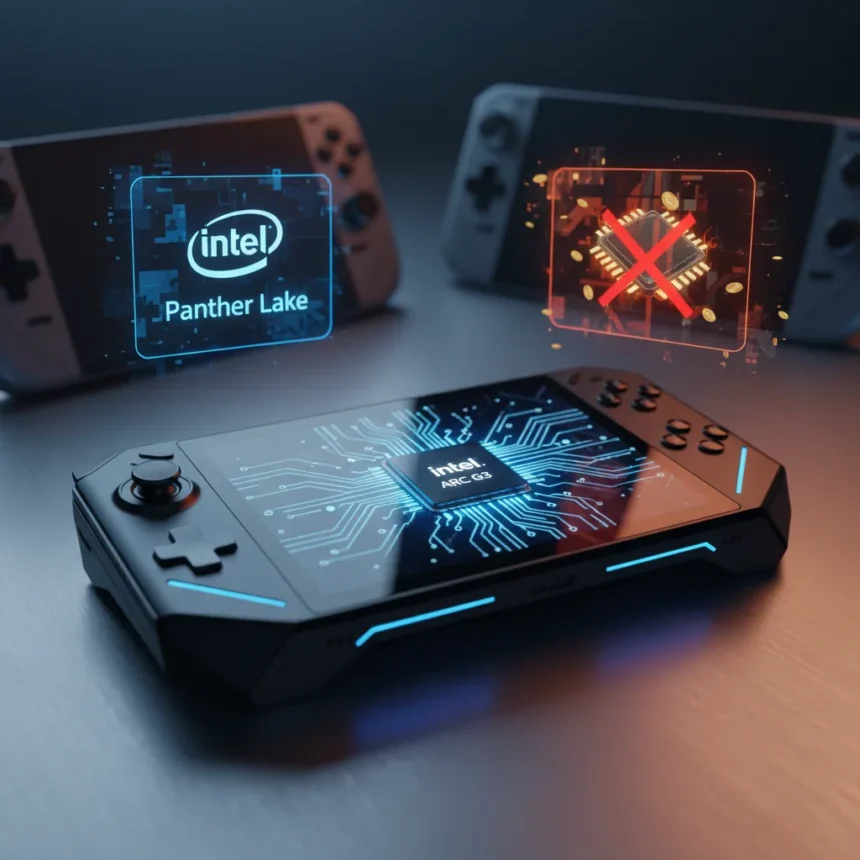
Intel Panther Lake handhelds are poised to shake up a market AMD has owned for two years, but a critical supply chain bottleneck threatens to undermine the entire push before it even launches. Intel announced Panther Lake mobile chips at CES 2026 in January, with over 200 laptop designs already in the field and handheld gaming devices expected to follow. The company is betting heavily on Arc G3 and Arc G3 Extreme chips—built on Panther Lake architecture with revised Arc iGPUs—to finally give AMD Ryzen Z2 and Z2 Extreme processors real competition in the portable gaming space.
Key Takeaways
- Intel Panther Lake handhelds rumored for Computex 2026 reveal in early June with Arc G3 and Arc G3 Extreme chips.
- Graphics use revised Arc B390, B370, B380, or B360 iGPUs, with B390 matching Xbox Series S performance.
- TDP flexibility ranges from 25W standard up to 65W or 80W turbo modes.
- MSI and OneXPlayer are confirmed partners; Acer, Microsoft, and GPD are possible contenders.
- Memory and storage shortages risk pushing handheld prices above $2,800 at launch.
Why Intel Panther Lake handhelds matter right now
AMD has dominated handheld gaming for two years through devices like the ROG Ally X, Lenovo Legion Go 2, and Steam Deck, but Intel’s aggressive entry could finally crack that monopoly. Intel Panther Lake handhelds are expected to arrive at Computex 2026—the Taiwan conference in early June—with official reveals of Arc G3 base models and Arc G3 Extreme high-end variants. This timing matters because it gives Intel a window to announce, partner, and launch before the second half of 2026, directly challenging AMD’s existing ecosystem. The company is claiming performance advantages that sound almost too good: 82% better performance than AMD-powered counterparts and up to 76% faster gaming than Lunar Lake chips. Those numbers need independent verification, but they signal Intel’s confidence in the architecture.
Intel Panther Lake handhelds: architecture and performance claims
The Arc G3 chips are built on Panther Lake’s mobile architecture with revised iGPUs that Intel claims will deliver serious gaming grunt. The graphics solutions—Arc B390, B370, B380, or B360—are the real story here. The B390, the flagship option, is said to match Xbox Series S performance in benchmarks. That’s a bold claim for a handheld chip, and if true, it would represent a meaningful leap over AMD’s current Z2 Extreme, which powers the most demanding portable gaming today. TDP flexibility gives manufacturers options: 25W standard operation, with the ability to turbo up to 65W or 80W for sustained performance. This flexibility is crucial because handheld design is a constant compromise between performance, thermals, and battery life.
Leaks suggest MSI will be the first manufacturer to release an Intel Panther Lake handheld, leveraging its experience with the MSI Claw (which used Intel’s earlier Meteor Lake chips). OneXPlayer is also confirmed as a partner. Acer, Microsoft, and GPD have been spotted with logos at CES, though none have officially confirmed handheld designs yet. absent from the partner list: Asus and Lenovo, both tied to AMD through existing partnerships and Microsoft’s ecosystem commitments.


The supply chain hurdle that could derail everything
Here’s the catch that overshadows Intel’s entire handheld ambition: memory and storage shortages are already inflating prices to absurd levels. The Lenovo Legion Go 2, powered by AMD’s Ryzen Z2 Extreme, is listed at over $2,800 USD in some markets. That’s not a typo. When the base Legion Go 2 launched at a reasonable price, shortages in NAND flash and DRAM have pushed availability into collector-item territory. If Intel Panther Lake handhelds launch into the same supply crunch, manufacturers will have no choice but to price them similarly high—or higher, given the novelty premium. This creates a vicious cycle: high prices limit adoption, limited adoption makes it harder for Intel to build momentum against AMD’s installed base and software ecosystem.
The lifecycle window is Q2 2026 through Q2 2027, giving Intel a full year to establish itself. But if the first wave of handhelds costs $2,500 or more due to memory constraints, that window could close before it opens. Casual gamers and enthusiasts looking to switch from Steam Deck or ROG Ally will balk at premium pricing, especially when AMD’s devices—despite shortages—still have years of driver optimization and game compatibility behind them.



Can Intel actually dethrone AMD?
On paper, Intel Panther Lake handhelds have the architecture and partner support to challenge AMD’s dominance. The Arc G3 lineup offers genuine performance improvements and TDP flexibility that manufacturers can tune for different market segments. But architecture alone doesn’t win markets. AMD’s Ryzen Z2 and Z2 Extreme benefit from two years of driver maturity, a proven track record in Steam Deck and ROG Ally, and a software ecosystem optimized for those chips. Intel’s Meteor Lake handhelds (the MSI Claw) proved that raw performance doesn’t guarantee success—the device launched to lukewarm reviews and struggled to gain traction against AMD’s established players.
The real question is whether Intel can avoid repeating that mistake. Panther Lake is a better architecture than Meteor Lake, but better hardware is only half the battle. Drivers, game compatibility, battery optimization, and pricing all matter. If Intel Panther Lake handhelds launch at $2,000 or higher due to supply constraints, the performance advantage becomes academic. Enthusiasts might bite, but the mass market won’t. AMD will keep selling through existing channels while Intel fights for shelf space and consumer mindshare.
Will Intel Panther Lake handhelds actually launch in 2026?
Computex 2026 in early June is the expected reveal window, with market availability likely in summer 2026. That’s only a few months away, which means prototypes and production samples should already be in testing. VideoCardz reports that the chips have undergone internal testing, suggesting the hardware is real and progressing. However, handheld launches are notoriously subject to delays—thermal issues, driver problems, or supply chain hiccups can push timelines back by months. Intel will want to avoid another MSI Claw scenario, where the device launched amid controversy and performance questions. Expect a methodical rollout rather than a bang, with initial availability limited to MSI and OneXPlayer before wider OEM adoption.
How do Intel Panther Lake handhelds compare to AMD Ryzen Z2?
Intel Panther Lake handhelds aim directly at AMD’s Ryzen Z2 and Z2 Extreme, which power the current generation of premium handhelds. Intel claims 82% better performance than AMD counterparts, but that figure lacks independent verification. The Arc B390 iGPU is said to match Xbox Series S performance, which would theoretically edge out AMD’s RDNA 3 graphics in the Z2 Extreme. However, performance in benchmarks doesn’t always translate to real-world gaming advantage—optimization, driver maturity, and software support matter enormously. AMD’s devices have a two-year head start in those areas. Intel will need to prove not just that the hardware is faster, but that it can deliver a better overall handheld experience than what AMD and its partners have already perfected.



FAQ
When will Intel Panther Lake handhelds launch?
Intel Panther Lake handhelds are expected to be officially revealed at Computex 2026 in early June, with market availability likely in summer 2026. The product lifecycle runs from Q2 2026 through Q2 2027.
What are the Arc G3 and Arc G3 Extreme chips?
Arc G3 and Arc G3 Extreme are Intel’s handheld gaming chips built on Panther Lake architecture with revised Arc iGPUs (B390, B370, B380, or B360). The Arc G3 Extreme is the high-end variant, following AMD’s Ryzen Z2/Z2 Extreme naming convention.
Will Intel Panther Lake handhelds be affordable?
Pricing hasn’t been announced, but memory and storage shortages are already pushing handheld prices above $2,800. Intel Panther Lake handhelds will likely face similar supply chain pressures, risking high launch prices that could limit adoption among casual gamers.
Intel’s Panther Lake handhelds could genuinely shake up the market if they launch with competitive pricing and strong driver support. But supply chain constraints and AMD’s two-year head start mean Intel faces an uphill battle. The hardware is promising—if it arrives at a reasonable price, it could finally give AMD real competition in portable gaming.
Edited by the All Things Geek team.
Source: Tom's Guide