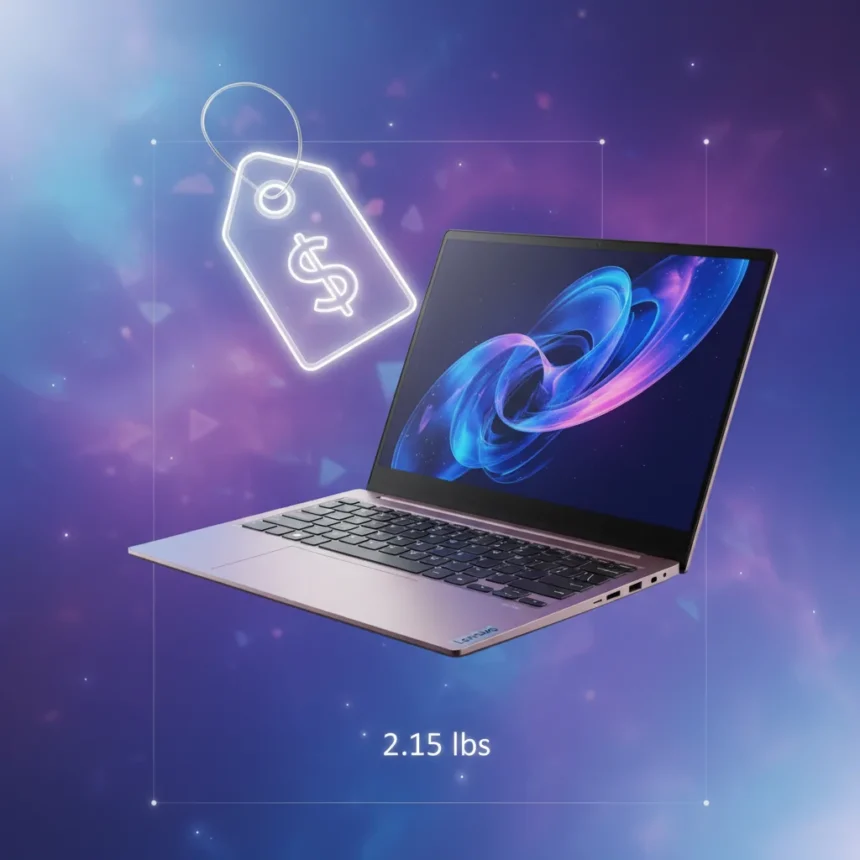
The Lenovo Yoga Slim 7i Ultra Aura Edition is the lightest Windows laptop you can buy right now, weighing just 2.15 pounds and measuring 0.55 inches thin. Lenovo engineered this machine using a magnesium-alloy chassis and stripped away mechanical components like the traditional touchpad, replacing it with a Force Pad haptic alternative to save weight. The result feels like holding a premium tablet, not a laptop. Yet beneath that featherweight frame sits genuine flagship hardware: an Intel Core Ultra X9 processor, a 14-inch OLED display with 1,100 nits of brightness, and a 75Wh battery promising impressive endurance. The problem? The price makes you question whether Lenovo’s engineering achievement justifies the cost.
Key Takeaways
- Weighs just 2.15 pounds with 0.55-inch thickness, lighter than the ASUS Zenbook A14.
- 14-inch OLED touchscreen delivers 2880×1800 resolution and 120Hz variable refresh rate.
- Intel Core Ultra X9 processor with up to 32GB LPDDR5x RAM and 2TB SSD storage.
- 75Wh battery supports extended battery life in an ultralight chassis.
- Premium pricing raises questions about real-world value for the weight savings.
A Magnesium Frame That Actually Works
Lenovo didn’t achieve 2.15 pounds through marketing hype. The magnesium-alloy chassis is rigid without flex, and the 1.5mm keyboard key travel feels surprisingly responsive for such a thin machine. The Force Pad haptic touchpad delivers physical feedback without the mechanical bulk of traditional trackpads, freeing up internal space for battery and cooling. This isn’t a gimmick—it’s engineering that prioritizes usability over weight for its own sake. The soft, rounded corners and raised comms bar above the display give the machine a distinctive look that separates it from typical ultrabooks.
Compared to the ASUS Zenbook A14, Lenovo’s approach edges out slightly in thinness and weight, making it the featherweight champion of the ultrabook category. The Zenbook A14 remains a solid alternative for those seeking similar portability without paying the Aura Edition premium, but Lenovo’s execution here is genuinely impressive.
OLED Display Brightness That Handles Sunlight
The Lenovo Yoga Slim 7i Ultra Aura Edition features a 14-inch OLED touchscreen with 2880×1800 resolution and 120Hz variable refresh rate, delivering smooth scrolling and responsive interactions. Peak brightness reaches 1,100 nits, enough to combat outdoor glare when working in sunlight—a practical advantage over standard laptop displays. Lenovo claims perfect color reproduction across sRGB, DCI-P3, and AdobeRGB color gamuts, positioning this as a machine for creators who demand color accuracy. The Dolby Vision support adds another layer of professional capability, though real-world color validation would require hands-on testing beyond the scope of this review.


The display alone justifies some of the Lenovo Yoga Slim 7i Ultra Aura Edition’s premium positioning. A 14-inch OLED panel at 2880×1800 resolution is rare in this weight class, and the brightness level genuinely solves the outdoor usability problem that plagues many thin-and-light machines.
Intel Core Ultra X9 and Thermal Compromise
Under the hood, the Lenovo Yoga Slim 7i Ultra Aura Edition can be configured with an Intel Core Ultra X9 (Series 3) processor, integrated Intel Xe graphics, up to 32GB of LPDDR5x-9600MT/s RAM, and up to 2TB M.2 PCIe 4.0 NVMe SSD storage. This is flagship-level hardware squeezed into a chassis that measures 0.55 inches thick. Lenovo says it has optimized thermals to keep everything running cool in such a compact space, which raises the practical question: how well do those thermals actually perform under sustained load? Thin-and-light machines often sacrifice sustained performance to maintain their weight and thickness targets. Without independent thermal and performance testing data, claims about optimization remain marketing assertions rather than proven facts.



The machine carries Copilot+ PC certification, unlocking Windows 11 AI features. For creators and knowledge workers, the hardware configuration is genuinely powerful. For everyday users, the Intel Core Ultra X9 is overkill—and that overkill is reflected in the price tag.
Battery Life: Impressive on Paper, Unproven in Practice
The 75Wh battery is substantial for a 2.15-pound machine, and Lenovo markets this as delivering huge battery life. The OLED display, while power-hungry at peak brightness, supports variable refresh rate technology that can dial back to lower rates when full performance isn’t needed, theoretically extending endurance. However, the research brief contains no specific runtime figures—no claim of 10 hours, 12 hours, or 15 hours of real-world use. Marketing language like huge battery life is deliberately vague. Real battery endurance depends on workload, brightness settings, and processor load. A machine running at 50% brightness with light productivity tasks will last far longer than one driving that 1,100-nit OLED at full power while compiling code or editing video.
The Pricing Problem
Here is where the Lenovo Yoga Slim 7i Ultra Aura Edition stumbles. The review summary explicitly flags pricing as a downside, yet the exact price is not disclosed in the available materials. What we know is that Lenovo is positioning this as a premium machine—and the hardware and engineering justify some premium. But premium and excessive are different things. A 2.15-pound laptop with OLED display and Intel Core Ultra X9 processor is rare, and rarity commands a price. The question is whether the weight savings alone justify what appears to be a significant cost premium over comparable machines like the ASUS Zenbook A14, which offers similar performance in a marginally heavier frame.
For creators who work in coffee shops, on airplanes, and at client sites, the extra portability might be worth it. For someone who works mostly at a desk, the Lenovo Yoga Slim 7i Ultra Aura Edition is an expensive way to solve a problem they don’t have.



Is the Lenovo Yoga Slim 7i Ultra Aura Edition worth buying?
The Lenovo Yoga Slim 7i Ultra Aura Edition is genuinely impressive engineering—the lightest Windows laptop on the market with no meaningful compromises in display quality or processing power. But impressive engineering doesn’t automatically justify the price. If you travel constantly and measure laptop weight in ounces, this machine is worth the investment. If you work mostly from home or office, the weight savings don’t translate into real productivity gains, and you should consider the ASUS Zenbook A14 or other premium ultrabooks that cost less.
How does the Yoga Slim 7i Ultra compare to the ASUS Zenbook A14?
The Lenovo Yoga Slim 7i Ultra Aura Edition is slightly lighter and thinner than the ASUS Zenbook A14 from 2024, making it the more portable option. Both machines target creators and premium users, but the Zenbook A14 likely offers better value at a lower price point, while the Yoga Slim 7i Ultra Aura Edition justifies its premium through absolute minimum weight and thickness.
What processor options are available in the Yoga Slim 7i Ultra Aura Edition?
The Lenovo Yoga Slim 7i Ultra Aura Edition can be configured with an Intel Core Ultra X9 (Series 3) processor paired with integrated Intel Xe graphics. Memory scales up to 32GB LPDDR5x RAM and storage up to 2TB PCIe 4.0 NVMe SSD, making this a fully configurable flagship machine.
The Lenovo Yoga Slim 7i Ultra Aura Edition proves that extreme weight reduction doesn’t require sacrificing display quality or processing power. What it does require is accepting a premium price tag for engineering achievement. For the right buyer—a creator who travels constantly and values portability above all else—this machine delivers genuine value. For everyone else, the weight savings don’t justify the cost.
Where to Buy
Edited by the All Things Geek team.
Source: Windows Central