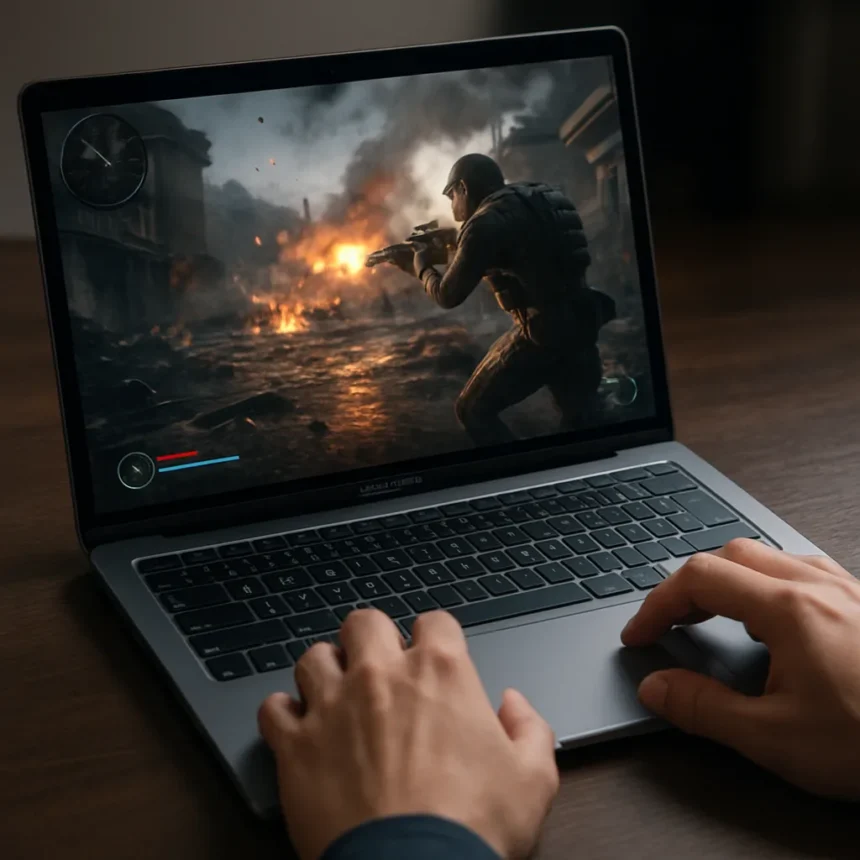
MacBook Neo gaming performance has become the most surprising conversation in the laptop world right now, with early test results painting a picture that is equal parts impressive and frustrating. The MacBook Neo is a budget-oriented Apple laptop powered by the A18 Pro chip, priced at $599, and it is generating genuine excitement among gamers who assumed Apple’s entry-level tier was a non-starter for anything beyond productivity. The reality, as testing from multiple sources confirms, is considerably more complicated than either the hype or the dismissal would suggest.
Where MacBook Neo Gaming Actually Delivers
The strongest case for the MacBook Neo as a gaming machine comes from native Mac titles. Games built specifically for Apple Silicon, such as Resident Evil 2 and Minecraft, run with a fluency that would surprise anyone who wrote off a $599 laptop as a gaming device. The A18 Pro chip’s architecture is genuinely capable when software is designed to take advantage of it, and the results in these native titles are not just playable — they are legitimately good.
This is not accidental. Apple has spent years pushing developers to bring titles natively to macOS, and the MacBook Neo benefits directly from that investment. For a buyer whose gaming library skews toward titles with native Mac support, the value proposition here is real. A $599 machine that runs demanding native games well is a meaningful achievement, and it positions the MacBook Neo in a category where few Windows laptops at this price can compete on raw efficiency.
The 8GB RAM Problem That MacBook Neo Gaming Cannot Escape
The ceiling arrives quickly, and it is made of RAM. The MacBook Neo’s 8GB of unified memory is a hard constraint that becomes painfully visible when running Windows games through CrossOver, the compatibility layer that allows macOS users to run titles not natively ported. CrossOver is a legitimate and increasingly capable solution, but it demands memory headroom, and 8GB leaves very little of it once the operating system and the compatibility layer take their share.


Testing shows that Windows titles run through CrossOver range from surprisingly functional to completely unplayable depending on the game’s memory demands. This is not a software problem that a future update will fix — it is a hardware ceiling baked into the base configuration. Buyers who want to use the MacBook Neo as a CrossOver gaming machine should understand that their experience will be inconsistent, and that inconsistency is directly tied to RAM, not to the chip’s processing power.
How MacBook Neo Gaming Compares to Windows Alternatives
At $599, the MacBook Neo enters a Windows laptop segment dominated by machines running integrated graphics from AMD and Intel. Those competitors typically offer more RAM at this price point — 16GB configurations are common — which gives them an edge in the CrossOver use case and in memory-intensive titles. However, Windows laptops at this tier rarely match the per-watt efficiency of Apple Silicon, and thermal throttling under sustained gaming loads is a genuine issue for many budget Windows machines.



The comparison is not straightforward because the ecosystems are fundamentally different. A Windows laptop at $599 gives you access to the full Steam library and DirectX titles without compatibility overhead. The MacBook Neo gives you a smaller but growing native library and a chip that punches well above its class when software is written for it. Neither is the objectively correct choice — the right answer depends entirely on which games a buyer actually plays.
Is the MacBook Neo worth buying for gaming?
It depends almost entirely on your library. If your most-played titles have native Mac versions, the MacBook Neo at $599 delivers performance that is genuinely surprising for the price. If you rely on Windows-only games through CrossOver, the 8GB RAM constraint will frustrate you regularly, and spending more on a higher-spec configuration or a Windows alternative would be the more honest recommendation.
Can CrossOver make Windows games run well on the MacBook Neo?
CrossOver can run many Windows games on the MacBook Neo, but performance varies significantly by title. Games with lower memory requirements tend to run acceptably, while more demanding titles hit the 8GB RAM ceiling hard. CrossOver is improving with each release, but it cannot overcome a hardware memory limitation — that is a fundamental constraint, not a software fix.
How does the A18 Pro chip affect MacBook Neo gaming?
The A18 Pro is the same chip found in higher-tier Apple devices, and it brings genuine GPU capability to the MacBook Neo’s $599 price point. In native Mac titles, it delivers results that exceed what the price tag suggests. The chip itself is not the bottleneck — the 8GB of unified memory shared between CPU and GPU is where the MacBook Neo gaming story runs into its limits.



The MacBook Neo is a genuinely interesting gaming machine trapped inside a memory configuration that undermines its best qualities. For native Mac gaming at $599, it is hard to beat. For anyone whose gaming life depends on Windows titles through CrossOver, the 8GB ceiling will define the experience in ways that no amount of chip performance can compensate for. Apple has built something capable here — it just needs more RAM to fully prove it.
Where to Buy
Apple MacBook Pro 14-inch M5 (2025)£1,599£1,417.97ViewSee all prices
Edited by the All Things Geek team.
Source: T3