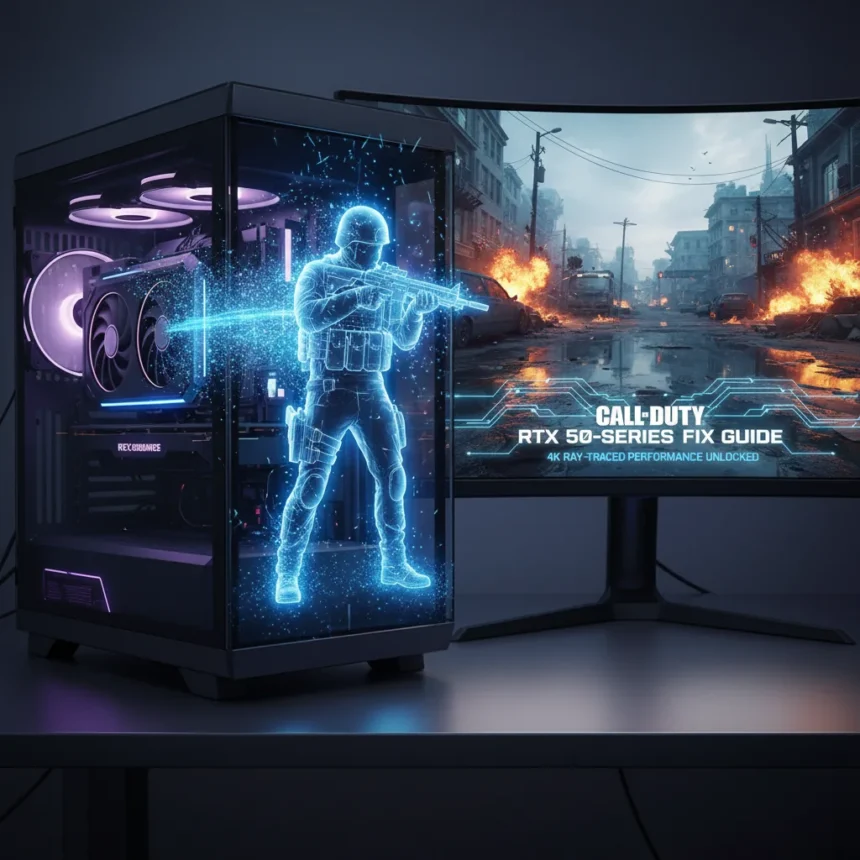
Call of Duty Modern Warfare RTX 50-series GPUs expose a visual compatibility issue that tanks image quality on the 2019 revival. The problem surfaces because newer RTX 50-series cards (like the RTX 5090 and RTX 5080) handle the game’s ray tracing and DLSS features differently than older hardware, causing rendering artifacts and visual glitches that make the game look worse than it should on hardware capable of 4K Ultra with ray tracing at 60+ FPS.
Key Takeaways
- RTX 50-series GPUs can run Call of Duty Modern Warfare at 4K Ultra with ray tracing enabled at high frame rates
- Visual issues stem from driver compatibility and in-game settings mismatches on newer GPU architecture
- Update NVIDIA drivers to the latest RTX 50-series optimized version as the first troubleshooting step
- Disable SMAA T2X anti-aliasing if you see noise and artifacts; it costs only 6 FPS but introduces visual problems
- Prioritize Particle Quality over other settings for better fidelity with minimal frame rate loss
Update Your NVIDIA Drivers First
The fastest fix for Call of Duty Modern Warfare RTX 50-series visual problems is updating to the latest NVIDIA driver build specifically optimized for RTX 50-series hardware. Older driver versions do not properly handle the architectural differences in these new cards, leading to shader compilation errors and incorrect ray tracing behavior. Download the newest driver directly from NVIDIA’s website, install it, and restart your system before launching the game.
Driver updates matter because RTX 50-series represents a generational leap in GPU design. The RTX 5090 delivers roughly 2x the ray-traced performance of dual RTX 3090 SLI setups, but that power only translates to clean visuals if the driver stack knows how to talk to the hardware. An outdated driver cannot optimize for these new capabilities, so the GPU either falls back to suboptimal rendering paths or produces visual artifacts.
Adjust Ray Tracing and DLSS Settings In-Game
Once drivers are current, launch Call of Duty Modern Warfare and navigate to graphics settings. Set the graphics preset to Ultra, then enable Ray Tracing and switch DLSS to Quality mode (disable Frame Generation, which is not supported on this 2019 title). This combination leverages the RTX 50-series architecture without overloading the rendering pipeline with features the game engine was not designed to handle.



The key is avoiding aggressive upscaling or experimental DLSS modes. Call of Duty Modern Warfare RTX 50-series performance scales predictably with standard DLSS Quality at 1440p or 4K, delivering clean image quality without the temporal artifacts that come from Frame Generation or Performance mode. If you see ghosting or blurring, dial the resolution scale down slightly (try 90% or 95%) rather than jumping to a different DLSS preset.
Disable Problematic Anti-Aliasing and Monitor Settings
The SMAA T2X anti-aliasing filter introduces visible noise and artifacts on RTX 50-series when combined with depth-of-field or screen-space reflections. Disable SMAA T2X entirely; the visual penalty is negligible (roughly 6 FPS), and you avoid the artifacts that make the game look worse than it actually is. Switch to FXAA or disable anti-aliasing altogether and rely on DLSS Quality to handle edge smoothing.



Monitor your GPU and CPU temperatures using MSI Afterburner or similar tools while playing. RTX 50-series cards run hot under sustained ray-traced loads, and thermal throttling can cause stuttering and visual pop-in. Ensure your case has adequate airflow and consider undervolting if temperatures exceed 85°C. Also check VRAM usage; if the game exceeds your GPU’s memory (for example, 4K Ultra with ray tracing on an 8GB card), you will see stuttering and visual corruption.
Prioritize Particle Quality for Visual Fidelity
Call of Duty Modern Warfare’s Particle Quality setting has an outsized impact on visual appearance with minimal performance cost. Maxing out Particle Quality adds roughly 3.5 FPS overhead but significantly improves explosion effects, smoke, and environmental detail. This is a smart trade-off on RTX 50-series hardware, which has enough headroom to absorb the cost while delivering noticeably better visuals than lower particle settings.
Leave other settings at Ultra: texture quality, shadow quality, and model detail all run smoothly on RTX 50-series at 4K. The visual problems you see are not caused by these settings being too high—they are caused by driver mismatches or anti-aliasing conflicts. Adjusting particle quality is about optimizing what you already have, not scaling back expectations.
How do I know if my RTX 50-series driver is up to date?
Open NVIDIA GeForce Experience or visit nvidia.com/Download and enter your GPU model (RTX 5090, RTX 5080, etc.). The website will show the latest driver version available. Compare it to the version number in your system settings (right-click desktop, NVIDIA Control Panel, Help menu). If they differ, download and install the latest build immediately.



Why does Call of Duty Modern Warfare look worse on RTX 50-series than older GPUs?
RTX 50-series uses a different memory architecture and ray tracing core design than previous generations. Outdated drivers do not optimize for these changes, causing the GPU to render incorrectly. Additionally, aggressive anti-aliasing settings (like SMAA T2X) interact poorly with the new hardware, producing visual artifacts. Updating drivers and disabling problematic filters fixes both issues.
Can I run Call of Duty Modern Warfare at 8K on RTX 50-series?
Yes, RTX 50-series is capable of 8K Ultra with ray tracing, though frame rates will drop below 60 FPS depending on your exact GPU model and CPU. An RTX 5090 can handle 8K at playable rates, but most players prefer 4K at high frame rates for smoother gameplay. Test 8K settings after applying the driver and in-game fixes above.
Call of Duty Modern Warfare RTX 50-series visual issues are fixable with three steps: update drivers, disable SMAA T2X anti-aliasing, and set DLSS to Quality mode. These changes unlock the true potential of your hardware, delivering clean 4K ray-traced gameplay at 60+ FPS without artifacts or performance surprises. The game was not broken—your settings were just fighting your new GPU’s architecture.
Edited by the All Things Geek team.
Source: Windows Central