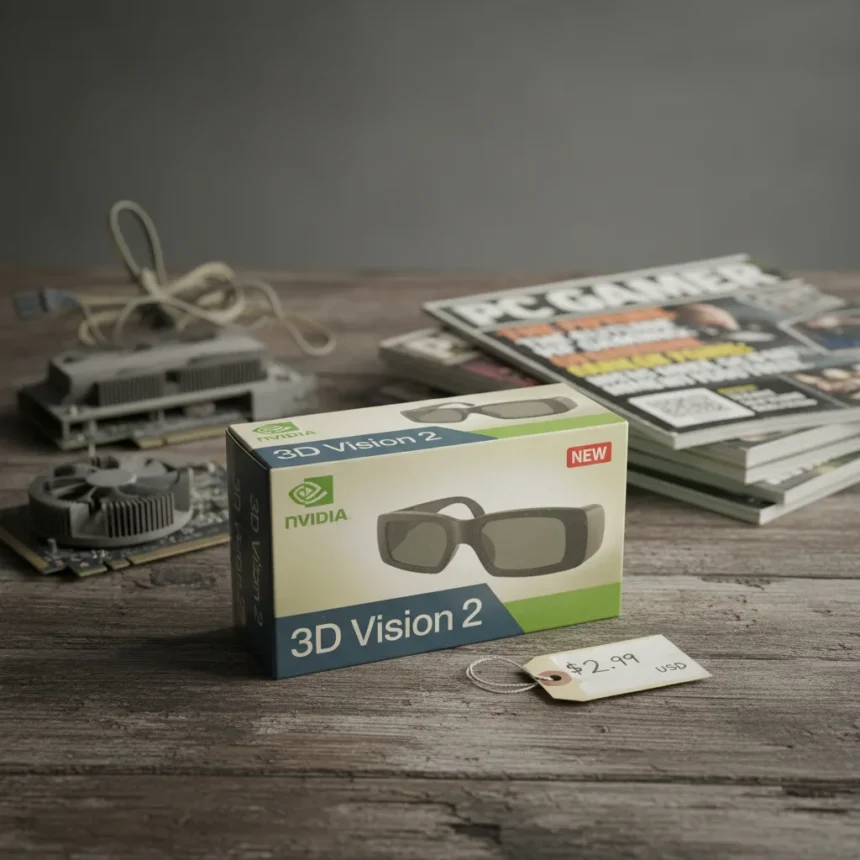
Nvidia 3D Vision 2 glasses represent one of gaming’s most dramatic value collapses. A Redditor recently discovered a sealed retail box of these stereoscopic shutter glasses for just $2.99 at a thrift store—a stunning markdown from their original $149 price tag when Nvidia launched them in 2011. What was once positioned as the future of PC gaming is now a forgotten relic gathering dust on clearance shelves.
Key Takeaways
- Nvidia 3D Vision 2 glasses originally cost $149 USD when released in 2011.
- A sealed pair sold recently for $2.99, a 98% price drop from launch.
- Lenses were 20% larger than the first-generation model with improved comfort and light blocking.
- Supported over 600 PC games and 70 compatible monitors, but the technology is now discontinued.
- Wireless range reached 15 feet with a 60-hour rechargeable battery.
Why Nvidia 3D Vision 2 Glasses Failed to Deliver on Their Promise
When Nvidia released 3D Vision 2 in 2011, the company believed stereoscopic 3D gaming would become mainstream. The glasses used active shutter technology—liquid crystal lenses that opened and closed at 60 Hz per eye, creating the illusion of depth at 120 Hz total. Nvidia backed this vision with hardware partnerships, releasing compatible monitors like the ASUS VG278H at $699 and notebooks from Toshiba and Dynabook. The ecosystem looked promising on paper. In practice, it never took off. Gamers rejected the technology for multiple reasons: eyestrain from prolonged use, the cost barrier of buying both glasses and compatible hardware, and the simple reality that flat-screen gaming felt fine. Modern VR headsets eventually offered true 3D immersion without the shutter-glass limitations, making Nvidia’s 3D Vision approach obsolete before the decade ended.
The dramatic price collapse—from $149 to $2.99—tells the real story. When a product drops 98% in value, it is not a bargain find; it is evidence of spectacular market failure. Retailers could not give these glasses away, and they did not. Nvidia discontinued the technology, and the gaming industry moved on. Today, finding a sealed box is almost an archaeological curiosity, a snapshot of an era when Nvidia gambled on a vision that gamers simply did not want.
Nvidia 3D Vision 2 Glasses vs. First-Generation 3D Vision
Nvidia’s original 3D Vision glasses, released before 3D Vision 2, set the foundation but suffered from design and optical compromises. The second-generation model addressed several of these issues. Lenses were 20% larger, providing a wider viewing area and more effective external light blocking. The frame materials shifted from rigid plastic to lightweight composites, making the glasses more comfortable for extended gaming sessions and compatible with gaming headphones without pinching. Nvidia also introduced LightBoost technology, which promised up to 2X brighter 3D images compared to the darker presentation of the original. The wireless range stayed consistent at up to 15 feet, but battery life improved with 60-hour rechargeable capacity via USB 2.0. Despite these improvements, the second-generation model never overcame the fundamental market resistance to shutter-glass 3D gaming. Better engineering could not fix the core problem: gamers did not want the technology badly enough to justify the cost and complexity.


What Made Nvidia 3D Vision 2 Glasses Technically Impressive
On a pure technical level, Nvidia 3D Vision 2 glasses were genuinely sophisticated for 2011. The active shutter design eliminated the ghosting and color separation issues that plagued passive 3D technologies, delivering cleaner stereoscopic images at 1080p resolution per eye. The wireless infrared system eliminated cable clutter, and the 60-hour battery meant you could game for weeks without recharging. The glasses supported over 600 PC games through driver-level software integration, with backward compatibility to over 70 monitors, notebooks, and projectors already in the 3D Vision ecosystem. This was not a half-baked prototype; it was a mature product with real engineering behind it. Nvidia had solved the technical problems. What it could not solve was the market problem. Gamers preferred the simplicity and comfort of flat-screen gaming, even if 3D offered deeper immersion. No amount of technical polish changes consumer preference, and Nvidia learned this lesson the hard way.
Why the $2.99 Find Matters
The Redditor’s $2.99 discovery is not just a funny deal—it is a window into how quickly latest gaming technology becomes worthless when the market rejects it. Nvidia spent engineering resources, partnered with monitor and notebook manufacturers, and built driver support for hundreds of games. The company created a closed ecosystem designed to lock in users. None of it mattered. Within a few years, the technology was dead. Sealed retail boxes that once represented a $149 investment in gaming’s future now sit in thrift stores because retailers need shelf space and cannot move inventory at any reasonable price. This is the fate of niche gaming peripherals that bet on a technology adoption curve that never materializes. The glasses work fine. The ecosystem still functions. But nobody wants them, and that is the only metric that matters in consumer electronics.



Is Nvidia 3D Vision 2 still worth buying?
Buying Nvidia 3D Vision 2 glasses today makes sense only as a novelty or for collectors of gaming history. The technology is discontinued, and Nvidia has stopped supporting driver updates. You would need to find a compatible monitor from 2011 or later, which narrows your options significantly. If you somehow locate both the glasses and a compatible display, you can still play the 600+ games that shipped with 3D Vision support. However, modern gaming monitors offer higher refresh rates, better color accuracy, and lower latency than anything available in the 3D Vision ecosystem. The $2.99 price reflects reality: this is a relic, not a functional gaming upgrade.
What was the original price of Nvidia 3D Vision 2 glasses?
Nvidia 3D Vision 2 glasses launched in 2011 at $149 USD for the glasses alone. If you wanted a complete 3D gaming setup, compatible monitors like the ASUS VG278H cost around $699 and included the glasses in the bundle. The total investment for a serious 3D gaming enthusiast could exceed $800 when factoring in a graphics card capable of driving 120 Hz 3D at acceptable frame rates.
How do Nvidia 3D Vision 2 glasses compare to modern VR headsets?
Nvidia 3D Vision 2 glasses and modern VR headsets serve fundamentally different purposes. 3D Vision 2 adds stereoscopic depth to traditional flat-screen games without changing the interface or gameplay. VR headsets create fully immersive environments with head tracking, hand controllers, and 360-degree environments. VR offers true 3D immersion that shutter glasses cannot match. However, VR requires purpose-built games and comes with its own comfort and cost challenges. The 3D Vision approach was less immersive but worked with existing PC games and flat-screen setups. Modern gamers overwhelmingly chose VR when immersion became the priority, making Nvidia’s shutter-glass strategy obsolete.
The $2.99 Nvidia 3D Vision 2 find is a perfect encapsulation of gaming’s brutal economics: great engineering and a complete ecosystem mean nothing if the market does not want the technology. Nvidia bet on 3D gaming becoming essential. It did not. Today, those sealed boxes are a reminder that hype and innovation are not the same thing, and the graveyard of gaming peripherals is full of products that promised the future but could not convince gamers to buy it.



Edited by the All Things Geek team.
Source: Tom's Hardware