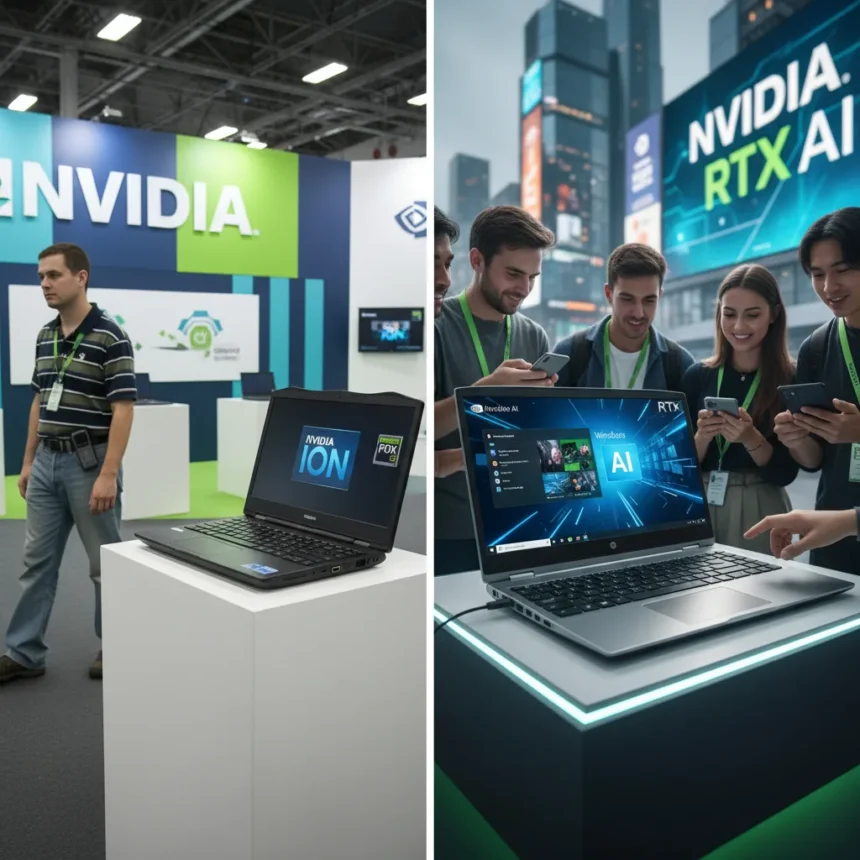
Nvidia-powered Windows laptops are making a comeback at Computex 2026, but the company has been here before—and it ended badly. Exactly 17 years ago, at Computex 2009, Nvidia unveiled its first attempt at mainstream Windows laptop dominance with the Mobinnova Elan, a device that became a cautionary tale in forgotten hardware. Now, as Jensen Huang prepares to pitch RTX Spark as a reinvention of laptop computing, the parallel is hard to ignore: Nvidia is betting on Arm-based Windows again, hoping this time sticks.
Key Takeaways
- The Mobinnova Elan, Nvidia’s first Nvidia-powered Windows laptop, debuted at Computex 2009 and became a market flop.
- RTX Spark is Nvidia’s 2026 return to Windows laptops, featuring 20 CPU cores and 6,144 CUDA cores on Blackwell architecture.
- Over 30 laptops and 10 desktops using RTX Spark are expected to ship in fall 2026.
- RTX Spark is co-designed with MediaTek and includes a Grace-class Arm CPU plus Blackwell GPU.
- Nvidia positions RTX Spark as a rival to Apple’s M-series chips and Intel/AMD laptop processors.
When Nvidia-powered Windows laptops first failed
The Mobinnova Elan was supposed to be a watershed moment. At Computex 2009, Nvidia believed it had cracked the code for bringing GPU power to mainstream Windows notebooks. The device arrived with Nvidia branding and expectations, yet it vanished from public consciousness almost immediately. The laptop was a flop that barely anyone remembered, a footnote in hardware history that Nvidia has largely avoided discussing. Few consumers ever saw one. Fewer still bought one. The question haunting the RTX Spark launch is whether Nvidia has learned why.
The 2009 failure was not merely a matter of bad timing or poor marketing. Nvidia-powered Windows laptops faced a fundamental problem: the ecosystem was not ready. Windows drivers were immature, software optimization for mobile GPUs was minimal, and the value proposition for consumers remained unclear. Why pay a premium for Nvidia graphics in a laptop when integrated graphics were becoming adequate for everyday tasks? The Mobinnova Elan could not answer that question convincingly, and the market moved on.
RTX Spark: Nvidia’s second act for Windows
Fast forward to 2026. Nvidia is not just returning to Nvidia-powered Windows laptops—it is reframing the entire category around artificial intelligence. RTX Spark is an Arm-based processor co-designed with MediaTek, featuring a Grace-class Arm CPU and a Blackwell GPU with 20 CPU cores and 6,144 CUDA cores. The chip is positioned as the engine for what Nvidia and Microsoft are calling a new era of personal AI computing on Windows.


The architectural shift is significant. Rather than bolt GPU power onto x86 processors, RTX Spark integrates Arm CPU and GPU on a single die, similar to Apple’s M-series strategy but with Nvidia’s Blackwell GPU architecture. This unified approach sidesteps some of the driver and optimization headaches that plagued earlier Nvidia-powered Windows laptops. Nvidia and Microsoft are partnering explicitly around Windows PCs for the age of personal AI, signaling that the operating system and hardware are moving in lockstep this time.
The initial lineup is substantial: over 30 laptops and 10 desktops are expected to ship in fall 2026. That is far more hardware partner commitment than Mobinnova ever achieved. OEMs from multiple tiers are backing the platform, suggesting genuine confidence—or at least genuine hedging against Qualcomm’s Snapdragon dominance in Windows on Arm.



Why RTX Spark might succeed where Mobinnova failed
The gap between 2009 and 2026 is not just time—it is ecosystem maturity. Windows 11 is built with Arm processors in mind. Developer tools for Arm are mature. The performance ceiling for integrated GPUs has risen dramatically, but so has the demand for AI acceleration in consumer laptops. RTX Spark arrives into a market actively asking for GPU power, not a market that needs convincing.
Competitive pressure is also different. Apple’s M-series chips have proven that Arm-based laptops can deliver premium performance and battery life, validating the entire architecture. Intel and AMD are scrambling to compete in the Arm Windows space, and Qualcomm’s Snapdragon X chips have gained traction but face criticism on performance. Nvidia is entering a proven category with a credible technical approach, not a speculative one.
The AI angle is the real differentiator. Mobinnova arrived in an era when GPU acceleration was a luxury feature for gamers and power users. RTX Spark arrives as AI agents, local LLM inference, and on-device processing become mainstream expectations. Nvidia is not selling GPU power as an option—it is selling it as essential infrastructure for the next generation of Windows computing.
Will history repeat or finally learn?
The comparison between Mobinnova and RTX Spark reveals both how much has changed and how easily Nvidia could stumble again. The company has better partners, better timing, and a clearer value proposition. But hardware success depends on software adoption, driver stability, and consumer willingness to pay a premium. The Mobinnova Elan had none of these. RTX Spark has better odds, but odds are not guarantees.



Jensen Huang’s framing of RTX Spark as a reinvention of laptop computing is ambitious. It is also a reminder that Nvidia has attempted this reinvention before. The fact that almost no one remembers the last attempt is either a sign that Nvidia has learned from failure, or a warning that history has a way of repeating itself when the fundamentals shift but the execution does not.
What is the difference between RTX Spark and Snapdragon X chips?
RTX Spark uses Blackwell GPU architecture with 6,144 CUDA cores and is co-designed with MediaTek, while Snapdragon X chips use Qualcomm’s Adreno GPU. RTX Spark is positioned as a direct competitor to Snapdragon X for Windows on Arm laptops, with Nvidia emphasizing its AI acceleration capabilities and unified memory architecture as advantages over Qualcomm’s approach.
When will RTX Spark laptops be available?
Over 30 RTX Spark laptops and 10 desktops are expected to ship in fall 2026. No specific retail pricing has been announced, and availability will depend on individual OEM partners and regional markets.
How does RTX Spark compare to Apple’s M-series chips?
Both RTX Spark and Apple’s M-series use Arm-based architecture with integrated GPUs, but RTX Spark is designed specifically for Windows 11 and emphasizes AI acceleration through Blackwell GPU cores, while M-series chips are optimized for macOS. RTX Spark is intended to challenge Apple’s dominance in high-performance Arm-based laptop processors, but in the Windows ecosystem rather than competing directly with macOS.
Nvidia’s return to Nvidia-powered Windows laptops with RTX Spark is a second chance that the company did not get in 2009. Whether it executes better this time will define not just Nvidia’s laptop ambitions but the entire trajectory of Windows on Arm as a mainstream platform.
Where to Buy
Edited by the All Things Geek team.
Source: TechRadar