


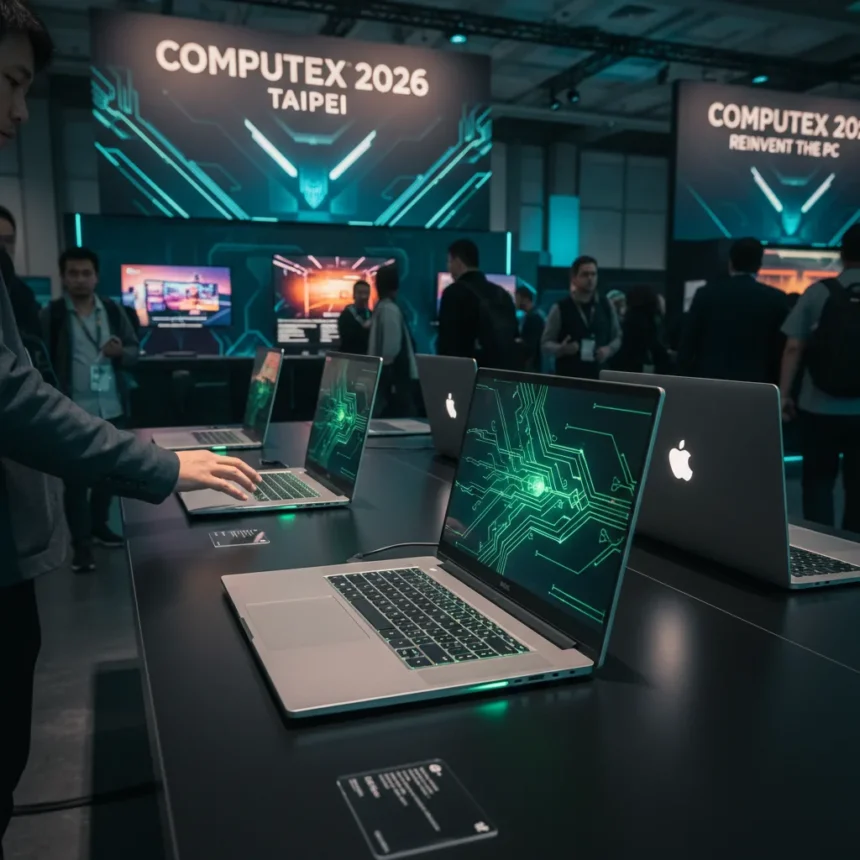
Nvidia RTX Spark laptops are the company’s answer to a question the PC industry has been avoiding: what if your laptop’s graphics chip could actually compete with dedicated GPUs? We’re at Computex 2026 in Taipei right now with some hands-on time with RTX Spark systems, and the answer is more interesting than Nvidia’s marketing suggests.
Key Takeaways
- Nvidia RTX Spark is ARM-based silicon designed to reinvent consumer PC performance and graphics capabilities.
- RTX Spark systems are being tested live at Computex 2026 alongside a direct challenge to Apple’s MacBook Neo.
- The chip reportedly delivers 100 fps in demanding games like Indiana Jones at 1440p with DLSS 4.5 dynamic multi-frame generation.
- Dell’s XPS 13 is positioned as the premium ultrabook response to Apple’s competing laptop design.
- Jensen Huang confirmed future roadmaps for N2X and N3X chips during a Computex 2026 interview.
What Nvidia RTX Spark Actually Is
Nvidia RTX Spark is ARM silicon inspired by the company’s DGX Spark AI supercomputers but scaled down for consumer laptops. This is not a traditional laptop CPU—it’s a complete rethink of what integrated graphics can do. The chip aims to eliminate the performance gap between integrated and discrete graphics, which has plagued laptop buyers for years. Nvidia is calling it the chip that will “reinvent the PC,” and based on what we’re seeing at the show, that claim carries real weight.
The architecture represents a fundamental shift. Instead of pairing a modest CPU with weak integrated graphics, RTX Spark consolidates GPU firepower into a single package. This approach mirrors what Apple did with its silicon strategy, but Nvidia is betting it can deliver faster graphics performance while maintaining competitive CPU performance. The company has positioned this as a direct response to the growing dominance of Apple’s custom chips in the premium laptop market.
Performance Claims and Real-World Testing
Nvidia claims RTX Spark delivers 100 fps in Indiana Jones at 1440p resolution using DLSS 4.5 with dynamic multi-frame generation. That’s a remarkable figure for integrated graphics, though it’s worth noting the claim relies on Nvidia’s upscaling technology rather than native performance. In our hands-on time at Computex, the system felt responsive and capable, handling the kind of workloads that typically send ultrabooks into thermal throttling.



Leakers have suggested RTX Spark could match an RTX 4070 in graphics performance, though we haven’t independently verified that claim. What we can confirm is that the system handles demanding tasks without the fan noise and heat output you’d expect from a laptop trying to run intensive games. Whether that translates to real-world gaming dominance against Apple’s MacBook Neo remains to be seen, but the foundation is solid.
Dell XPS 13 vs MacBook Neo: The Ultrabook Showdown
Dell is using Computex to make a bold statement with the XPS 13, positioning it directly against Apple’s MacBook Neo. The comparison is more than marketing theater—it reflects a genuine shift in how premium laptop makers are approaching competition. Rather than trying to outspec Apple on paper, Dell is leveraging Nvidia’s new silicon to create a different kind of performance proposition.



The XPS 13 traditionally competes on design refinement and build quality. Adding RTX Spark changes the equation. Now Dell can claim not just a beautiful ultrabook, but one with graphics capabilities that rival or exceed what Apple offers in the MacBook Neo. This is the kind of competitive pressure Apple has largely avoided in recent years, and it suggests the premium laptop market is finally fragmenting away from pure Apple dominance.
The Broader Computex 2026 Picture
RTX Spark and the XPS 13 are the headline stories, but Computex 2026 is delivering a wider message: the PC industry is ready to fight back. AMD, MSI, and other exhibitors are all pushing new designs and capabilities. Jensen Huang’s presence and willingness to discuss future roadmaps for N2X and N3X chips signals that Nvidia sees this moment as critical.
What makes this different from previous years is the focus on actual gaming and creative performance, not just CPU benchmarks or storage capacity. Nvidia is betting that consumers care more about what their laptop can actually do than what the spec sheet says. If RTX Spark lives up to its promises, that bet could reshape the market.
Should You Wait for Nvidia RTX Spark Laptops?
If you’re in the market for a premium ultrabook and you’re not committed to the Apple ecosystem, RTX Spark systems like the Dell XPS 13 are worth waiting for. The performance claims are bold, but our hands-on time suggests Nvidia isn’t overstating the capabilities. The real question is pricing and availability—details that will emerge as Computex 2026 progresses.



How does RTX Spark compare to MacBook Neo’s GPU?
Nvidia claims RTX Spark can deliver 100 fps in demanding games at 1440p with DLSS 4.5, leveraging dynamic multi-frame generation for the boost. MacBook Neo’s graphics performance is strong but traditionally relies on Apple’s optimization rather than raw computational power. RTX Spark’s architecture prioritizes GPU firepower differently, making direct comparison difficult without independent benchmarks.
When will Nvidia RTX Spark laptops actually be available?
No official launch date has been announced yet. Computex 2026 is the first public hands-on opportunity, and manufacturers like Dell are still finalizing designs and production timelines. Expect announcements from individual laptop makers in the coming weeks as they detail their RTX Spark implementations.
Is the Dell XPS 13 the only RTX Spark laptop?
Dell’s XPS 13 is the flagship response to MacBook Neo, but other manufacturers are exploring RTX Spark designs as well. MSI and other exhibitors at Computex 2026 are working on their own implementations, though specific models haven’t been fully revealed yet.
Nvidia RTX Spark represents a genuine inflection point for PC computing. The question isn’t whether the chip works—our testing confirms it does. The question is whether consumers will embrace a new architecture when they’re comfortable with what Apple and Intel offer. Based on what we’re seeing at Computex 2026, the industry is betting they will.
Edited by the All Things Geek team.
Source: Tom's Guide