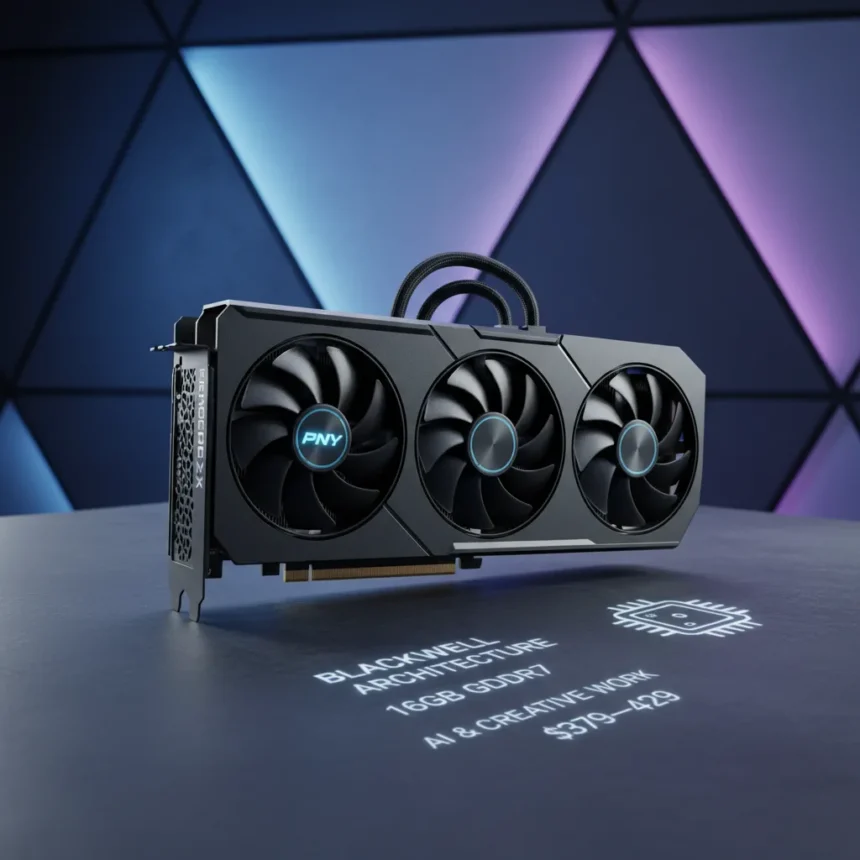
The PNY GeForce RTX 5060 Ti is a budget-friendly entry point to NVIDIA’s Blackwell architecture, designed to unlock AI acceleration and creative workloads for users stepping up from older GPUs like the RTX 3060. With 16GB of GDDR7 video memory, a 128-bit bus, and 4,608 CUDA cores, this card packs nearly double the compute performance of its predecessor while staying affordable at $379–$429 MSRP. But here’s the catch: it’s not built for gaming dominance, and PNY knows it.
Key Takeaways
- PNY GeForce RTX 5060 Ti features Blackwell architecture with 16GB GDDR7 and 4,608 CUDA cores at $379–$429 MSRP
- Delivers 29.15 TFLOPS FP32 compute—nearly double the RTX 3060’s 16.2 TFLOPS—for AI and creative tasks
- Outperforms higher-tier cards like the RTX 5070 and RTX 4070 in AI text generation despite fewer cores
- Designed for creators, developers, and AI workflows rather than competitive gaming
- PNY’s Verto design emphasizes thermal efficiency and quiet operation at NVIDIA reference standards
Where the PNY GeForce RTX 5060 Ti Actually Excels
Forget chasing frame rates. The PNY GeForce RTX 5060 Ti’s real strength lies in creative acceleration and local AI inference. In Procyon AI Text Generation tests, the card punches above its weight, competing effectively against the RTX 5070 (which has 6,144 cores and a wider 192-bit memory bus) and the RTX 4070 (5,888 cores, also 192-bit). This matters because creators increasingly rely on AI tools for image upscaling, voice synthesis, and text generation—tasks that benefit enormously from GPU acceleration.
The 16GB of GDDR7 memory is the real differentiator here. Previous budget-tier cards capped out at 8GB or 12GB, forcing creators to either upgrade or work with smaller assets. With 16GB, you can load larger models, process longer sequences, and multitask without constantly offloading to system RAM. For developers training smaller machine learning models or running inference locally, this is a meaningful upgrade path that doesn’t demand a $1,000+ investment.
The Blackwell architecture itself brings efficiency gains. The PNY GeForce RTX 5060 Ti’s base clock of 2.41 GHz and boost clock of 2.57 GHz deliver solid performance-per-watt, and PNY’s Verto cooler design keeps the card cool and quiet—a deliberate choice that aligns with NVIDIA’s reference thermal and acoustic standards. This matters in creative workspaces where noise pollution matters and thermals directly affect sustained performance during rendering or encoding jobs.


Gaming Performance: The Honest Verdict
The PNY GeForce RTX 5060 Ti is not a gaming card, and pretending otherwise would be misleading. With 4,608 CUDA cores and a 128-bit memory bus, it’s positioned as an upgrade from the RTX 3060 for users targeting 1440p gaming at moderate settings. That’s a real use case, but it’s not the card’s primary identity. If you’re chasing high refresh rates or maxed-out settings at 4K, look elsewhere—the RTX 5070 or RTX 4070 are better choices, though at significantly higher costs.
The value proposition here is different. You’re not buying the fastest card in the class; you’re buying an affordable entry to Blackwell that happens to game adequately while excelling at creative tasks. PNY’s design philosophy reflects this: the company historically avoids aggressive overclocking, instead matching NVIDIA’s reference standards for voltage, thermals, and acoustics. A modest ~0.59% overclock on the Verto models keeps the card stable and cool rather than squeezing every last frame.


PNY GeForce RTX 5060 Ti vs. The Upgrade Path
If you’re running an RTX 3060 or older, the PNY GeForce RTX 5060 Ti is a meaningful upgrade. The jump from 16.2 TFLOPS to 29.15 TFLOPS FP32 compute is substantial, and the architectural improvements in Blackwell compound that advantage. You’ll see better AI inference performance, faster content creation workflows, and more breathing room for larger projects.
Compared to the RTX 5070, you’re trading raw compute power and a wider memory bus for $200+ in savings. If your workload is primarily AI text generation or creative tasks rather than demanding 3D rendering, the RTX 5060 Ti is the smarter choice. The RTX 4070, meanwhile, is last-generation hardware at a similar price point—it lacks the efficiency gains and DLSS 4 capabilities of Blackwell, making the RTX 5060 Ti the forward-looking option.
PNY’s Design Philosophy: Cool and Quiet
PNY’s Verto lineup scales across the RTX series, and the design consistency matters. The company supplies NVIDIA’s RTX PRO 6000 Blackwell workstation GPUs for professional AI and compute workloads, and that expertise translates to the consumer Verto cards. The triple-fan cooler design, copper heat pipes, and conservative power tuning ensure the PNY GeForce RTX 5060 Ti runs at thermal and acoustic levels that won’t disrupt a creative workspace.
This is not a flashy, RGB-laden card. It’s built for professionals and serious hobbyists who prioritize stability and low noise over visual flair. If you’re rendering video for 12 hours straight, you’ll appreciate a cooler that doesn’t sound like a jet engine.


Is the PNY GeForce RTX 5060 Ti Worth Buying?
Yes—but only if your workload aligns with its strengths. If you’re a content creator, developer, or AI enthusiast upgrading from a 3060 or older, the PNY GeForce RTX 5060 Ti delivers real value at $379–$429. The 16GB GDDR7, Blackwell efficiency, and proven AI performance make it a solid choice for local inference, creative acceleration, and multitasking with heavier assets. If gaming is your primary concern, save for the RTX 5070 or RTX 4070.
What makes the PNY GeForce RTX 5060 Ti good for AI tasks?
The card’s 29.15 TFLOPS FP32 compute and 16GB GDDR7 memory enable efficient local AI inference without relying on cloud APIs. It outperforms higher-tier cards in AI text generation benchmarks despite lower core counts, making it ideal for running models locally and processing larger datasets without constant offloading to system memory.
How much VRAM does the PNY GeForce RTX 5060 Ti have?
The PNY GeForce RTX 5060 Ti comes in two variants: a 16GB GDDR7 model and an 8GB variant, both available at launch. The 16GB version is the stronger choice for creative work and AI tasks, as it supports larger models and multitasking without memory bottlenecks.
Is the PNY GeForce RTX 5060 Ti better than the RTX 4070?
For creative and AI workloads, yes. The RTX 5060 Ti uses newer Blackwell architecture with better efficiency, supports DLSS 4, and costs less. The RTX 4070 has more CUDA cores but is last-generation hardware. For gaming, the RTX 4070 pulls ahead, but the RTX 5060 Ti is the smarter long-term investment for creators and developers.
The PNY GeForce RTX 5060 Ti succeeds because it’s honest about what it is: an affordable, efficient entry to Blackwell designed for creators and AI workflows, not gaming dominance. For the right user, that’s exactly what the GPU market needed.
Where to Buy
Edited by the All Things Geek team.
Source: Creativebloq