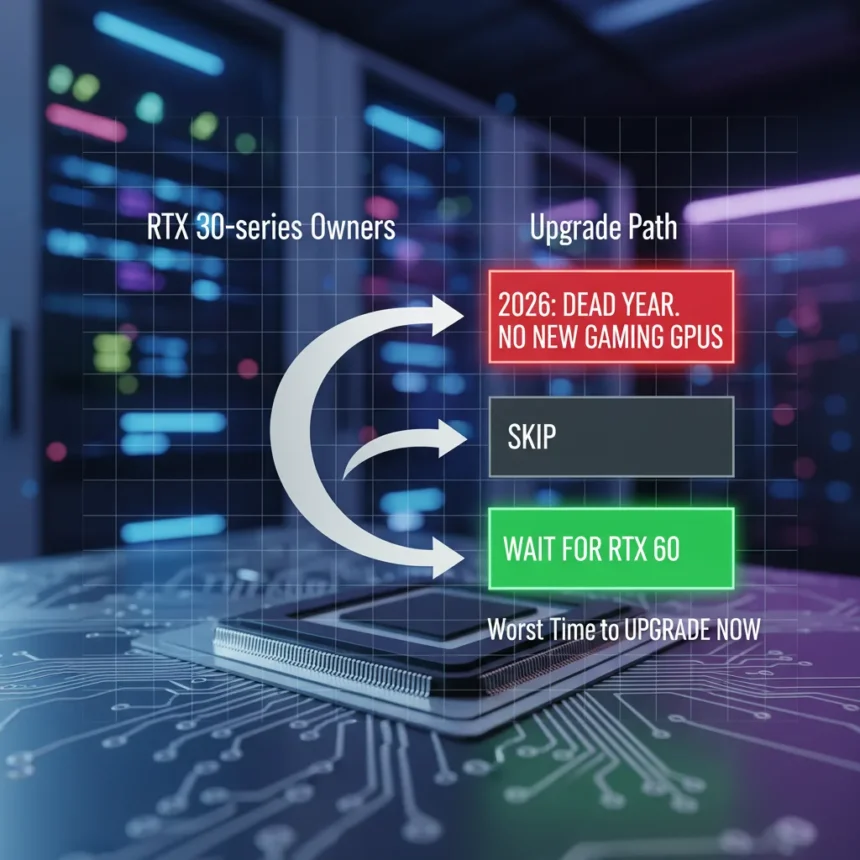
The RTX 30-series upgrade matrix reveals an uncomfortable truth for Ampere GPU owners: 2026 is a trap year. No new RTX gaming GPUs launch this year, leaving RTX 30-series owners choosing between holding Ampere hardware or jumping to older RTX 40-series stock. The RTX 60-series won’t arrive until 2027 or 2028, creating a performance plateau that makes any 2026 upgrade feel premature.
Key Takeaways
- No new RTX gaming GPUs launch in 2026; RTX 60-series delayed to 2027-2028
- RTX 30-series (Ampere) remains viable for 1440p and 1080p gaming at high settings
- RTX 3090 offers 50% performance gain over RTX 2080 Ti, justifying past purchases
- RTX 30 inventory dumps via steep discounts signal RTX 40 preparation, not RTX 30 value
- Blackwell and RDNA4 alternatives exist but 2026 offers no fresh Nvidia options
Why 2026 Is The Worst Year To Upgrade From RTX 30-Series
The RTX 30-series upgrade matrix shows that 2026 presents zero compelling reasons to leave Ampere. Nvidia has no new consumer RTX GPUs launching this year. The RTX 40-series (Ada Lovelace architecture) is imminent, but that is a 2-3 year old architecture by now. The RTX 60-series, the true next-generation platform, won’t debut until 2027 at earliest, possibly 2028. This creates a gap where RTX 30 owners have nowhere logical to upgrade without buying yesterday’s technology.
Steep discounts on RTX 30-series inventory through retailers like EVGA and Newegg are not signs of value—they are signs of clearance. Nvidia is dumping Ampere stock ahead of RTX 40 availability. Buying a discounted RTX 30 in 2026 is buying a GPU Nvidia wants gone, not one it recommends for new builds. For RTX 30 owners, this inventory pressure is actually good news: your existing hardware is not obsolete, it is just no longer in Nvidia’s sales pipeline.
RTX 30-Series Performance Still Holds Up
The RTX 30-series upgrade matrix must account for real-world performance. When Ampere launched, the RTX 3090 delivered roughly 50% more performance than the RTX 2080 Ti, despite the RTX 2080 Ti having no direct Ampere equivalent. That generational leap was massive. But generational leaps shrink over time. A pre-launch Ampere GPU showed a 30% lead over the RTX 2080 Ti at peak clocks, suggesting the jump was real but not infinite.


For 1440p gaming at high settings, an RTX 3070 or RTX 3080 remains entirely adequate in 2026. Newer games demand more, but Ampere’s tensor cores and ray tracing cores—core upgrades over Turing—still handle modern workloads. The RTX 30-series upgrade matrix is not about whether RTX 30 GPUs work; it is about whether the jump to a newer GPU justifies the cost when no new consumer option exists.
Unverified RTX 30 Super Rumors Miss The Point
Leaker kopite7kimi circulated potential RTX 30 Super specifications in early 2022, suggesting refreshed SKUs with faster memory or retained CUDA cores paired with GDDR6X. These specs never materialized. The RTX 30-series upgrade matrix should not hinge on phantom products. Nvidia never released a Super refresh for Ampere, and waiting for unconfirmed hardware is a losing strategy.



The broader lesson: the RTX 30-series upgrade matrix is not a puzzle with a hidden answer. It is a straightforward timeline problem. Ampere was built for 2020-2022 gaming. In 2026, it still plays games. In 2027, when RTX 60 arrives, the decision becomes real. Until then, hold.
What About Blackwell And RDNA4 Alternatives?
The RTX 30-series upgrade matrix does not exist in isolation. AMD’s RDNA4 and Nvidia’s rumored Blackwell platform offer alternatives, but neither solves the 2026 timing problem for RTX 30 owners. Blackwell is still speculative for consumer gaming. RDNA4 is AMD’s play, but switching architectures and driver ecosystems is friction that only makes sense if the performance jump justifies it. In 2026, with no new Nvidia option, jumping to RDNA4 is a lateral move, not an upgrade.
The RTX 30-series upgrade matrix ultimately asks: do you need to upgrade right now? The answer is almost always no. Your RTX 3070, RTX 3080, or even RTX 3060 Ti will play 2026 games at playable settings. The real upgrade window opens in 2027 when RTX 60 arrives and the RTX 30-series upgrade matrix becomes a genuine choice between two current-generation platforms.
Should RTX 30-series owners upgrade in 2026?
No. There is no new Nvidia option, RTX 40-series is old, and RTX 60 is not here yet. Wait until 2027 when you have actual next-generation hardware to compare against Ampere.



Are RTX 30-series GPUs still good for gaming?
Yes. RTX 3070 and RTX 3080 models handle 1440p gaming at high settings comfortably. 4K gaming requires compromises, but Ampere is far from dead.
Why are RTX 30-series prices dropping in 2026?
Nvidia is clearing Ampere inventory ahead of RTX 40 and future launches. Discounts signal end-of-life clearance, not a sign that RTX 30 is a bargain—it is a sign Nvidia wants the stock gone.
The RTX 30-series upgrade matrix is not complicated: hold your Ampere GPU through 2026, reassess in 2027 when RTX 60 launches, and make your upgrade decision then. Nvidia has given RTX 30 owners an accidental gift—a year to save money and let the next platform mature. Do not waste it on yesterday’s hardware.
Edited by the All Things Geek team.
Source: Tom's Hardware