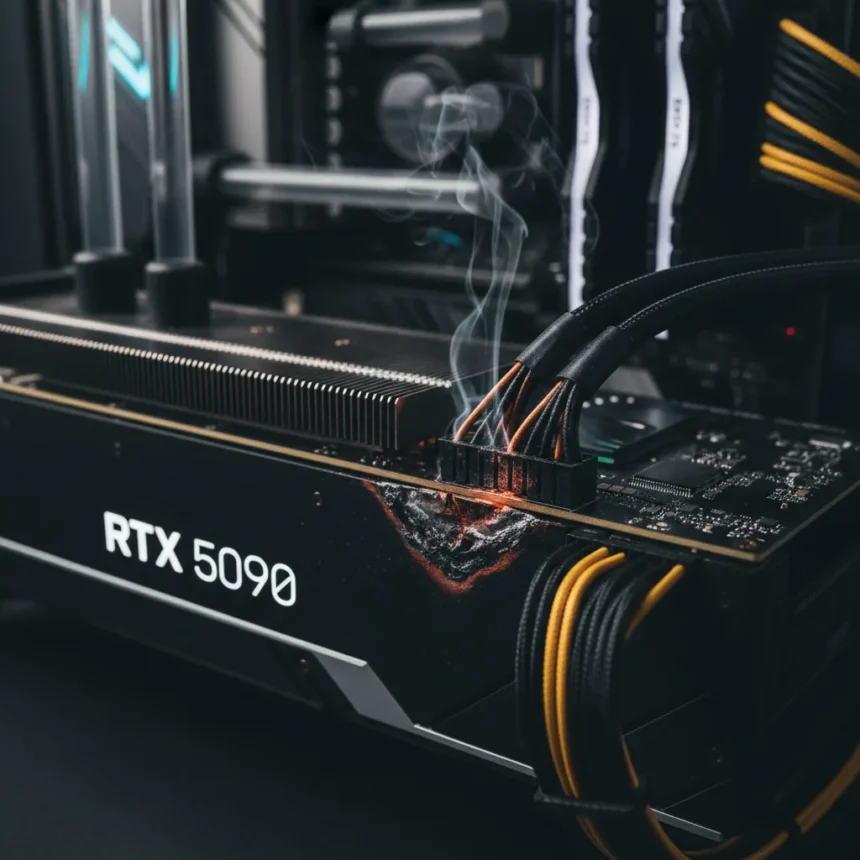
RTX 5090 power cable melting remains a critical hardware failure risk despite Nvidia’s switch to the updated 12V-2×6 connector standard. The new connector was supposed to solve the melting problems that plagued the RTX 4090’s original 12VHPWR design, but reports of charred cables, exposed copper wires, and thermal imaging showing uneven current distribution prove the fundamental issue persists.
Key Takeaways
- RTX 5090 uses 12V-2×6 connector, an improvement over 12VHPWR, but melting incidents continue under heavy loads
- Transient power spikes can reach 2x rated power, causing catastrophic current concentration on individual pins
- At least 3-4 documented melting cases exist, including one RTX 5090 fire incident on Christmas using the original cable
- RTX 5080 carries lower risk due to 360W TDP; RTX 4090 remains vulnerable despite lower than RTX 5090 frequency
- Asus claims a solution but unverified; replugging often provides temporary fixes while faulty cables require replacement
Why the 12V-2×6 Standard Didn’t Fix the Problem
The 12V-2×6 connector improved pin design by tweaking prong lengths to prevent power flow if improperly inserted. This was meant to be a safeguard against the catastrophic failures seen with the original 12VHPWR. Yet the mitigation fails in real-world conditions because the root cause isn’t connector geometry—it’s physics. High-frequency effects including inductance, capacitance, and skin effect create uneven current distribution across pins. When one pin fails or develops contact resistance through wear, oxidation, or repeated plug-unplug cycles (typically 30-40 cycles), the remaining pins must handle the full load. For a 600W power envelope, that concentration is lethal.
Thermal imaging of affected cards shows current flowing unevenly—some pins carrying over 9 amps while others carry far less. The 12V-2×6 standard does not address this current imbalance. It only prevents the cable from being inserted wrong, which is a mechanical safeguard, not an electrical one. The physics of high-power delivery at small form factors remains unsolved.
RTX 5090 Power Cable Melting: Documented Cases and Risk Scope
RTX 5090 power cable melting has been reported in at least 3-4 confirmed cases, with photographic and thermal evidence. One incident occurred on Christmas using Nvidia’s original cable, ruling out third-party cable failure as the sole culprit. Another case involved an RTX 5090 TUF OC model from Asus, where users reported melted connectors and exposed copper—the hallmark of catastrophic current concentration. An RTX 5080 melting case also exists, though far rarer given the card’s 360W TDP versus RTX 5090’s 575W envelope.


The RTX 4090, which uses the original 12VHPWR connector, remains at risk but with lower incident frequency than RTX 5090. This progression suggests that higher power envelopes amplify the failure risk—not because the connector is worse, but because the physics of current delivery at extreme wattages is harder to manage. The RTX 3090, which used older connectors, avoided widespread melting issues due to better current balancing architecture, demonstrating that the problem is not inevitable at these power levels but rather a specific design consequence.
What Causes RTX 5090 Power Cable Melting
Melting occurs when transient power spikes—temporary surges that can reach 2x the rated power draw—force current through a connector not designed to handle such extremes. Under normal sustained loads, the cable and connectors operate within spec. But GPU workloads, particularly in gaming and AI inference, generate sudden power demands that spike far above steady-state consumption. If a connector pin has developed even slight contact resistance—from oxidation, wear, or a manufacturing defect—that pin becomes a chokepoint. Current reroutes through adjacent pins, creating a localized hotspot that melts the plastic housing and insulation.



The 30-40 plug-unplug cycles typical in a user’s ownership also degrade contact quality over time. Each insertion and removal creates microscopic wear. After repeated cycles, contact resistance rises. The 12V-2×6 standard does not eliminate this wear mechanism; it only makes the connector harder to insert incorrectly. Once installed and cycled, the physics of current concentration remains the same. Products like Thermal Grizzly temperature monitoring adapters have emerged specifically because this issue persists and users need real-time warnings.
Asus’s Claimed Solution and Why Skepticism Is Warranted
Asus claims to have solved the RTX 5090 power cable melting problem, but the article title provides no specifics, test results, or independent verification of what this solution entails. Without details on whether Asus has modified connector geometry, added thermal management, improved contact materials, or simply bundled better-quality cables, the claim remains unverified. Forum discussions on Asus RTX 5090 TUF OC models show that replugging the connector often fixes temporary issues, suggesting loose contact rather than a fundamental design change. Users report that truly faulty cables still require replacement, indicating the underlying vulnerability persists.
If Asus’s solution is merely better cable quality or tighter tolerances, it addresses a symptom, not the cause. The transient power spikes and current concentration physics remain unchanged. A better cable might last longer before contact resistance develops, but it does not eliminate the risk. Without published specifications, thermal testing, or long-term reliability data, the claim deserves skepticism. The RTX 4090 shipped with claims of improved connectors too; history suggests incremental hardware tweaks alone cannot solve a physics problem.
RTX 5090 vs. RTX 5080: Risk Tiers and Power Envelope Trade-offs
The RTX 5080 carries significantly lower risk of power cable melting than the RTX 5090, primarily due to its 360W TDP versus RTX 5090’s 575W. Lower power envelopes mean lower transient spikes and less current concentration when failures occur. However, one RTX 5080 melting case has been reported, proving the 5080 is not immune. The RTX 4090, with its 450W TDP, sits between the two—less risky than RTX 5090 but more vulnerable than RTX 5080. This pattern confirms that power envelope directly correlates with melting risk: higher wattage amplifies the consequences of any connector failure.



For users considering RTX 5090 versus RTX 5080, power cable melting risk is a genuine trade-off. RTX 5090 delivers higher performance but carries real hardware risk. RTX 5080 is safer by design but sacrifices performance headroom. This is not theoretical—it is backed by documented melting cases across multiple cards.
Can DIY Fixes Solve RTX 5090 Power Cable Melting
Forum users have proposed DIY solutions including XT60 connectors and custom wire modifications, but these approaches are not recommended. While technically possible, they void warranty, introduce new failure points, and require expertise most users lack. A poorly soldered XT60 adapter could fail catastrophically, potentially causing a fire or damaging the entire system. The underlying current concentration problem remains unaddressed by swapping connectors—you are simply moving the risk to a different interface.
Temporary fixes like replugging the connector work because they reduce contact resistance momentarily, but this is a band-aid. The structural issue—transient power spikes and current imbalance—persists. Users experiencing melting should contact the card manufacturer for a replacement cable or RMA, not attempt modifications.
Is RTX 5090 power cable melting a widespread problem?
No, but it is not rare enough to ignore. At least 3-4 confirmed cases across RTX 5090 and RTX 5080 exist, with photographic evidence and thermal imaging. Given the RTX 5090’s relatively limited installed base compared to mainstream cards, this frequency suggests a real underlying vulnerability. The issue is not affecting every RTX 5090, but it affects enough cards that buyers should be aware and take precautions like using quality power supplies and monitoring cable temperature.
What should RTX 5090 owners do to prevent power cable melting?
Use a high-quality, stable power supply rated well above your system’s peak draw. Avoid repeatedly unplugging and replugging the power connector—install it once and leave it. Monitor cable temperature using thermal imaging or a temperature monitoring adapter if available. If you notice any discoloration, smell burning plastic, or see thermal imaging showing hot spots, immediately power down and contact Nvidia or your card manufacturer for a replacement cable or RMA. Do not attempt DIY fixes.
Does RTX 5090 power cable melting affect all high-power GPUs?
No. The RTX 3090 used older connectors and avoided widespread melting despite extreme power draw, proving the problem is specific to the 12VHPWR and 12V-2×6 connector designs under extreme transient conditions. Older architectures with better current balancing did not face this issue. The problem is not inherent to high-power GPUs—it is a consequence of how Nvidia’s latest connectors handle current distribution at 575W and above.
The RTX 5090 power cable melting problem exposes a critical gap between electrical engineering and real-world thermal physics. The 12V-2×6 upgrade was a step forward, but it solved the wrong problem. Until Nvidia redesigns the connector to handle transient spikes and current imbalance at the pin level, or substantially reduces power envelope through better efficiency, this risk will persist. Asus’s claimed solution sounds promising, but without verification, it remains marketing. Users buying RTX 5090 cards should be aware of the risk, take precautions, and demand accountability from manufacturers if failures occur.
Edited by the All Things Geek team.
Source: TechRadar