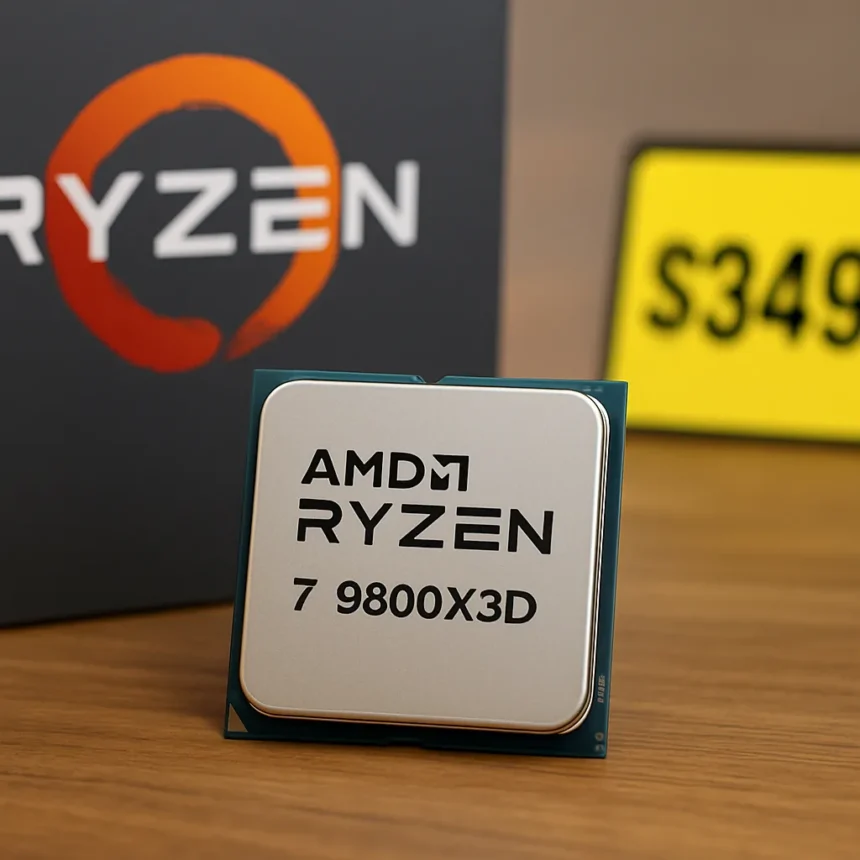
The Ryzen 7 9800X3D is an 8-core, 16-thread Zen 5 desktop processor made by AMD, launched on Socket AM5 with a 120W TDP, a base clock of 4.7 GHz, and a max boost of up to 5.2 GHz, originally priced at $479 MSRP and widely available at major retailers. It has now hit an all-time low of $429, and the timing could not be more pointed — the successor Ryzen 7 9850X3D is set to launch at $499, and the performance gap between the two barely justifies the $70 premium.
What Makes the Ryzen 7 9800X3D the Best Gaming CPU for the Money
The engineering story behind this chip is genuinely impressive. AMD’s 2nd-gen 3D V-Cache technology stacks 64MB of SRAM directly beneath the processor cores, tripling the total L3 cache from 32MB to 96MB and bringing the total cache to 104MB. That enormous cache pool means the processor can feed game data to the cores without constantly waiting on slower system memory — and the real-world result is gaming performance that rivals chips with far more cores and far higher price tags.
One of the more counterintuitive benefits of this architecture is how little it demands from your memory kit. According to AMD, across an average of 30-plus games, the FPS difference between DDR5-4800 and DDR5-6000 is less than one percent. That means buyers do not need to chase expensive high-frequency RAM to get the most out of this chip. A mid-range DDR5 kit is genuinely sufficient, which keeps total build costs in check. AMD EXPO support is present for those who do want memory overclocking, and the chip is unlocked for overclocking via Precision Boost Overdrive.
Ryzen 7 9800X3D vs 9850X3D: Is the Upgrade Worth It?
The Ryzen 7 9850X3D launches on January 29, 2026 at $499, and AMD’s own description of the improvement is telling: it features a 400MHz improvement to the boost clock, making it marginally faster in gaming workloads. That is the headline change. The core count, thread count, cache architecture, and platform are essentially identical. For the vast majority of gamers, that 400MHz difference will not translate into a meaningful real-world experience improvement — certainly not one worth $70 over a chip already at its all-time low.


AMD has claimed the 9850X3D delivers up to an average 27% gaming performance improvement versus the Intel Core Ultra 9 285K, which implies the 9800X3D occupies a similar position of dominance over Intel’s flagship. The 9800X3D was previously considered the fastest gaming CPU available, and while the 9850X3D technically claims that crown now, the gap between the two AMD chips is negligible for gaming purposes.
How the Ryzen 7 9800X3D Compares to the Ryzen 9 9950X3D
At the other end of AMD’s stack sits the Ryzen 9 9950X3D, which adds eight more cores and a higher boost clock for workloads that can actually use them — productivity, content creation, heavy multitasking. For pure gaming, however, the 9950X3D delivers near-identical frame rates to the 9800X3D, and it costs roughly $175 more. A rumored Ryzen 9 9950X3D2 is also in the pipeline, which makes the 9950X3D a harder sell at its current price point. For a dedicated gaming rig, spending that extra $175 on a better GPU or faster storage makes far more sense than chasing marginal CPU gains.



The Ryzen 7 9800X3D sits on Socket AM5, supports PCIe 5.0, and includes integrated AMD Radeon Graphics — useful for troubleshooting or display output without a discrete GPU installed. It pairs optimally with AMD Radeon RX 7000 series graphics cards, and the platform’s AI-ready acceleration features position it for workloads beyond traditional gaming. No cooler is included in the box, so budget for a capable AM5-compatible cooler when planning a build.
Is now a good time to buy the Ryzen 7 9800X3D?
The $429 price represents the all-time low for a new unit, down from an MSRP of $479 and well below the average selling price of $492. Price tracking shows the chip has dipped to around $451.50 on multiple occasions in July 2025, with recent prices sitting at $464 and $469 before this latest drop. The arrival of the 9850X3D at $499 on January 29, 2026 gives retailers a natural reason to clear 9800X3D stock, which is likely to keep downward pressure on pricing in the near term.
Does the Ryzen 7 9800X3D require expensive DDR5 memory?
No. AMD’s own data shows that across more than 30 games, the FPS difference between DDR5-4800 and DDR5-6000 is less than one percent, thanks to the 3D V-Cache architecture. A standard DDR5 kit is sufficient for full gaming performance, making total build costs more manageable than competing platforms that demand high-frequency memory to hit peak speeds.
What socket does the Ryzen 7 9800X3D use?
The Ryzen 7 9800X3D uses AMD’s Socket AM5 platform, which also supports the Ryzen 7 9850X3D and Ryzen 9 9950X3D. This means buyers who purchase a compatible AM5 motherboard today have a clear upgrade path to future AMD processors without needing a new platform.



The Ryzen 7 9800X3D at $429 is the rare deal that is genuinely hard to argue against. The chip that held the gaming CPU crown for most of 2025 is now cheaper than it has ever been, the successor offers almost nothing extra for $70 more, and the platform gives builders a credible upgrade path. Unless you have a specific need for the 9850X3D’s marginal clock speed boost, this is the smarter buy.
Where to Buy
$429.95 for a limited time | Check out this deal on Amazon | AMD Ryzen 7 9800X3D: | Ryzen 7 9800X3D at just $429
Edited by the All Things Geek team.
Source: Tom's Hardware