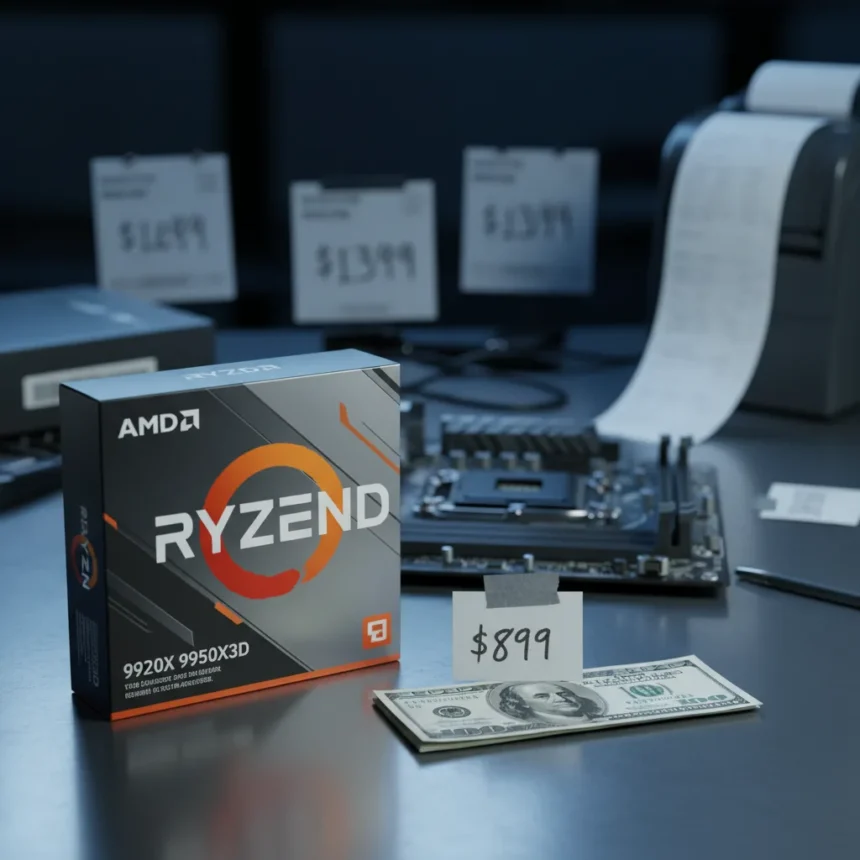
The Ryzen 9 9950X3D2 pricing story reveals a widening gap between AMD’s official claims and what buyers will actually encounter at checkout. AMD officially announced the Ryzen 9 9950X3D2 at $899 USD MSRP, launching April 22, 2026, positioning it as the world’s first dual-cache X3D processor with 3D V-Cache technology on both core chiplets. Yet early retail listings across Canada and the UK already hint at prices approaching $1,000 or higher, raising questions about whether the $899 tag will survive contact with real-world markets.
Key Takeaways
- AMD’s official Ryzen 9 9950X3D2 pricing is $899 MSRP, launching April 22, 2026
- Early Canadian retailers list the chip at CAD $1,373-$1,375 (~$985-$987 USD equivalent)
- UK listings range from £679 to £905 (~$847-$1,200 USD), including VAT variations
- The Ryzen 9 9950X3D2 costs $200 more than the predecessor 9950X3D’s $699 launch MSRP
- Dual 3D V-Cache delivers 192 MB L3 cache but demands a 200W TDP, 30W higher than the original
What makes Ryzen 9 9950X3D2 pricing controversial
AMD’s $899 official price for the Ryzen 9 9950X3D2 represents a straightforward $200 premium over the Ryzen 9 9950X3D, which launched at $699. That 29 percent increase reflects genuine architectural differences—the 9950X3D2 packs 192 MB of L3 cache across dual core chiplets, versus 128 MB on the single-cache original. But the real pricing controversy emerges when you examine what retailers are actually charging. PC-Canada.com and ShopBRC.com both list the chip at CAD $1,373-$1,375, which converts to roughly $985-$987 USD at current exchange rates. That is not $899. That is closer to $1,000.
Early UK listings compound the confusion. GamingKit prices the Ryzen 9 9950X3D2 at £905.82 including VAT, which translates to approximately $1,197 USD with tax included, or £725.54 (~$960 USD) without VAT. Other UK retailers hover between £679 and £905, creating a pricing band that spans nearly $350 depending on retailer and tax treatment. This is the classic pattern for high-end CPUs at launch—MSRP is aspirational, retail reality is harsher.
Ryzen 9 9950X3D2 specifications justify the cost, but not the gap
The Ryzen 9 9950X3D2 arrives with 16 cores, 32 threads, a base clock of 4.3 GHz, and a maximum boost clock of 5.6 GHz across TSMC 4nm FinFET cores. That 5.6 GHz ceiling is 100 MHz lower than the original 9950X3D’s 5.7 GHz peak, a minor concession to power delivery. The real story is cache: 192 MB of L3 cache spread across both core chiplets, versus 128 MB on the predecessor. Dual 3D V-Cache is genuinely novel—no other consumer CPU offers this architecture—and AMD markets it explicitly for gaming, productivity, development, and creative workloads.


But there is a trade-off. The Ryzen 9 9950X3D2 demands 200W TDP, a 30W jump from the 9950X3D’s 170W. That means higher power bills, more demanding cooling, and less headroom for overclocking on mid-range boards. You are paying $200 more for more cache, but also accepting higher thermal demands. Whether that exchange is worth it depends entirely on your workload—gaming benefits from cache, but productivity tasks may see diminishing returns.
How Ryzen 9 9950X3D2 compares to the original 9950X3D
The Ryzen 9 9950X3D2 is a direct successor, not a lateral refresh. The original Ryzen 9 9950X3D launched at $699 with a single core chiplet featuring 3D V-Cache, delivering 128 MB of L3 cache and a 5.7 GHz max boost. The 9950X3D2 doubles the cache footprint to 192 MB by placing 3D V-Cache on both core chiplets, a first for any consumer processor. This architectural leap does not come cheap: you are looking at a $200 MSRP premium, or a $286-$498 real-world premium depending on your region.



The performance delta is harder to predict without independent benchmarks. More L3 cache typically improves gaming frame rates and reduces latency in memory-bound tasks, but 64 MB of additional cache yields diminishing returns past a certain point. The 100 MHz lower boost clock on the 9950X3D2 may offset some cache gains in single-threaded scenarios. Ultimately, the 9950X3D2 is the flagship choice for buyers who demand maximum cache and do not mind the power penalty, while the 9950X3D remains the smarter value play for most gamers and creators.
Should you wait for Ryzen 9 9950X3D2 pricing to stabilize?
Yes. The gap between AMD’s $899 MSRP and early retail listings near $1,000 suggests supply constraints or regional markup practices that typically ease within 4-6 weeks of launch. Canadian and UK retailers may be pricing defensively due to limited stock, expecting demand to exceed supply at MSRP. By late May or early June 2026, after the April 22 launch, prices should drift closer to the official $899 target as supply normalizes. If you are building a system now, waiting two months could save you $100-$200, depending on your region.
That said, MSRP rarely holds for ultra-premium chips. The Ryzen 9 9950X3D itself has appreciated in value since its $699 launch, with current pricing around €685-€769 in Europe—roughly 5-10 percent above launch. Do not expect the 9950X3D2 to trade at $899 forever. If the chip delivers the gaming and productivity performance AMD claims, demand will sustain prices near $950-$1,000 indefinitely.
Is Ryzen 9 9950X3D2 pricing worth the $200 premium over the original?
That depends on your use case. If you are a competitive gamer chasing frame rates in CPU-limited scenarios, the extra 64 MB of L3 cache could mean 5-15 additional frames per second in certain titles—worth the premium if you are already spending $2,000-plus on a high-end system. If you are a 3D artist, video editor, or developer working with large datasets, the dual-cache architecture may reduce memory latency and speed up rendering or compilation. But if you play esports titles, stream, or use productivity software that does not stress memory bandwidth, the 9950X3D remains the smarter buy at $699.



The power penalty matters too. A 30W TDP increase means higher electricity costs over the chip’s lifespan, plus more demanding cooling requirements. Budget an extra $50-$100 for a robust tower cooler if you do not already own one. Factor that into your total cost of ownership.
Will Ryzen 9 9950X3D2 pricing drop after launch?
Historically, flagship CPUs see modest discounts 2-3 months post-launch, typically 5-10 percent off MSRP. The Ryzen 9 9950X3D2 is likely to follow that pattern—expect $799-$849 street prices by summer 2026 if supply stabilizes and newer competition emerges. However, if the chip performs as advertised for gaming and creative work, demand may sustain prices near MSRP or higher, especially in regions with limited availability.
The Ryzen 9 9950X3D2 pricing story is ultimately about patience and regional variation. AMD’s $899 MSRP is real, but it is a starting point, not a guarantee. Early adopters in Canada and the UK are paying a 10-25 percent premium over MSRP, a tax on being first. If you can wait until May or June 2026, you will likely find better deals. If you need the chip now, budget for $950-$1,000 and accept that early-mover pricing always carries a premium in the high-end CPU market.
Where to Buy
Ryzen 9 9950X | Ryzen 9 9900X | Ryzen 7 9700X
Edited by the All Things Geek team.
Source: Tom's Hardware