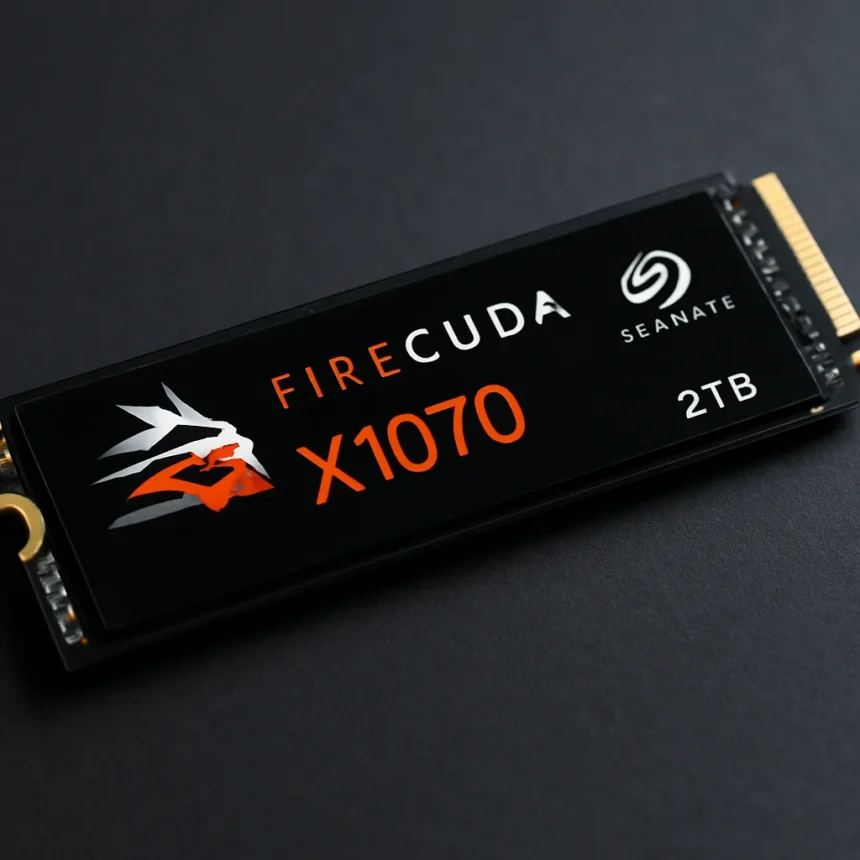
The Seagate FireCuda X1070 2TB SSD marks the company’s return to the consumer M.2 storage market after a lengthy hiatus, positioning itself as an entry-level PCIe Gen4 option built for handheld gaming and everyday PC use. It’s a calculated retreat from premium performance in favor of lower thermals, reduced power consumption, and bundled services—a bet that gamers and general users care more about convenience than raw speed.
Key Takeaways
- PCIe Gen4 x4 interface compatible with any modern gaming PC or handheld device like the ROG Ally
- 1,200 TBW endurance for the 2TB model, half the 530R predecessor’s 2,400 TBW rating
- Includes 5-year warranty, 3-year Rescue Data Recovery Services, and trial bundles for Xbox Game Pass and Adobe Creative Cloud
- Sequential read speeds 500–800 MB/s slower than the FireCuda 530R
- Over 40% lower power draw than predecessor, improving thermal performance
Seagate FireCuda X1070 specs and design
The Seagate FireCuda X1070 2TB SSD is a budget-oriented M.2 2280 drive with PCIe Gen4 x4 connectivity, designed for seamless booting, gaming, and multitasking on PCs and handheld systems. The drive’s real strength lies not in its performance envelope but in its power efficiency—it consumes over 40% less power than the FireCuda 530R, a meaningful advantage for thermal-constrained devices like portable gaming handhelds.
Seagate bundles the drive with substantial software perks: a 3-year Rescue Data Recovery Services subscription, a 1-month Xbox Game Pass Ultimate trial, and a 2-month Adobe Creative Cloud Pro trial. The 5-year parts-and-labor warranty is solid for an entry-level drive, though the endurance rating tells a different story. At 1,200 TBW for the 2TB variant, it’s rated for half the write cycles of the FireCuda 530R, which specified 2,400 TBW.
Performance: Solid for everyday use, not for power users
The FireCuda X1070 delivers respectable random performance where it matters most for gaming—900,000 read IOPS and 1,000,000 write IOPS for the 2TB model, making it competitive in random writes. Sequential speeds, however, lag behind its predecessor. The 530R achieved sequential reads up to 7,800 MB/s and writes at 7,400 MB/s; the X1070 trails by 500–800 MB/s on reads, a noticeable gap for file transfers and content creation.


For general gaming, web browsing, and office work, these speeds are more than adequate. Load times on modern games won’t suffer meaningfully, and boot performance remains snappy. But anyone considering this drive for video editing, large file transfers, or sustained creative workloads should look elsewhere—or accept that rendering and export times will creep longer than with a 530R or a PCIe Gen5 drive.
How the FireCuda X1070 compares to its predecessor
The FireCuda 530R remains available at roughly $170, and the comparison is instructive. The 530R delivers higher sequential speeds, double the endurance, and sits in Seagate’s high-end PCIe 4.0 tier. The X1070 is a step down—cheaper upfront, but with compromised longevity and throughput. This is not a refresh or an upgrade; it’s a deliberate market segmentation play. Seagate is targeting buyers who prioritize thermal efficiency and bundled software over peak performance, particularly those using handheld gaming devices where power and heat matter as much as speed.



PCIe Gen5 drives have also begun entering the sub-$300 range on discounts, which raises the question: is an entry-level Gen4 drive the right choice in 2026? For handheld gaming specifically, yes—Gen5 support remains scarce on ROG Ally and similar devices. For PC gamers with Gen5-capable motherboards, the calculus shifts.
Premium support and bundled software
Seagate’s real differentiator here is the services package. The 3-year Rescue Data Recovery Services subscription is genuine value—professional data recovery is expensive, and having it pre-included removes a financial risk. The Xbox Game Pass trial and Adobe Creative Cloud trial sweeten the deal for casual gamers and creative hobbyists, though they are time-limited carrots.
The 5-year warranty is competitive. Combined with the recovery services, Seagate is signaling that it stands behind the drive’s reliability even if the endurance spec is lower. Whether this trust is warranted depends on real-world failure rates, which won’t be clear for months.
Is the FireCuda X1070 worth buying?
The Seagate FireCuda X1070 2TB SSD makes sense for handheld gaming enthusiasts and budget-conscious PC users who value thermal efficiency and included services over maximum speed. If you own a ROG Ally or similar handheld and want a fast, cool-running Gen4 drive, this is a reasonable choice. If you’re building a high-performance gaming PC or workstation, the FireCuda 530R remains a better value despite higher cost, and PCIe Gen5 options are becoming more affordable.



Initial pricing is reported as high, and temporary stock shortages have plagued early availability. Wait for prices to stabilize and stock to normalize before committing.
What storage capacity options does the Seagate FireCuda X1070 come in?
The research brief confirms the 2TB capacity (model ZP2000GS3A001). Capacity options beyond 2TB are not detailed in available sources, so check Seagate’s official product page or authorized retailers for current SKU availability.
How does the FireCuda X1070 perform in random access workloads?
The 2TB FireCuda X1070 achieves 900,000 read IOPS and 1,000,000 write IOPS, placing it among the stronger performers for random writes in the entry-level Gen4 segment. This makes it suitable for gaming and multitasking, where random I/O patterns dominate.
Should I buy the FireCuda X1070 or wait for prices to drop?
Early pricing is steep and stock is limited as of early 2026. If you need storage immediately and plan to use a handheld gaming device, the bundle value and warranty justify purchase. Otherwise, waiting for street prices to settle and supply to normalize is prudent.
Seagate’s return to consumer M.2 storage is pragmatic, not ambitious. The FireCuda X1070 doesn’t redefine the segment—it occupies a specific niche where thermal efficiency and bundled services matter more than speed. For that niche, it delivers. For everyone else, the market has faster and cheaper alternatives.
Edited by the All Things Geek team.
Source: Tom's Hardware