






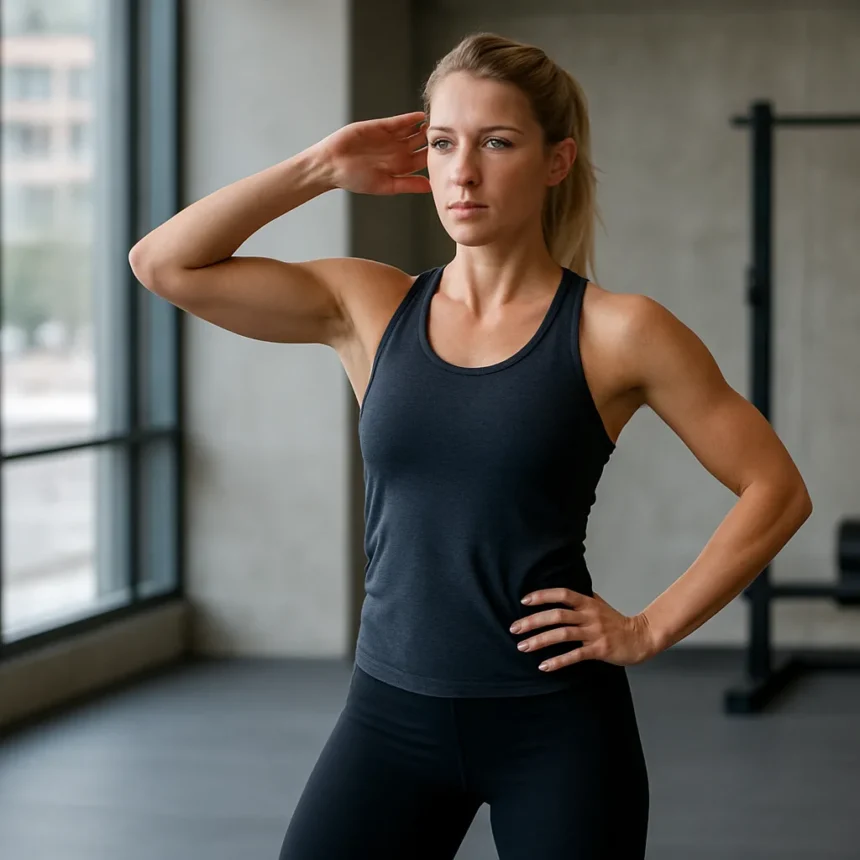
Standing ab exercises are movements performed upright that engage your core muscles for stability and strength without requiring floor work. Unlike traditional sit-ups and planks, these exercises reduce strain on your neck, lower back, and wrists while building functional core power. A growing number of fitness professionals now recommend standing variations as superior alternatives for developing deep abdominal strength and hip stability.
Key Takeaways
- Standing ab exercises eliminate neck and back strain compared to sit-ups and planks
- Core engagement cue: draw belly button toward spine and brace like laughing
- Standing side crunch and Pallof press are effective starting points
- Standing movements improve balance, energy transfer, and compound calorie burn
- Cyclists who performed 6-week core routines showed measurable speed improvements
Why standing ab exercises outperform floor work
Floor-based core work like sit-ups and planks creates unnecessary pressure on your cervical spine, wrists, and lower back. Standing ab exercises eliminate these contact points while forcing your stabilizer muscles to work harder. Because you’re upright, your body must continuously engage your core to prevent your pelvis and torso from rotating or tilting—a demand that floor exercises sidestep. This unilateral stability requirement makes standing variations harder and more functional for real-world movement.
The standing side crunch exemplifies this principle. Stand tall with fingertips behind your ears and elbows wide, core engaged. Draw your right knee up and out while crunching your right elbow toward it, then return to standing. Perform 20 repetitions per side. Unlike a traditional crunch, this movement forces your hip stabilizers and obliques to coordinate, building the kind of integrated strength that transfers to sports, daily activities, and injury prevention.
How to properly engage your core for standing ab work
Correct core bracing is non-negotiable for standing ab exercises. Draw your belly button inward toward your spine without holding your breath. Avoid rib flare—your ribs should stay stacked over your pelvis. Think of bracing your midsection the way you would if someone were about to laugh at you; that natural tension is what you’re after. Maintain this engagement throughout every repetition.


This cue matters because sloppy form shifts the workload away from your abs and onto your hip flexors and lower back. Many people perform standing ab exercises with a relaxed core, which defeats the purpose. Before adding any movement, practice standing tall with proper bracing for 30 seconds. Once that feels automatic, layer in the exercise.
Standing ab exercises vs. traditional core training
The Pallof press is one of the most effective standing ab variations for advanced practitioners. Anchor a resistance band to a fixed object at chest height. Stand perpendicular to the anchor point, grab both handles with your arms straight out in front of you, and engage your core. Rotate your torso toward the anchor, then resist the band’s pull by rotating back using your core muscles while keeping your hips completely stable. Perform 10 to 12 repetitions per side. This anti-rotation movement specifically targets deep stabilizer muscles that sit-ups ignore entirely.



Standing ab exercises also burn more calories than their floor-based equivalents because they recruit larger muscle groups. A standing side crunch engages your obliques, hip stabilizers, and glutes simultaneously, whereas a traditional crunch isolates the rectus abdominis in isolation. This compound effect means better energy expenditure and functional strength carryover.
Real-world benefits beyond aesthetics
Core stability does more than create visible abdominal definition. A stable core improves energy transfer during athletic movement, protects your spine from injury, and enhances balance. One study tracked 30 male cyclists who performed a dedicated 6-week core routine; the group showed significant improvements in ride speed compared to a control group. This demonstrates that standing ab work delivers measurable performance gains, not just theoretical benefits.
Standing ab exercises also reduce injury risk during compound movements like squats and deadlifts. A braced, stable core prevents excessive spinal flexion and rotation under load. For runners, cyclists, and strength athletes, this translates to fewer nagging injuries and longer training consistency.
Adding standing ab exercises to your routine
You can perform standing ab exercises with minimal equipment. A resistance band, dumbbell, or medicine ball enhances difficulty, but bodyweight versions work well for beginners. Start with the standing side crunch for 3 sets of 15 to 20 reps per side, performed twice weekly on non-consecutive days. Once that feels easy, progress to the Pallof press or standing banded knee drives, which require greater stability and core engagement.



Standing ab exercises integrate smoothly into existing workouts. Perform them after your main strength session when your nervous system is primed but your energy is still high. Avoid placing them before heavy compound lifts, as fatigue in your stabilizers can compromise your form on squats or deadlifts.
Are standing ab exercises safe for beginners?
Yes, standing ab exercises are generally safer for beginners than sit-ups or planks, provided you maintain proper form and core engagement. If you have balance issues or are returning from injury, use a chair or wall for light support during single-leg variations like standing knee drives. Always consult a qualified fitness professional before starting any new exercise program, especially if you are recovering from back pain or injury.
How long before you see results from standing ab exercises?
Core strength improvements typically become noticeable within 2 to 3 weeks of consistent training. Visible abdominal definition depends on diet and overall body composition, not exercise selection alone. Focus on progressive overload—adding reps, sets, or resistance—to maintain results over time.
Can standing ab exercises replace sit-ups entirely?
Yes. Standing ab exercises deliver superior core engagement and functional strength without the joint stress of sit-ups. They also improve hip stability and balance, benefits that traditional crunches do not address. For most fitness goals, standing variations are the smarter choice.
Standing ab exercises represent a meaningful shift in how fitness professionals approach core training. By eliminating floor contact and demanding continuous stabilization, these movements build stronger, more resilient cores than sit-ups or planks ever could. If you have been grinding out crunches for years with minimal results, switching to standing variations might be exactly the reset your core training needs.
Edited by the All Things Geek team.
Source: Tom's Guide




