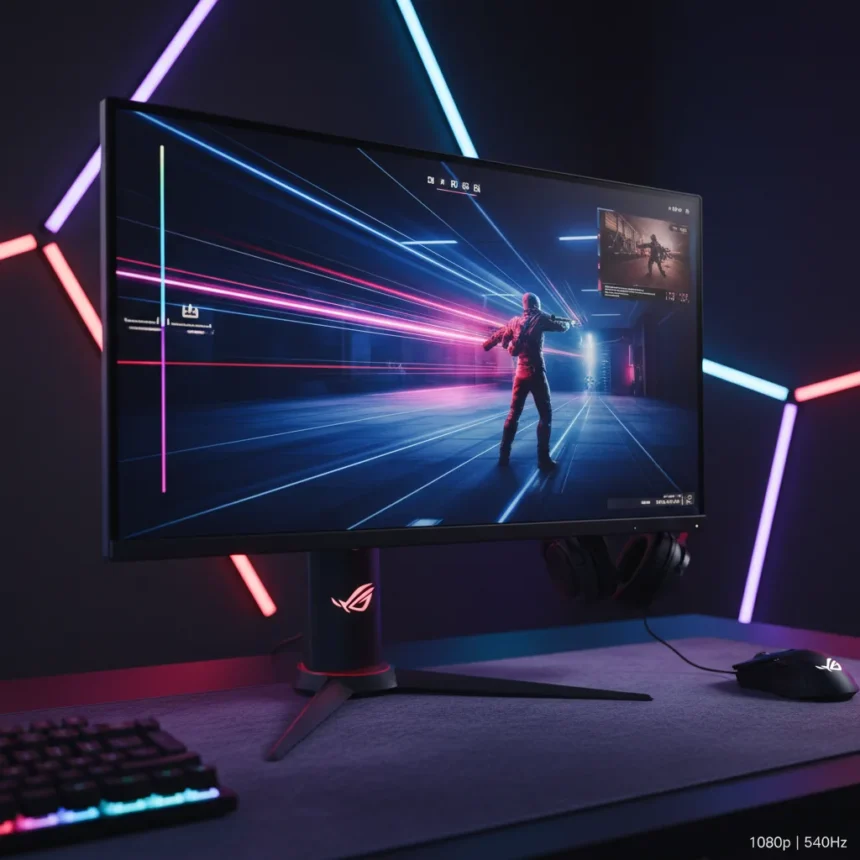
Asus’ new OLED esports monitor represents a significant shift in competitive gaming displays. The company has unveiled four fresh ROG monitors, with three featuring OLED panels and one using Fast IPS, marking an aggressive push into high-refresh OLED territory. The headline product—a world-first OLED esports monitor—can reach 540Hz at 1080p, a refresh rate previously dominated by TN and IPS technology.
Key Takeaways
- Asus launched four new ROG monitors with three using OLED and one using Fast IPS technology.
- The flagship OLED esports monitor achieves 540Hz at 1080p, a first for OLED displays.
- Asus already offers OLED monitors reaching 480Hz at 1080p and 240Hz at 4K.
- OLED esports monitors deliver lower input lag than comparable 540Hz IPS models.
- The ROG Strix OLED model is among the four new offerings in this lineup.
Why OLED esports monitor technology matters now
For years, extreme refresh rates—anything above 360Hz—belonged exclusively to TN and IPS panels. OLED technology, with its superior contrast and response times, arrived too late to the high-refresh party, relegated mostly to 240Hz and lower. This new OLED esports monitor shatters that ceiling. Reaching 540Hz at 1080p means competitive players can finally access OLED’s legendary input lag advantages without sacrificing the extreme refresh rates demanded by fast-paced titles like Counter-Strike 2 or Valorant.
The timing matters. Gaming monitors have become a performance arms race, and OLED’s transition from niche luxury to mainstream competitive tool is accelerating. Asus already ships OLED monitors with 480Hz at 1080p and 240Hz at 4K options, proving the company has solved the engineering challenges that long kept OLED out of the esports space. This new 540Hz model is the logical next step.
How this OLED esports monitor compares to existing ROG displays
Asus’ existing lineup already includes serious OLED competitors. The ROG Strix XG27AQDPG delivers 500Hz at 2560 x 1440 on a 27-inch QD-OLED panel, while the ROG Swift PG27AQDP offers 480Hz at the same resolution. The ROG Swift OLED PG32UCDP supports 240Hz at 4K or 480Hz at 1080p, and , it can match the draw times of 540Hz IPS monitors while delivering dramatically less input lag. The new 540Hz OLED esports monitor extends this advantage into the absolute upper tier of refresh rates.


What separates OLED from Fast IPS at these extreme speeds is responsiveness. Where a 540Hz IPS monitor excels in raw refresh cadence, OLED’s instant pixel transitions mean competitive players experience lower latency between input and on-screen response. For esports titles where milliseconds determine outcomes, that difference translates directly to advantage.
What Asus’ four-monitor announcement signals
Launching four monitors simultaneously—three with OLED, one with IPS—tells a clear story: Asus is hedging its bets while pushing OLED forward. The Fast IPS option ensures competitive gamers who demand proven technology still have a choice, but the overwhelming focus on OLED signals where the company believes the market is heading. Three OLED models out of four is not a cautious move; it is a conviction play.



This strategy reflects broader industry momentum. OLED gaming monitors, once considered experimental, are becoming the default for players who can afford them. By offering multiple OLED options at different resolutions and refresh rates—from 240Hz at 4K down to 480Hz and 540Hz at 1080p—Asus is building a complete OLED ecosystem for esports and content creators alike.
Is the OLED esports monitor worth the premium?
OLED displays cost more than IPS alternatives. The question for competitive players is whether 540Hz OLED justifies that premium over a traditional 540Hz IPS monitor. The answer depends on priorities. If input lag and visual clarity matter more than absolute refresh rate, OLED wins decisively. If a player is already comfortable with IPS response times and wants maximum frame cadence at minimum cost, the Fast IPS option in Asus’ new lineup remains valid. For esports professionals and streamers, though, the OLED esports monitor’s combination of speed and responsiveness likely tips the scales.
When can you buy these monitors?
Asus has not yet disclosed specific launch dates, pricing, or regional availability for the four new ROG monitors in this announcement. Interested buyers should monitor Asus’ official ROG channels for availability details and configuration options.
What makes 540Hz OLED different from 480Hz OLED?
The jump from 480Hz to 540Hz represents incremental but meaningful gains in frame delivery speed. At 1080p, 540Hz provides slightly tighter frame pacing for competitive shooters, though the real-world advantage depends on whether your GPU can consistently push 540 frames per second. Most players will see the biggest benefit in reduced frame variance rather than raw speed alone.


Can OLED monitors handle 540Hz without burn-in risk?
Modern OLED panels, especially those designed for gaming, include burn-in mitigation features that address static-image concerns. Asus’ existing OLED monitor lineup has proven durable in competitive and content-creation environments. The new 540Hz OLED esports monitor inherits these protections, though any OLED display benefits from periodic screen rotation and avoiding permanently static UI elements.
Asus’ four-monitor announcement marks a turning point for OLED in esports. The 540Hz OLED esports monitor is not just a spec bump—it is a statement that OLED technology has matured enough to compete head-to-head with IPS in the highest-refresh-rate segment, while delivering the responsiveness advantages that define modern competitive gaming. For players who have waited for OLED to reach peak performance, that moment has arrived.
Edited by the All Things Geek team.
Source: Tom's Hardware