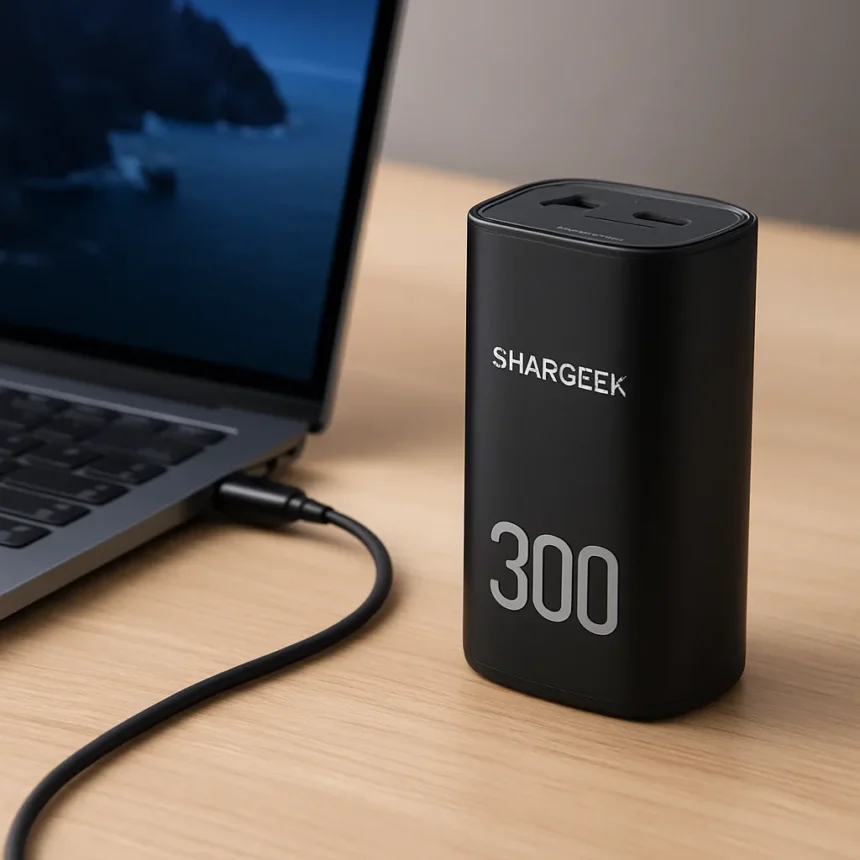
The Shargeek 300 power bank is a 24,000mAh (86.4Wh) portable charger that delivers 300W total output—280W of which flows through dual USB-C ports simultaneously—in a form factor barely larger than a soda can. Launched via Kickstarter and reviewed in early 2026, it challenges the assumption that serious power delivery requires serious bulk. The device uses Full-Tab Battery Cell technology, the same heat-dissipation architecture Tesla employs in its vehicles, to pack this much output without thermal disasters.
Key Takeaways
- 300W total output with 280W dual-port capability (140W per USB-C simultaneously)
- 86.4Wh capacity is airline-safe; charges from 0–50% in 20 minutes with 140W input
- 1.9-inch IPS display shows real-time wattage, temperature, charge cycles, and voltage per cell
- Compact soda-can size with transparent aluminum body and dual RGB light bars
- Measured real capacity lower than some competitors; USB-A 20W output unverified in testing
Three Features That Justify the Hype
The Shargeek 300 power bank succeeds where most competitors fail: it lets you charge two power-hungry devices at full speed simultaneously. The dual USB-C ports each deliver 140W via PD 3.1 (up to 28V/5A), meaning you can fuel two 16-inch MacBook Pros at maximum wattage while still fast-charging a smartphone at 20W through the USB-A port. That is not marketing copy—reviewers have verified the 300W output in real-world testing.
Second, the 1.9-inch IPS smart display eliminates the guesswork. Unlike power banks that hide their behavior behind a row of LED dots, the Shargeek 300 shows input and output wattage in real time, battery temperature, remaining capacity, charging curves, cycle count, and even voltage per individual cell. Three physical buttons let you customize the recharge threshold, DC barrel voltage, and boot-up messages. This transparency matters when you are debugging why a charger is slow or why a device is not charging at expected wattage.
Third, the DC barrel port (5525 connector, 25–140W adjustable, two-way) transforms the device from a phone charger into a universal power solution. Route 140W to a laptop, monitor, or router without touching USB-C. This flexibility is why the Shargeek 300 power bank outperforms ordinary power banks for gaming laptops, drones, and DSLRs—devices that demand non-standard connectors.


Real-World Performance and Quirks
Charge speed is genuinely fast. The Shargeek 300 power bank reaches 50% capacity in 20 minutes and full charge in 75 minutes when fed 140W input from a PD 3.1 charger. That requires a compatible EPR cable and charger—not every 100W USB-C brick will cut it—but the speed justifies the requirement. The transparent aluminum alloy body with 180-grit sandblasting and anodizing feels premium, and dual RGB light bars add customizable visual feedback without gimmickry.
The battery holds over 90% charge after 15 days of storage, and a low-current mode helps charge small devices like wireless earbuds without triggering safety cutoffs. The Shargeek 300 power bank also includes a 1.9-inch display that is 2.5 times larger than the Shargeek 100, making real-time monitoring actually usable rather than squinting at tiny text.



However, measured real capacity came in lower than some competitors. Testing revealed the device does not quite match the capacity of the Shargeek 100 (93.5Wh) or certain Anker models (99.54Wh), though the Shargeek 300 power bank still delivers the advertised 300W output. Additionally, the USB-A port’s claimed 20W output (12V/1.67A) could not be replicated in testing, so do not rely on that port for high-speed charging of large devices.
Shargeek 300 vs. Alternatives
The Shargeek 300 power bank occupies a unique niche. It outperforms ordinary 25,000–26,000mAh power banks in output flexibility because of the DC barrel port and verified 300W total delivery. Compared to the author’s previous UGREEN power bank, the Shargeek 300 power bank offers superior wattage and the smart display that UGREEN lacks. For users who need to charge a laptop and a phone simultaneously at maximum speed, the dual 140W USB-C architecture makes this the practical choice.
The trade-off is size and learning curve. The Shargeek 300 power bank is larger than a typical 20,000mAh stick, though still pocketable compared to a laptop charger. The display and menu system require a few minutes to understand, but that transparency is also the point—you are trading simplicity for control.
Is the Shargeek 300 Worth the Investment?
The Shargeek 300 power bank makes sense if you regularly charge two power-hungry devices or need non-standard power delivery (via the DC barrel). If you charge only a phone and occasionally a tablet, a lighter 10,000–20,000mAh power bank remains a better fit. But for creative professionals, remote workers, and anyone who travels with a gaming laptop and smartphone, the Shargeek 300 power bank removes a charging bottleneck that has plagued portable power for years. The verified 300W output, dual simultaneous 140W delivery, and transparent display justify the premium over generic alternatives.



What makes the Shargeek 300 power bank different from other 24,000mAh options?
The Shargeek 300 power bank is the first to deliver 300W total output with 280W dual-port simultaneous delivery (140W per USB-C). Most competitors max out at 140W total or force you to choose between ports. The smart display and DC barrel port add versatility ordinary power banks do not offer.
How long does the Shargeek 300 power bank take to recharge?
The Shargeek 300 power bank reaches 50% capacity in 20 minutes and full charge in 75 minutes when supplied 140W input via PD 3.1. Slower chargers will extend these times proportionally.
Can the Shargeek 300 power bank charge a MacBook Pro and iPhone simultaneously?
Yes. You can route 140W to a 16-inch MacBook Pro via one USB-C port, 140W to another laptop via the second USB-C port, and 20W to an iPhone via USB-A, all at the same time. This simultaneous multi-device charging is the core strength of the Shargeek 300 power bank.
The Shargeek 300 power bank does not reinvent portable charging—it simply executes what users have wanted for years: enough wattage to charge multiple devices fast, in a size you can actually carry, with visibility into what is happening inside. That combination is rare enough to matter.
Edited by the All Things Geek team.
Source: Android Central