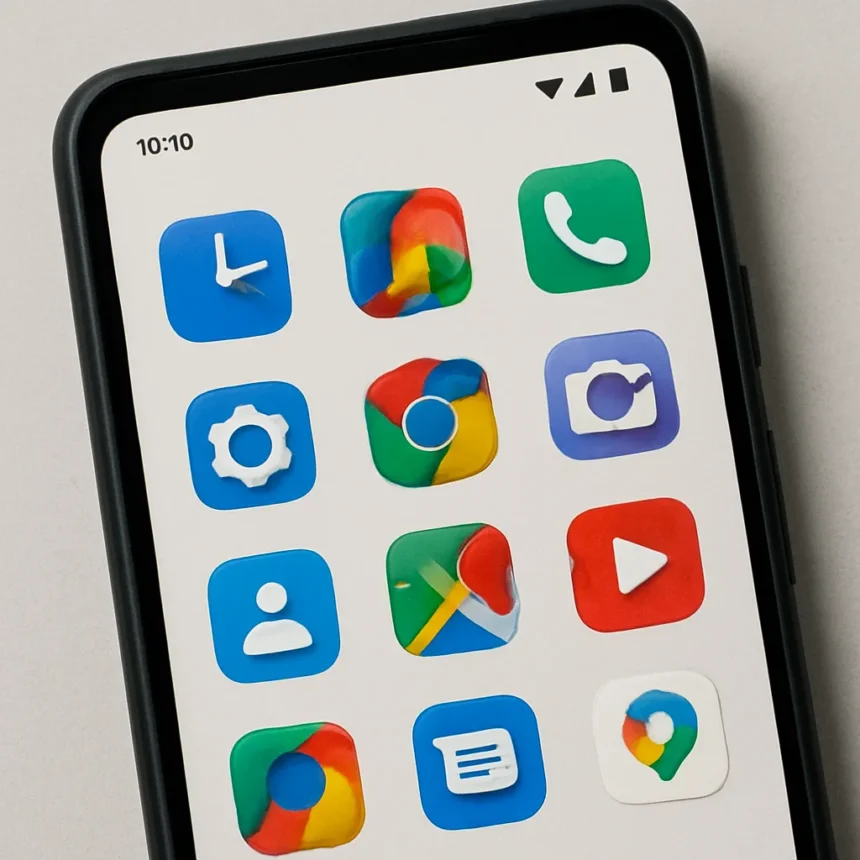
Google’s AI-generated app icons for Pixel phones represent a genuinely interesting approach to personalization, but after testing the feature, it becomes clear that the execution falls short of the promise. The AI-generated app icons feature, rolling out as part of Google’s March 2026 Pixel Drop update, allows users to create custom icons powered by artificial intelligence. The problem is not the concept—it is how Google has chosen to implement it.
Key Takeaways
- AI-generated app icons are now available on Pixel phones through the March 2026 Pixel Drop update
- The feature uses artificial intelligence to create custom icons but applies strict limitations
- Google restricts AI icon generation to its own ecosystem, limiting third-party app customization
- The implementation undermines Android’s core strength: genuine user choice and flexibility
- Personalization on Pixel phones now feels more controlled than customizable
What the AI-generated app icons feature actually does
Google’s AI-generated app icons let Pixel users create custom icons for their home screens using generative AI. The feature integrates into the native Pixel launcher and allows users to generate multiple icon variations based on prompts or themes they choose. It sounds like a genuine innovation—a way to make Android phones feel truly personal without relying on third-party icon packs or manual design work. But the reality is far more restrictive than the marketing suggests.
The core limitation is stark: Google has locked AI icon generation exclusively to its own apps and a limited set of preapproved applications. This means you cannot use the AI feature to generate custom icons for most of your installed apps. If you want personalized icons for Spotify, Discord, or other third-party applications, you are out of luck. You get the AI feature or nothing—Google does not allow you to fall back to traditional icon pack customization for unsupported apps.
Why this breaks Android’s promise of personalization
Android has always positioned itself as the customizable alternative to iOS. Users can install custom launchers, icon packs, and themes without restriction. That flexibility is supposed to be Android’s defining strength. Google’s AI-generated app icons undermine that philosophy entirely. Rather than expanding personalization options, the feature narrows them by gatekeeping AI-generated icons behind Google’s own ecosystem.


The contradiction is particularly frustrating because Google is not preventing third-party developers from building AI icon generation tools—the company is simply refusing to let those tools work with the Pixel launcher in the same way. Users who want AI-generated icons for apps beyond Google’s approved list have no official path forward. They cannot use the native feature, and they cannot easily substitute an alternative solution. This is not personalization. This is controlled customization masquerading as innovation.
Compare this to how Android handles other customization features. Wallpapers, widgets, and launchers are all open ecosystems where third-party developers compete and innovate freely. Users get to choose which solution works best for their needs. AI-generated app icons should follow the same pattern, but instead, Google has created a walled garden.



The practical impact on daily use
In practice, the AI-generated app icons feature creates an inconsistent home screen experience. Some of your apps will have beautiful, personalized AI-generated icons. Others will display their default icons because Google has not approved them for AI customization. This visual inconsistency defeats the purpose of personalization—instead of a cohesive, custom-designed home screen, you end up with a patchwork that highlights what Google allows versus what it does not.
Users who want a truly unified icon aesthetic are forced to choose: use the AI feature and accept the inconsistency, or abandon it entirely and fall back to traditional icon packs that work across all apps. Neither option is satisfying. The AI feature should enhance customization, not replace it with a more limited alternative.
What Google should have done instead
A better implementation would have opened AI icon generation to third-party developers and launchers. Let developers build competing AI icon tools. Let users choose which service generates their icons. Let the Pixel launcher support multiple icon sources—AI-generated, traditional packs, and custom designs—all in the same home screen. This would be true personalization. It would be Android as it should work.
Instead, Google has chosen control. The company gets to decide which apps are worthy of AI customization. Users get to accept Google’s choices or go without. That is not innovation—it is limitation dressed up as a feature.



How does AI-generated app icons compare to traditional icon packs?
Traditional icon packs offer broad app support and consistent visual styles across hundreds of applications. AI-generated icons provide unlimited variation and personalization but only for Google’s approved apps. Icon packs work everywhere on Android; AI icons work only on Pixel devices with the latest update. For most users, traditional icon packs remain the more practical choice.
Can you use AI-generated icons with third-party launchers?
The AI-generated app icons feature is locked to the Pixel launcher and does not extend to third-party launchers like Nova or Microsoft Launcher. This further limits the feature’s usefulness for users who prefer alternative launcher experiences. You cannot take your AI-generated icons and use them in a different launcher environment.
Will Google expand AI icon generation to more apps?
Google has not announced plans to expand the approved app list beyond its current ecosystem. The company’s approach suggests that this is a deliberate strategy to keep the feature within its own services. Users hoping for broader support should not hold their breath.
Google’s AI-generated app icons are a missed opportunity. The technology is interesting, but the implementation is too restrictive to justify the hype. Pixel phones deserve better—and so do Android users who want genuine personalization without gatekeeping.
Edited by the All Things Geek team.
Source: Tom's Guide