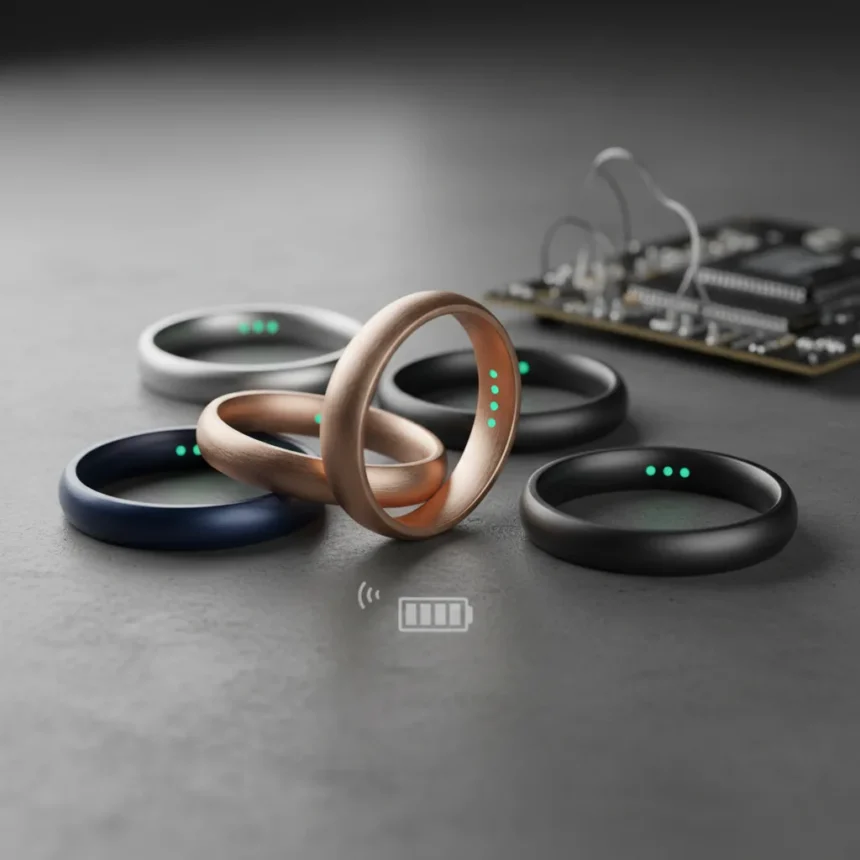
Oura Ring 5 leaks have surfaced ahead of an expected late-2027 launch, revealing a sleeker, more curved outer shell that finally looks less like a tech gadget and more like an actual ring. The design shift matters because Oura’s current Ring 4 is thicker, wider, and heavier than competitors like RingConn Gen 2 without delivering superior battery life to justify the bulk. If these leaks are accurate, Oura is finally listening to the form-factor complaint that has dogged its flagship since launch.
Key Takeaways
- Oura Ring 5 features a sleeker, more curved design compared to the flatter Ring 4, with new color options including Deep Rose, matte black (Stealth), gold, and silver
- Expected late-2027 launch, though FCC filings suggest a possible September release date
- Ring 4 battery lasts 5-7 days depending on size; Ring 5 expected to match or improve efficiency
- Upgraded health sensors may include atrial fibrillation detection, ECG, and potential smart glasses integration
- RingConn Gen 2 offers 10-12 days of battery life, setting a competitive benchmark Oura must meet
Oura Ring 5 Design and Color Upgrades
The leaked design shows Oura Ring 5 adopting a more traditional ring aesthetic with a curved exterior, a significant departure from the Ring 4’s flatter, more angular profile. New finishes include Deep Rose (a bronze-like tone replacing the previous Rose Gold), matte black (possibly branded as Stealth), gold, and silver, with options for both glossy and brushed textures. This is not just cosmetic—the thinner profile addresses a real usability complaint from Ring 4 owners, particularly women, who found the device too prominent for daily wear.
The color expansion matters in the wearable space where personalization drives adoption. A ring that looks like jewelry rather than technology has broader appeal, and Oura appears to recognize this. The matte finishes, in particular, suggest durability improvements over glossy alternatives that scratch easily.
Health Sensors and Tracking Improvements in Oura Ring 5
Oura Ring 5 is expected to feature upgraded internal health-tracking sensors that promise more accurate sleep, activity, and wellness metrics. Speculation includes additions like atrial fibrillation detection and ECG capabilities, features that would position the ring closer to medical-grade wearables. Integration with smart glasses is also rumored, expanding the ecosystem beyond the ring itself.


These upgrades would address a key weakness: while the Ring 4 excels at sleep tracking, its activity recognition lags behind smartwatch competitors. Atrial fibrillation detection would be a significant differentiator, offering early warning for a serious cardiac condition that many users never discover until a health crisis.
Battery Life: The Feature That Actually Matters for Oura Ring 5
Here is where Oura Ring 5 must improve or risk irrelevance. The Ring 4 delivers 5-7 days of battery depending on size and usage, which sounds reasonable until you compare it to RingConn Gen 2’s 10-12 days. That is a significant gap. Oura recently released a portable charging case to extend battery from days to weeks, a band-aid solution that adds bulk and cost to an already premium product.



Ring 5 is expected to match or improve on Ring 4’s battery life through either efficiency gains or a larger battery. Efficiency would be the smarter path—a larger battery risks undoing the design gains from the slimmer form factor. If Oura cannot reach 8-10 days of real-world battery life, the Ring 5 will remain a device you charge almost as often as a smartwatch, defeating its core value proposition of inconspicuous health tracking.
Missing Features That Could Make or Break Oura Ring 5
The leaks reveal what Oura is adding, but the real test is what it is not. Haptic feedback—finger-based vibrations for alarms and notifications—would bring practical functionality without requiring you to glance at your wrist. NFC for contactless payments would justify the premium price point. Cheaper subscription tiers would address the barrier that keeps casual users away from Oura’s ecosystem.
Oura Ring 4 requires a subscription to unlock advanced health insights, a model that works for power users but alienates mainstream buyers who expect basic tracking without recurring fees. Ring 5 should offer a free tier with core metrics and a premium tier for advanced analytics. Without this, the ring remains a niche product for health obsessives, not a mainstream wearable.
How does Oura Ring 5 compare to RingConn Gen 2?
RingConn Gen 2 offers 10-12 days of battery life and a more compact form factor, making it the primary competitive threat. Oura Ring 5’s slimmer design and upgraded sensors address these gaps, but only if battery life actually improves. Design alone does not win in the smart ring market—endurance does.



When will Oura Ring 5 launch?
Oura Ring 5 is expected to launch in late 2027, though FCC filings suggest a possible September release, which would be significantly earlier. Neither date is confirmed, so treat both as speculation until Oura makes an official announcement.
Will Oura Ring 5 have NFC for payments?
The leaks do not confirm NFC functionality for Oura Ring 5. Some competitors and smartwatches offer this feature, but Oura has not publicly committed to adding it. This remains a wishlist item rather than a confirmed upgrade.
Oura Ring 5 is shaping up to be a meaningful evolution—the design leaks suggest the company finally understands that a health ring must feel like jewelry, not a sensor. But design alone will not reclaim market share from RingConn. Battery life is the real battleground, and if Oura cannot hit 8-10 days of realistic use, the Ring 5 will remain a premium option for existing fans rather than a category leader. The 2027 launch window gives Oura time to get this right, but the window is closing.
Edited by the All Things Geek team.
Source: Tom's Guide