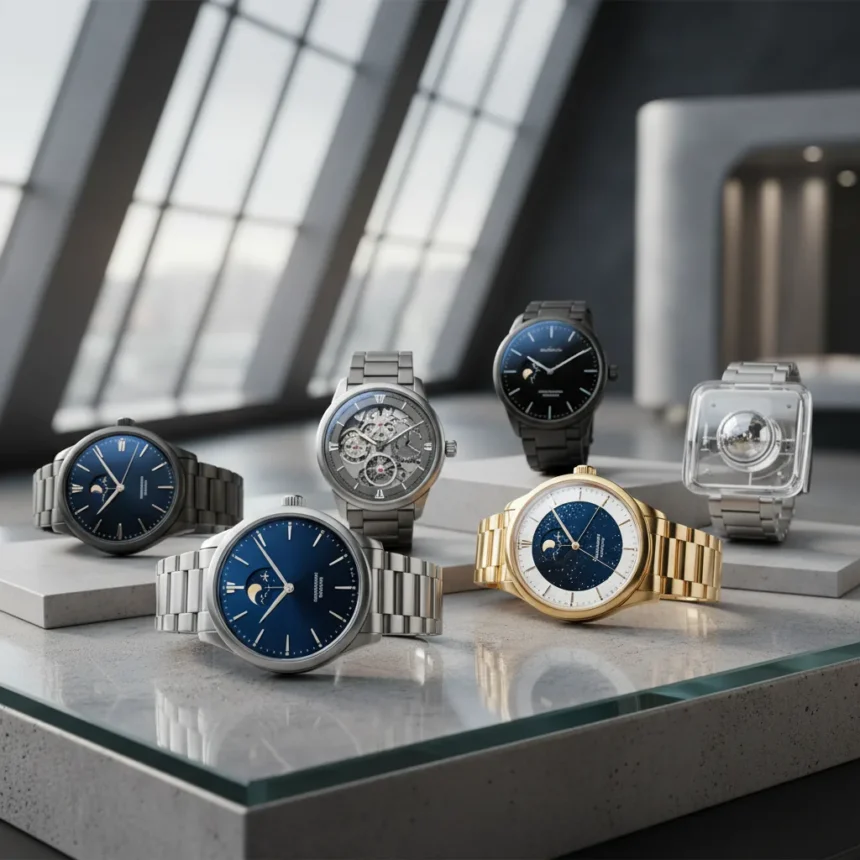
Moonphase watches dominated Watches and Wonders 2026, with 65 exhibiting brands including Rolex, Tudor, TAG Heuer, and Zenith showcasing new models featuring this celestial complication. From affordable quartz to ultra-luxury perpetual calendars, the event proved that moonphase appeal spans every price tier. Here are the six most compelling moonphase watches that caught attention at the 2026 event.
Key Takeaways
- Camden Watch Company No. 27 Moonphase delivers starry night dial and moonphase at 6 o’clock for under £190.
- Arnold & Son Luna Magna Steel Turquoise features a stunning 3D astronomical moonphase sphere visible through the caseback.
- MoonSwatch introduces Earth phase complication alongside traditional moonphase, a first-time pairing in the collection.
- Jaeger-LeCoultre Master Control Chronometre variant shows perpetual calendar accuracy until 2100 without adjustment.
- Frederique Constant Classics Moneta Moonphase packs significant complications for under £1000, challenging luxury pricing norms.
Affordable Moonphase Excellence: Camden Watch Company No. 27
The Camden Watch Company No. 27 Moonphase proves that compelling moonphase watches don’t require five-figure price tags. This quartz-powered model features a starry night sky dial mimicking aventurine stone, with the moonphase positioned at 6 o’clock. The small case size aligns with growing demand for refined, wearable complications rather than oversized statement pieces. At up to £190 for the most expensive version, the Camden No. 27 competes directly with the Christopher Ward C1 MoonPhase, which uses a similar aesthetic approach.
The watch targets collectors who want genuine complication appeal without the maintenance demands of mechanical movements. Japanese quartz reliability means the moonphase will track accurately for years without service, a practical advantage that luxury brands rarely emphasize because it undermines their service revenue model.
Three-Dimensional Moonphase Innovation: Arnold & Son Luna Magna Steel Turquoise
Arnold & Son’s Luna Magna Steel Turquoise introduces a moonphase complication that transcends traditional dial windows. The watch features a 3D astronomical moonphase sphere measuring 12mm in diameter, positioned at 6 o’clock and visible both from the dial and through the caseback. This dual-visibility design transforms the moonphase from a functional display into a sculptural element, rewarding both casual glances and detailed inspection.

The turquoise-inspired design reflects American aesthetic traditions, making this a US exclusive with no international availability. The 3D sphere approach represents a departure from flat disk moonphases that dominate the market, offering collectors a tangible sense of the lunar cycle’s three-dimensional reality. This architectural choice justifies the premium positioning that Arnold & Son commands in the horological hierarchy.
Unprecedented Earth Phase: The New MoonSwatch
Omega’s MoonSwatch collection has introduced a complication that redefines the affordable space-themed watch category: Earth phase pairing with traditional moonphase. The new model features a 29.5-day Earth phase cycle moving counter-clockwise beneath a static cover, paired with a clockwise-moving moonphase that cycles beneath its own static cover. This dual-complication approach creates visual complexity and collectible appeal that justifies the £288 price point, though limited availability makes finding stock difficult.



The Earth phase mechanism itself operates on a 29.5-day cycle, matching the lunar month and creating thematic coherence with the moonphase display. This pairing targets space enthusiasts and Speedmaster collectors who want to celebrate both celestial bodies in a single affordable watch, a positioning that separates the MoonSwatch from traditional luxury moonphase offerings.
Perpetual Calendar Precision: Jaeger-LeCoultre Master Control Chronometre
Jaeger-LeCoultre’s Master Control Chronometre variant showcases how moonphase integrates into complex perpetual calendar systems. This 9.1mm-thick watch displays time, date, day, month, year, and moonphase with accuracy guaranteed until 2100 without manual adjustment. The perpetual calendar movement represents the opposite design philosophy from quartz simplicity—it demands extraordinary mechanical precision and justifies the luxury pricing through technical achievement rather than affordability.
Perpetual calendar watches appeal to collectors who view horology as mechanical art, where the challenge of creating a system that accounts for leap years and varying month lengths becomes the entire value proposition. The moonphase integration within this complex movement demonstrates how complications layer upon one another in haute horlogerie.
Jewelry Meets Astronomy: Van Cleef & Arpels Midnight Jour Nuit Phase de Lune
Van Cleef & Arpels expanded its Jour Nuit collection with a moonphase variant that treats the lunar cycle as a jewelry element. The watch features two overlapping complications: the signature Jour/Nuit display indicating day and night, paired with a moonphase that transitions through full, half, waxing, and waning crescents over time. This combination appeals to collectors who view watches as wearable art rather than purely functional instruments.



The Jour Nuit collection has established Van Cleef & Arpels as a jewelry-first watchmaker, and the moonphase addition deepens this positioning. The watch targets buyers who prioritize aesthetic integration of complications over technical specification sheets, a market segment that luxury houses dominate through design authority rather than mechanical innovation.
Luxury Moonphase at Every Price: Frederique Constant Classics Moneta
Frederique Constant’s Classics Moneta Moonphase demonstrates that sophisticated moonphase complications don’t require six-figure budgets. Priced under £1000, this watch packs significant features that challenge luxury industry pricing conventions. The classy moonphase complication positions Frederique Constant as a brand that delivers horological substance to buyers who reject the premium markups that heritage houses command.
This watch occupies a strategic market position between affordable fashion watches and ultra-luxury brands, offering genuine complications and respectable build quality without the heritage tax. Collectors seeking moonphase functionality without the marketing premium find compelling value here.
Additional Standouts: Oris and A. Lange & Söhne
The Oris Artelier Complication features a moonphase at 12 o’clock, available in multiple dial colors with blue emerging as the favored option. The urbane styling positions this as an everyday luxury watch that happens to include moonphase rather than a moonphase watch that happens to be wearable.
A. Lange & Söhne presented two moonphase variants in its limited collection at Watches and Wonders 2026. One model pairs a 6 o’clock moonphase indicator with a small seconds register, while another offsets the moonphase at the dial base topped by a seconds hand. Both exemplify the ultra-luxury positioning where moonphase becomes one element within a constellation of complications, each executed with meticulous precision.
Why Moonphase Complications Matter Right Now
Moonphase watches have shifted from niche collector interest to mainstream horological currency. The 2026 event demonstrated that brands across every price tier—from sub-£200 quartz to seven-figure perpetual calendars—recognize moonphase appeal. This trend reflects broader watch market movement toward complications that offer genuine utility (lunar cycle tracking for photographers, divers, and astronomers) combined with romantic visual appeal.
The diversity of approaches at Watches and Wonders 2026 shows that moonphase design remains unsolved territory. 3D spheres, Earth phase pairing, jewelry integration, and perpetual calendar embedding represent different philosophical answers to the same question: how should a watch display the moon’s cycle? This creative diversity indicates the complication will remain relevant as long as makers find new ways to express it.
Which moonphase watch should you buy?
Your choice depends on budget and philosophy. For affordable entry: the Camden Watch Company No. 27 Moonphase at £190 delivers genuine complication appeal without mechanical complexity. For mid-luxury: the Frederique Constant Classics Moneta under £1000 offers respectable build quality and complications. For ultra-luxury: A. Lange & Söhne and Jaeger-LeCoultre represent the technical pinnacle, where moonphase becomes one element within systems of extraordinary mechanical achievement.
Are moonphase watches practical or purely aesthetic?
Both. Photographers and night-sky enthusiasts use moonphase displays for genuine planning purposes. Divers reference lunar cycles for tide prediction. But most buyers appreciate moonphase for romantic appeal—the connection between wrist and cosmos justifies the complication cost regardless of practical utility. The best moonphase watches succeed on both fronts simultaneously.
What makes the Arnold & Son Luna Magna different from traditional moonphases?
The 3D astronomical sphere visible through both dial and caseback transforms moonphase from a flat disk display into a sculptural element. This dual-visibility approach rewards detailed inspection and creates a sense of three-dimensional lunar reality that standard moonphase windows cannot achieve. The design justifies premium positioning through architectural innovation rather than mechanical complexity alone.
Watches and Wonders 2026 confirmed that moonphase complications transcend price tiers and design philosophies. Whether you seek affordable quartz reliability, mid-luxury daily wear, or ultra-luxury mechanical achievement, a compelling moonphase watch exists at your price point. The real question isn’t whether to buy a moonphase watch—it’s which interpretation of this celestial complication aligns with your horological values.
Edited by the All Things Geek team.
Source: T3