





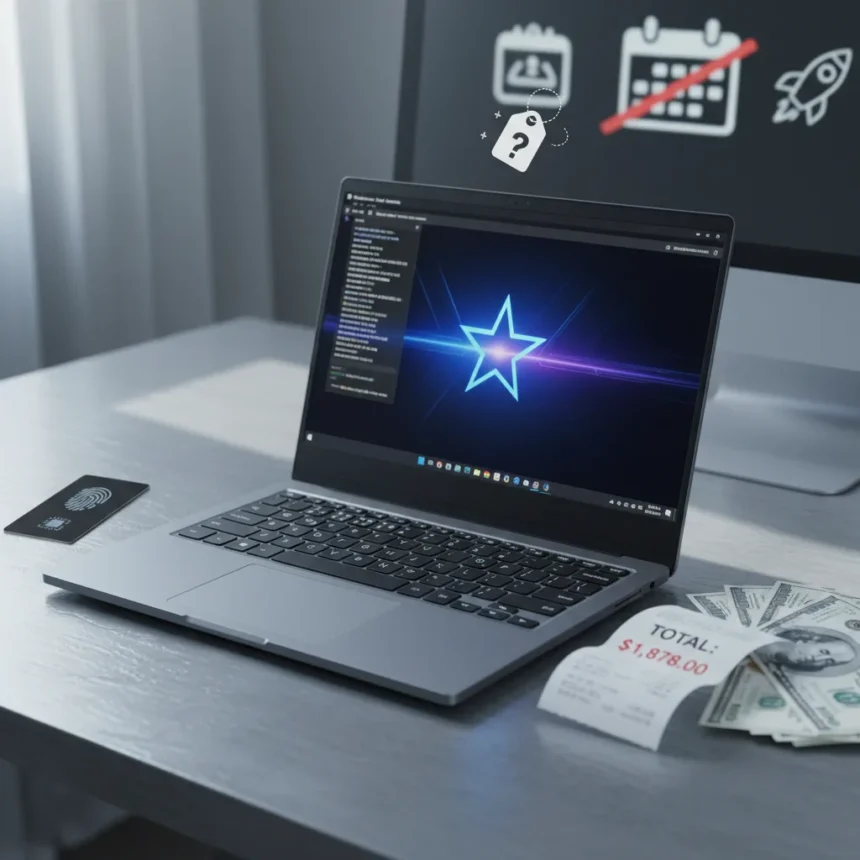
The StarFighter Linux laptop from Star Labs Systems is now available for purchase after months of pre-order delays, starting at $1,878 for the entry-level configuration. This 16-inch machine targets developers and privacy-conscious users willing to pay a significant premium for open-source firmware, hardware configurability, and privacy-focused features like a removable camera and Wi-Fi kill switch.
Key Takeaways
- StarFighter Linux laptop pricing starts at $1,878, with configurations reaching approximately $3,000
- 16-inch 4K display (3840 x 2400) at 60Hz standard, or 1440p up to 165Hz as alternative
- Dual processor options: Intel 14th-gen Core or AMD Ryzen 7 6800H in same product line
- RAM configurations of 16GB, 32GB, or 64GB; fully upgradeable storage with two M.2 slots supporting up to 8TB
- Open-source Coreboot firmware available; removable camera and Wi-Fi kill switch for privacy
StarFighter Linux laptop: What You’re Actually Paying For
At $1,878 for the base model, the StarFighter Linux laptop occupies an unusual market position. You are not buying the most powerful laptop available. You are buying a machine designed for users who value open-source firmware, hardware control, and privacy guarantees over raw performance metrics or brand prestige. Star Labs Systems is a small startup based in rural England, approximately 30 miles southeast of London, operating from a barn location. This is not Dell or Lenovo. Shipping costs, limited production scale, and the cost of supporting multiple Linux distributions explain part of the premium, but not all of it.
The entry-level configuration pairs an Intel Core i3-1215U processor with 16GB RAM and the standard 4K display. That is a modest processor paired with a high-resolution screen—a choice that signals the device is built for software development and productivity work, not gaming or video rendering. Configurations climb to approximately $3,000 when you add an Intel Core i9 processor, 64GB RAM, and storage upgrades. The AMD Ryzen 7 6800H option sits in the middle, offering a different ecosystem choice within the same product family.
Privacy and Open Firmware: The Real Value Proposition
What separates the StarFighter Linux laptop from mainstream competitors is its commitment to open-source hardware and user control. The device ships with Coreboot open-source firmware, meaning users can inspect and modify the low-level code that runs before the operating system boots. Few consumer laptops offer this level of transparency. The removable magnetic camera is not a gimmick—it addresses a legitimate privacy concern for users who work with sensitive information. A Wi-Fi kill switch provides hardware-level disconnection, not just software toggling.


These features appeal to a narrow audience: security researchers, journalists, developers handling classified information, and privacy advocates. For a general user buying a laptop to browse the web and write emails, these features add cost without perceived benefit. The StarFighter Linux laptop is not competing against the MacBook Air or ThinkPad X1 Carbon on general appeal. It is competing against the principle that users should own and understand their hardware.
Hardware Specs and Display Choices
The StarFighter Linux laptop ships with either a 4K matte display running at 60Hz or a 1440p panel capable of up to 165Hz refresh rates. The 4K option prioritizes screen real estate for development work and content creation. The 1440p alternative suits users who prioritize responsiveness and smoother scrolling. Both use matte finishes to reduce glare, a practical choice for extended work sessions.



Storage and RAM are fully user-upgradeable through two M.2 2280 slots supporting up to 8TB total capacity. This modularity is rare in modern laptops, where many manufacturers solder RAM and storage to reduce thickness. The ability to start with 16GB and upgrade to 64GB later appeals to budget-conscious buyers and those whose needs evolve over time. Battery life is rated for 18 hours, though real-world performance will depend on display choice, processor load, and usage patterns.
Connectivity differs based on processor choice. Intel-powered models include Thunderbolt 4 and USB 4 support. AMD models currently feature USB 3.2 Gen 2 Type-C, with a potential upgrade to USB 4 pending certification—a conditional promise that may or may not materialize. For users working with high-bandwidth external storage or displays, this distinction matters.
Linux Distribution Flexibility vs. Windows Option
The StarFighter Linux laptop ships with a choice of Ubuntu 22.04 LTS, Elementary OS, Kubuntu, Linux Mint, MATE, XFCE, Plasma, Gnome versions of Manjaro, Zorin OS, MX Linux, or Windows 11. Users can also request no operating system and install their own. This flexibility is genuine, but it also fragments the support story. A user installing Arch Linux or a custom distribution is on their own for troubleshooting. Star Labs cannot provide the same level of support across dozens of OS variants. The Windows 11 option exists for users who cannot leave the Microsoft ecosystem, but it undermines the privacy and open-source messaging of the device.
Market Positioning and Delays
The months-long pre-order delay before general availability raises questions about Star Labs’ production capacity and supply chain management. A small barn-based operation cannot match the logistics of multinational manufacturers. This delay will frustrate some buyers, but it also signals that Star Labs is not over-promising. The company is shipping what it can produce, not flooding the market with units that cannot be supported.


Comparing the StarFighter Linux laptop to mainstream options reveals the trade-off clearly. A MacBook Pro 16 starts around $2,499 and offers superior build quality, ecosystem integration, and resale value. A ThinkPad X1 Carbon provides similar performance at a lower price with stronger enterprise support. What the StarFighter Linux laptop offers is not better performance or build quality—it is control, transparency, and alignment with open-source principles. That matters to some users. It does not matter to most.
Should You Buy the StarFighter Linux laptop?
The StarFighter Linux laptop makes sense if you are a developer who values open-source firmware, need hardware-level privacy controls, and can tolerate limited manufacturer support. If you are buying a laptop to run Slack, email, and web browsers, the premium is not justified. If you are a gamer, content creator, or casual user, look elsewhere. The StarFighter Linux laptop is a statement purchase for a specific audience, not a general-purpose computer.
What operating systems does the StarFighter Linux laptop support?
The StarFighter Linux laptop ships with a choice of 11 different Linux distributions including Ubuntu, Linux Mint, Manjaro, and Zorin OS, plus Windows 11 or no operating system. Users can install and customize their own OS if preferred.
How much RAM can the StarFighter Linux laptop support?
The StarFighter Linux laptop offers configurable RAM in 16GB, 32GB, and 64GB options. Storage is fully upgradeable via two M.2 2280 slots supporting up to 8TB total capacity.
Is the StarFighter Linux laptop worth the price?
The $1,878 starting price is steep for the processor and display specs alone. The value lies in open-source Coreboot firmware, privacy features like a removable camera and Wi-Fi kill switch, and full hardware upgradeability. If those features matter to your workflow, yes. If you need a general-purpose laptop, the premium is hard to justify when mainstream alternatives cost less and offer better support.
Star Labs Systems has built a laptop for users who demand transparency and control over their hardware. The StarFighter Linux laptop delivers on that promise, but only for the narrow audience that prioritizes it. For everyone else, the price remains the barrier to entry.
Edited by the All Things Geek team.
Source: Tom's Hardware




