





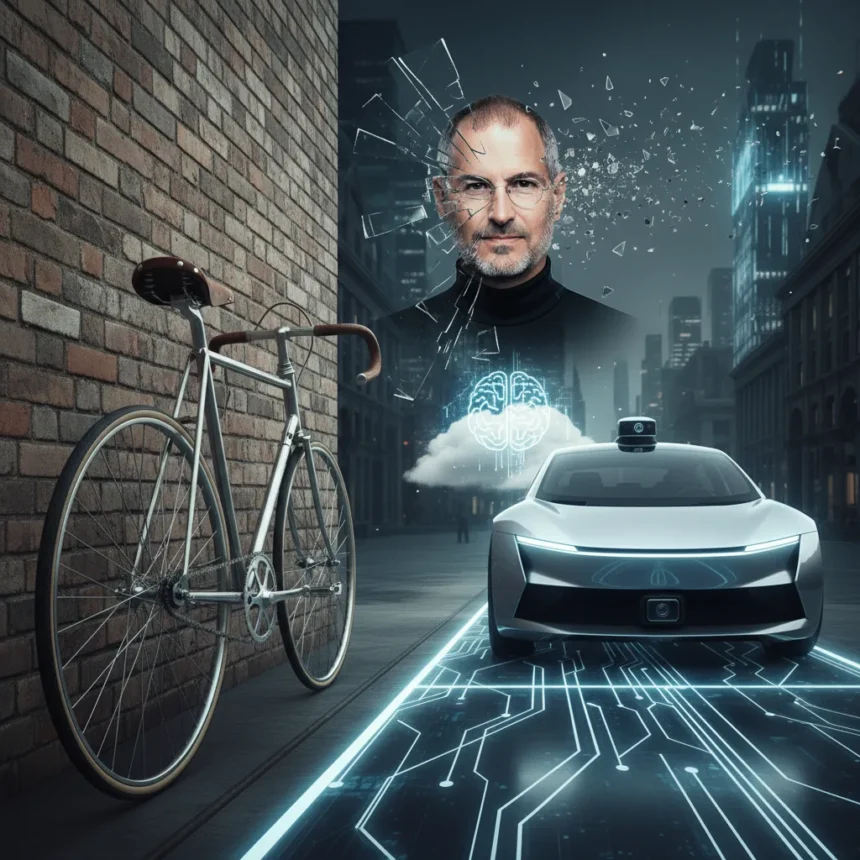
The Steve Jobs era is officially over, according to Nirav Patel, founder and CEO of Frameworks. In a sharp critique of modern computing philosophy, Patel argues that computers have fundamentally transformed from what Jobs envisioned in 1990 as a “bicycle for the mind” into something far more constraining: a “self-driving car that takes you directly to the destination.” The shift reflects how AI and cloud computing have reshaped personal computers from tools of exploration into instruments of automation.
Key Takeaways
- Nirav Patel rejects Steve Jobs’ “bicycle for the mind” metaphor as obsolete in the AI era.
- Modern PCs function as “self-driving cars,” automating user paths rather than amplifying human agency.
- Jobs’ 1990 vision positioned computers as tools amplifying human capability through effort and skill.
- Cloud and AI integration has reduced user control and exploratory potential in contemporary computing.
- Frameworks challenges this trend with modular, user-upgradeable hardware design.
What Jobs Actually Meant by “Bicycle for the Mind”
When Steve Jobs described computers as a “bicycle for the mind” in 1990, he was making a specific argument about human potential. A bicycle amplifies human locomotion—a person on a bicycle outperforms a condor in energy efficiency per kilometer traveled. Jobs applied this logic to computing: a computer, like a bicycle, is a tool that extends human capability through active engagement. It requires skill, intention, and exploration. The user steers. The user decides the destination. The user learns through interaction.
This philosophy dominated personal computing for decades. Early PCs demanded user participation. You had to understand your machine. You navigated file systems. You made choices about software, hardware, and workflows. The tool amplified your thinking, but only if you engaged with it actively. This was the bicycle model: effort-aligned flourishing. You pedaled, you went places, you felt the road.
The Self-Driving Car Metaphor: Automation Over Agency
Patel’s “self-driving car” metaphor inverts Jobs’ vision entirely. A self-driving car removes user agency. You enter the vehicle, state your destination, and the machine takes over. You cannot steer. You cannot choose an alternate route for exploration. You cannot learn the route or understand the terrain. The car optimizes for efficiency—the shortest path, the fastest arrival, the least friction.


Modern PCs, Patel argues, have become self-driving cars through AI and cloud integration. Algorithms predict what you want to do and do it for you. Cloud services handle computation remotely, removing the need for user understanding or control. AI assistants autocomplete your thoughts. Recommendations replace exploration. The system is efficient, but it constrains agency. You are no longer steering. You are being transported.
This shift is not accidental. Cloud computing and AI integration reduce complexity for users but also reduce transparency and control. You cannot easily upgrade your hardware. You cannot understand how decisions are made. You depend on distant servers and proprietary algorithms. The user becomes a passenger rather than a pilot.



Why This Matters for Computing Philosophy
The distinction between bicycle and self-driving car is not merely metaphorical—it reflects fundamentally different visions of what computers should be. Jobs believed tools should amplify human capability while demanding engagement. Modern AI-driven computing assumes users prefer automation over understanding.
Frameworks, as a modular PC manufacturer, explicitly rejects the self-driving car model. The company builds laptops designed for user upgrades and repairs, forcing engagement with hardware and encouraging tinkering. This is a deliberate return to bicycle-for-the-mind principles: the user controls the machine, understands its components, and can modify it to suit specific needs.
The irony is sharp. Thirty years after Jobs articulated his vision, the computing industry has moved in the opposite direction. Smartphones—the devices that arguably define modern computing—are the ultimate self-driving cars: sealed, cloud-dependent, algorithm-driven, and opaque. Even traditional PCs now push users toward cloud services and AI features that reduce local control.
Is the Steve Jobs Era Actually Over?
Patel’s declaration that the Steve Jobs era has ended reflects a real philosophical rupture in computing. The industry no longer designs for user agency. It designs for convenience and algorithmic optimization. Whether this is progress or regression depends on what you value: efficiency or understanding, automation or control.



For many users, the self-driving car is preferable. They want their devices to work without friction, to anticipate needs, to handle complexity invisibly. But this comes at a cost: reduced transparency, diminished control, and a shift from tool-user partnership to service-provider dependency. The user is no longer a participant in the computing experience—they are a consumer of it.
What Does This Mean for PC Design?
If Patel is right that the Steve Jobs era is over, then PC manufacturers face a choice: lean into the self-driving car model with ever-more automation and cloud integration, or resist it with modular, user-centric design. Frameworks is betting on resistance. The company’s upcoming product launch will test whether there is sufficient market demand for computers that treat users as pilots rather than passengers.
This is not a niche debate among tech enthusiasts. It touches on fundamental questions about technology’s role in human flourishing. Do tools amplify human capability, or do they replace it? Should users understand their devices, or is ignorance bliss? Can we have both efficiency and agency, or must we choose?
Is the bicycle-for-the-mind metaphor still relevant today?
Jobs’ bicycle metaphor remains relevant philosophically, but its practical application has narrowed dramatically. Most modern computing—smartphones, tablets, cloud services—operates on self-driving car principles. However, some users and manufacturers still value the bicycle model, viewing hands-on engagement with technology as essential to digital literacy and autonomy. The metaphor endures as a critique of automation-first design.
Can AI and modular hardware coexist?
Yes, but they represent competing philosophies. AI features typically assume cloud connectivity and algorithmic decision-making, which reduce user control. Modular hardware emphasizes user choice and hands-on customization. Frameworks is attempting to integrate both by offering upgradeable systems, but the fundamental tension remains: automation and user agency often pull in opposite directions.
Why does Frameworks emphasize repair-and-augment design?
By designing laptops for user upgrades and repairs, Frameworks forces engagement with hardware and extends device lifespan. This approach aligns with Jobs’ bicycle-for-the-mind philosophy: the user controls and understands their machine rather than relying on proprietary cloud services or sealed components. It is a deliberate rejection of the self-driving car model.
Patel’s critique of the Steve Jobs era reveals a genuine philosophical fracture in computing. For three decades, the industry moved away from user agency toward algorithmic automation. Whether this is inevitable progress or a missed opportunity depends on what we believe computers should do: amplify human capability or replace human decision-making. Frameworks is betting that enough users still want bicycles, not self-driving cars.
Edited by the All Things Geek team.
Source: TechRadar




