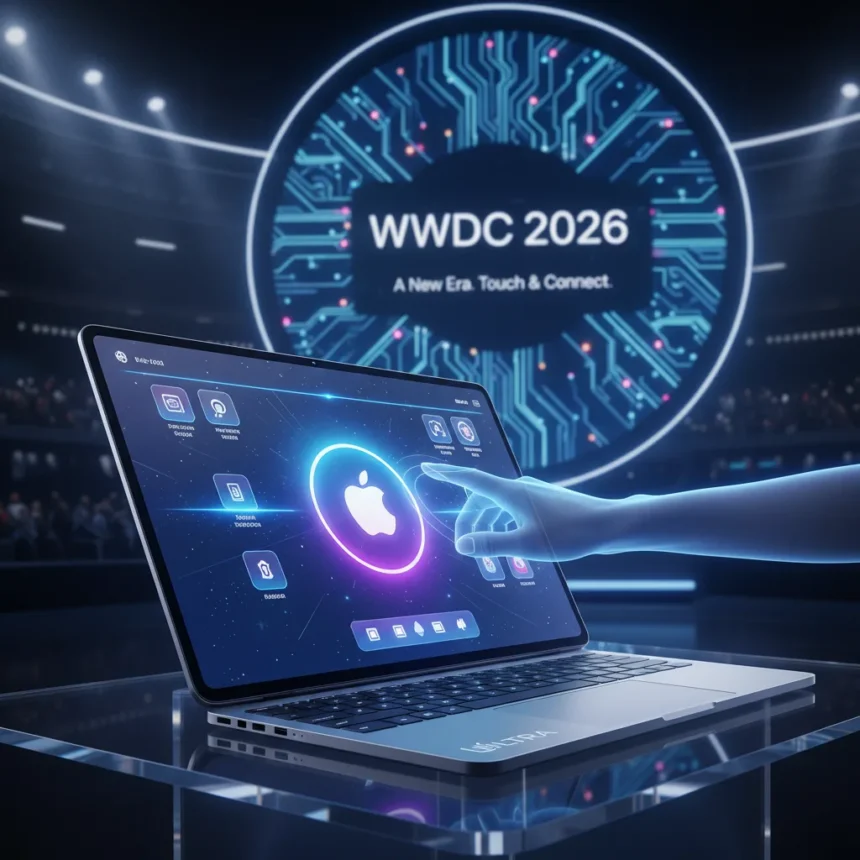
WWDC 2026 announcements are shaping up to be one of Apple’s most disruptive hardware reveals in years, with the MacBook Ultra expected to challenge everything the company has built around the Mac line. The keynote is expected around June 8, and early rumors suggest Apple will use the stage to introduce a device that finally brings touch interaction to macOS—a feature the company has resisted for over a decade.
Key Takeaways
- WWDC 2026 keynote expected around June 8 will likely feature MacBook Ultra announcements
- MacBook Ultra rumored to include a tandem OLED touchscreen, the first touch-enabled Mac
- M6 Pro and M6 Max chips expected to power the device, built on TSMC’s 2nm process
- Built-in 5G/LTE cellular connectivity via Apple’s C1X or C2 modem would eliminate iPhone hotspot dependency
- Device expected to launch late 2026 or early 2027 with slimmer, lighter design and Dynamic Island
The MacBook Ultra’s touchscreen revolution
Apple’s WWDC 2026 announcements will likely center on a fundamental redesign of how people interact with laptops. The MacBook Ultra is rumored to feature a tandem OLED touchscreen—a display technology Apple has perfected on iPad Pro but never deployed on a Mac. This shift represents a philosophical reversal, as Apple CEO Tim Cook and his design team have long argued that touch on a horizontal keyboard-attached display creates ergonomic problems. Yet the MacBook Ultra appears to be the exception Apple is willing to make.
The device will reportedly come in 14-inch and 16-inch models with a slimmer and lighter design than today’s MacBook Pro lineup. Instead of the notch that has defined MacBook Air and Pro designs since 2021, the MacBook Ultra is expected to use the Dynamic Island—the pill-shaped cutout that iPhone users know well. This design language unification suggests Apple sees the MacBook Ultra as a flagship device that bridges the Mac and iPhone ecosystems more directly than any laptop to date.
M6 chips and 2nm manufacturing power
WWDC 2026 announcements will introduce the M6 Pro and M6 Max chips, Apple’s most advanced silicon yet. According to MacRumors reporting referenced by Tom’s Guide, these processors will be manufactured on TSMC’s 2nm process, representing a significant leap in transistor density and efficiency from the current generation. The 2nm jump means faster performance per watt, which is crucial for a portable device that Apple expects to run independently without constant charging.


The M6 family will power not just the MacBook Ultra but likely influence the entire Mac lineup revealed at WWDC 2026. Thinner devices, longer battery life, and more aggressive computational photography features all become possible with this generational jump. Apple’s history shows that new chip families drive new capabilities—the M1 enabled the MacBook Air’s fanless design, and the M6 will unlock whatever Apple considers the next frontier for professional Mac users.
Cellular connectivity changes everything
The most radical rumor surrounding the MacBook Ultra is built-in 5G and LTE connectivity using Apple’s C1X modem or its successor, the C2. This would make it Apple’s first MacBook with independent cellular connectivity, eliminating the need for an iPhone hotspot to stay connected while mobile. For professionals who travel constantly, this feature alone could justify the premium pricing that a MacBook Ultra will undoubtedly command.



Cellular MacBooks also signal Apple’s confidence in its custom modem strategy. Rather than licensing Qualcomm modems like most PC makers, Apple is building its own silicon for wireless connectivity—a move that took years of development and acquisition of Intel’s modem business. By WWDC 2026, that investment will finally pay off in hardware that differentiates Apple’s laptops from every Windows alternative on the market.
What WWDC 2026 announcements mean for macOS
Beyond hardware, WWDC 2026 announcements will almost certainly include touch-optimized macOS features designed specifically for the MacBook Ultra’s interactive display. Apple will need to introduce new UI paradigms, gesture controls, and application frameworks that let developers build experiences that work smoothly with both trackpad and touch input. This is not a simple port of iPad OS—it requires rethinking how menus, windows, and controls respond to finger input on a desktop operating system.
The MacBook Ultra’s expected late 2026 or early 2027 launch window gives Apple time to refine these software features between WWDC 2026 and release. Developers will get months to adapt their applications, and early adopters will help Apple identify friction points that need smoothing before the device reaches mainstream users. This staged approach—announce at WWDC, refine through the summer, ship in fall or winter—is Apple’s proven playbook for major transitions.
How the MacBook Ultra compares to current MacBooks
Today’s MacBook Pro, despite its power and capability, remains fundamentally a traditional laptop—trackpad input, keyboard-centric interaction, and a static display cutout. The MacBook Ultra represents a generational leap in ambition. It is not simply a faster MacBook Pro; it is Apple’s attempt to create a new product category that sits above the Pro line, targeting users who demand both creative power and mobile flexibility.



The slimmer and lighter design also marks a departure from recent MacBook Pro trends, which have prioritized durability and thermal performance over portability. Apple appears to be betting that the M6’s efficiency gains let it build a thinner chassis without sacrificing performance or thermals—a calculation that previous generations could not make.
Will WWDC 2026 announcements disappoint?
The risk is real. Touch on a laptop sounds innovative in theory but may feel gimmicky in practice. Users accustomed to precise trackpad input might find touch less reliable for professional work. The Dynamic Island on a 14-inch screen could prove more distracting than the notch it replaces. And a premium price—which a device with this much custom silicon will surely command—might limit adoption to a small subset of creative professionals and early adopters.
Yet Apple’s track record suggests the company would not devote this much engineering effort to a feature it did not believe would resonate. The MacBook Ultra is not a side project; it is a fundamental rethinking of what a professional laptop can be. WWDC 2026 announcements will frame it as the future of computing, and whether that future actually arrives depends on execution and price.
When will the MacBook Ultra actually ship?
The MacBook Ultra is rumored to launch in late 2026 or early 2027, according to Macworld as cited by Tom’s Guide. This timeline means WWDC 2026 will be an announcement and preview event, not a release date. Apple will likely show the device, demonstrate touch features, and let developers begin optimizing their apps, but customers will wait months to actually purchase one.
What else might Apple announce at WWDC 2026?
Tom’s Guide’s original article promises seven major announcements, though the specific items beyond MacBook Ultra details are not fully detailed in available coverage. Expect iOS 20 or whatever version number Apple assigns, macOS updates with touch support, and potentially new iPad Pro models to complement the MacBook Ultra’s positioning as a premium device.
Will the MacBook Ultra replace the MacBook Pro?
No. The MacBook Ultra will sit above the Pro line as a new tier for users who need maximum performance and innovation. The MacBook Pro will continue to serve mainstream professionals, while the Air remains the entry-level option. Apple’s product segmentation strategy relies on clear tier separation, and the MacBook Ultra enforces that by pushing the boundaries of what a Mac can do.
WWDC 2026 announcements will reshape how people think about laptops, but only if Apple executes the vision flawlessly. A touchscreen MacBook with cellular connectivity and custom silicon is bold. Whether it becomes essential or remains a curiosity depends on software, price, and how effectively Apple communicates why touch matters on a machine designed for serious work.
Edited by the All Things Geek team.
Source: Tom's Guide