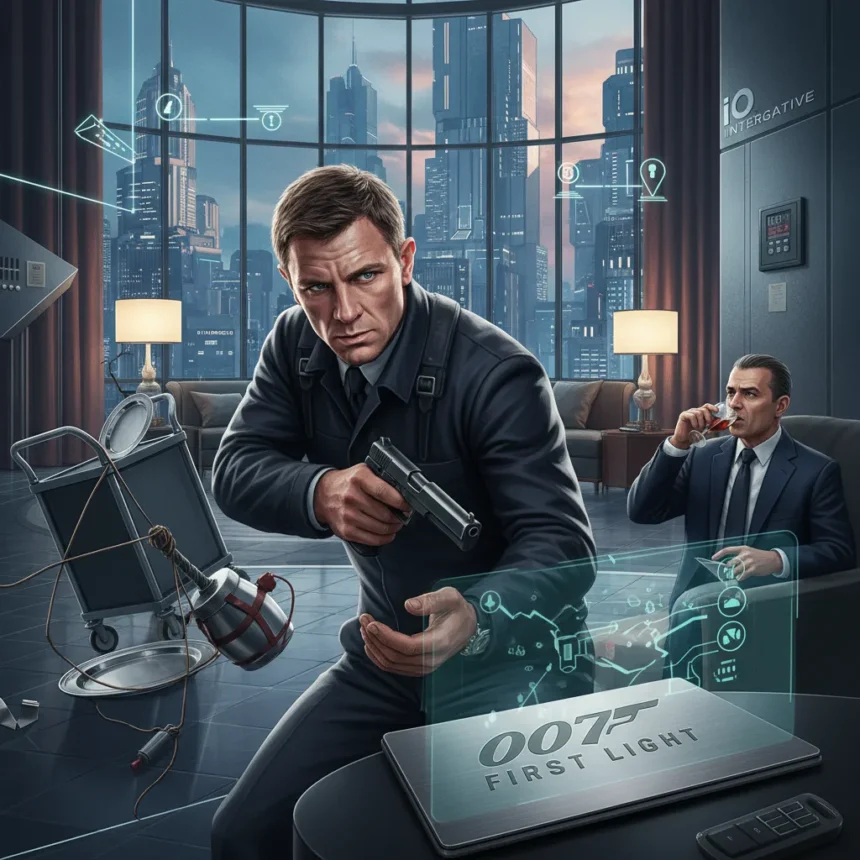
007 First Light gameplay proves that IO Interactive understands something most Bond games miss: the spy works best when he thinks on his feet, improvises, and finds absurd solutions to impossible problems. This prequel explores a young, inexperienced James Bond before he becomes the polished icon, and the studio’s hands-on approach to mission design—borrowed from its Hitman expertise—gives him room to be creative in ways that would make Agent 47 smile.
Key Takeaways
- IO Interactive’s 007 First Light portrays Bond as irreverent, unrefined, and still learning when to act or hold back.
- Gameplay emphasizes creative multi-approach spy action with bluffing and improvisation mechanics alongside intense shoot-outs.
- Bond differs fundamentally from Agent 47: he is a witty hero saving the world, not a cold-blooded assassin.
- The game features one of the franchise’s most unique vehicle chase sequences, setting it apart from previous Bond titles.
- Narrative Director Martin Emborg described 007 First Light as a very character-driven experience where all momentum revolves around Bond himself.
007 First Light Gameplay Embraces Creative Chaos
The core appeal of 007 First Light gameplay lies in its refusal to funnel players into a single solution. Like Hitman, the game rewards experimentation—but with a crucial difference. Where Agent 47 operates as a blank slate pursuing efficiency, Bond brings personality, wit, and emotional stakes to every encounter. Mission design encourages players to bluff their way past guards, improvise with available tools, and discover absurd kill methods that feel both cinematic and earned. This approach transforms 007 First Light gameplay from a linear action sequence into a sandbox where personality matters as much as precision.
IO Interactive’s Narrative Director Martin Emborg explained the philosophy behind this character-first design: a very character-driven experience where all the momentum revolves around Bond himself. This distinction matters. Hitman strips away personality to focus on mechanical mastery. 007 First Light gameplay does the opposite—it builds every system around who Bond is at this stage of his career: irreverent, quick-witted, energetic, and still learning the difference between acting and holding back.
How 007 First Light Differs From Agent 47’s World
The comparison to Hitman is inevitable and, frankly, essential to understanding what makes this Bond game work. Both franchises share IO Interactive’s DNA: sandbox missions, multiple approaches, and environmental storytelling. But 007 First Light gameplay and Agent 47’s methodology diverge at a fundamental level. If Hitman is a single-minded killer and basically the bad guy of the game, Bond is the hero, according to Art Director Rasmus Poulsen. Agent 47 is described as an empty shell by IO CEO Hakan Abrak—a vessel for player agency with no internal compass. Bond, by contrast, arrives with opinions, humor, and a mission to save the world rather than merely complete contracts.


This distinction reshapes how 007 First Light gameplay feels in practice. Where Hitman celebrates cold efficiency and dark comedy, Bond’s approach balances action with charm and levity. IO deliberately infused the game with British humor and wit to capture Bond’s personality while maintaining the creative problem-solving that makes Hitman sandbox missions so satisfying. The result is a spy game that does not require players to become emotionless killers—just clever agents who know when to talk, when to shoot, and when to steal a car and drive it through impossible terrain.
The Vehicle Chase That Stands Apart
Among the standout moments in 007 First Light gameplay is a vehicle chase sequence that ranks among the franchise’s most unique. Without details on the full mechanics, hands-on impressions highlight how this sequence breaks from typical Bond game conventions. It exemplifies IO’s willingness to push beyond gadget showcases and glamorous set pieces toward moments that feel genuinely fresh. For a franchise as storied as James Bond, that kind of innovation matters—it signals that IO sees this prequel not as a nostalgia vehicle but as a chance to redefine what a Bond game can be.



Character-Driven Action Over Franchise Checklist
The most telling aspect of 007 First Light gameplay is what it does not prioritize. There is no mention of gadget wheels, elaborate spy tech sequences, or globe-trotting glamour for its own sake. Instead, IO has stripped the formula down to its essence: a young man learning to be a spy, fumbling through assignments, and discovering that charm and improvisation often work better than preparation. This approach feels radical for a Bond game because most entries treat the character as a vehicle for spectacle rather than a protagonist with internal conflict.
Narrative Director Martin Emborg’s emphasis on a character-driven experience reflects a deliberate choice to prioritize Bond’s journey over franchise obligations. The game trusts that players want to experience who Bond is becoming, not just what gadgets he will eventually use. It is a bet that personality and humor can carry a spy game just as effectively as explosions and exotic locations.
Does 007 First Light gameplay feel like Hitman in a tuxedo?
Not quite. While 007 First Light gameplay borrows Hitman’s multi-approach mission design and environmental problem-solving, it wraps those systems around a character with actual personality and stakes. You are not playing as an empty shell—you are playing as a young Bond learning to navigate espionage with wit, charm, and occasional recklessness.
How does Bond’s personality shape 007 First Light gameplay?
Bond is portrayed as irreverent, quick-witted, and still learning when to act or hold back. This personality influences mission design by rewarding improvisation, bluffing, and creative solutions alongside direct action. The game celebrates Bond’s ability to talk his way into situations, charm his way out of trouble, and find absurd solutions that feel true to his character.


What makes the vehicle chase in 007 First Light unique?
The game features one of the franchise’s most unique vehicle chase sequences, though full details remain limited from hands-on impressions. It stands out as a moment that breaks from typical Bond game conventions and exemplifies IO’s approach to creating fresh experiences rather than relying on franchise checklist moments.
007 First Light gameplay succeeds because IO Interactive refused to make another gadget-heavy, globe-trotting spectacle. Instead, it bet on character—on a young Bond who is still figuring out how to be a spy, armed with creativity, humor, and the kind of multi-approach problem-solving that made Hitman so satisfying. That is not just a fresh take on a Bond game. It is a reminder that the best spy stories are about people, not just the tools they carry.
Edited by the All Things Geek team.
Source: TechRadar