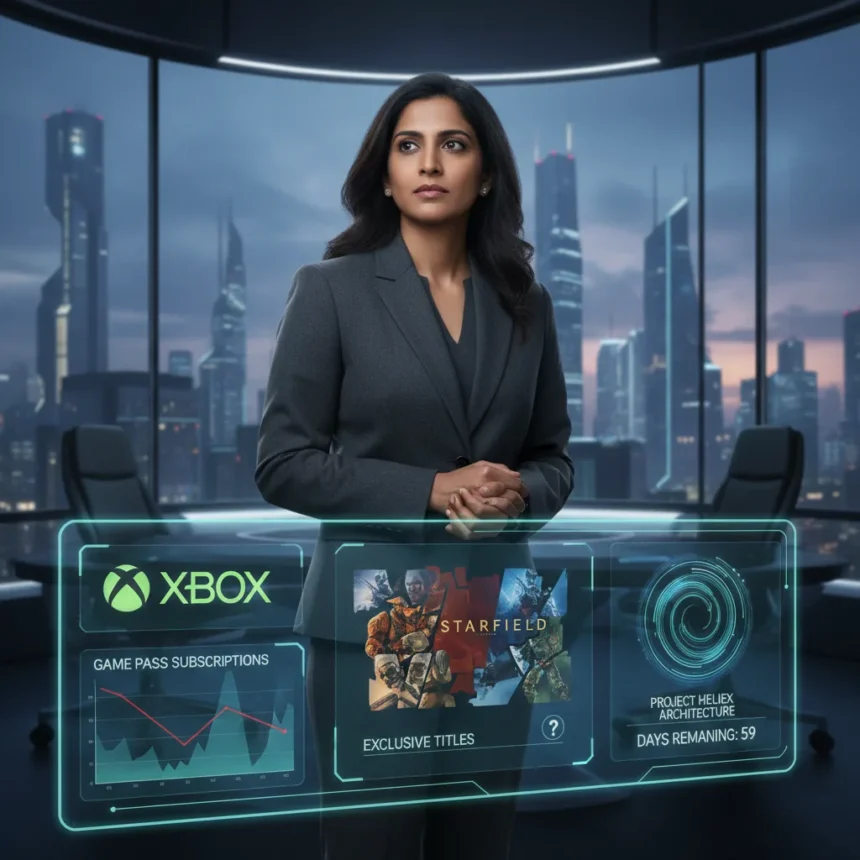
Asha Sharma became Xbox CEO two months ago, stepping into Phil Spencer’s role as Microsoft’s gaming division faces a reckoning. She inherited a platform caught between two conflicting strategies: porting major franchises like Halo and Fable to PlayStation while simultaneously trying to convince players that Xbox exclusivity still matters. In her first 60 days, Sharma has made rapid moves—reverting a Game Pass price hike, killing the Xbox Mobile Store, and signaling a potential shift on exclusives. The question now is whether these tactical fixes address the deeper strategic problems facing the platform.
Key Takeaways
- Asha Sharma reverted a 50% Game Pass price hike and called the service “too expensive for players” in an internal memo
- Xbox has ported Halo, Forza Horizon, Fable, and Gears of War to PlayStation, diluting its exclusive appeal
- Project Helix, Microsoft’s next-gen hardware, will run both PC and Xbox games natively from launch
- A poll of over 14,000 Xbox gamers showed strong preference for some form of platform exclusivity
- Sharma ended the “This is an Xbox” marketing campaign and signaled openness to reconsidering the multi-platform strategy
Game Pass Pricing: The Elephant in the Room
Game Pass has become a strategic liability under Sharma’s watch, and she knows it. In an internal memo, she stated bluntly that the service “has become too expensive for players,” a damning assessment from the person now responsible for its future. Microsoft had attempted a 50% price increase, but Sharma reversed it—a public acknowledgment that the pricing model is broken. The service that launched as Xbox’s killer app now costs more than PlayStation Plus and carries a reputation for rising fees rather than delivering value.
The economics are brutal. Game Pass subsidizes third-party studios through guaranteed payouts, but those same studios often see their games underperform on the service because players treat it as a buffet rather than a destination. The result is a negative feedback loop: higher prices to offset lower per-game engagement, which drives players away, which requires even higher prices to maintain revenue. Sharma’s reversal buys time but does not solve the underlying problem. Either Microsoft needs to accept lower margins, or it needs to fundamentally change how Game Pass works—perhaps moving toward a tiered model with fewer games at a lower price point, or introducing a premium tier with exclusive early access to new releases.
The Exclusives Contradiction
Nothing exposes Xbox’s strategic confusion more than its approach to exclusives. Over the past two years, Microsoft has ported Halo, Forza Horizon, Fable, and Gears of War to PlayStation and Steam. These are not niche titles—they are the franchises that defined Xbox’s identity. Yet Sharma has not committed to ending the multi-platform strategy. Instead, she offered a cryptic statement: “The plan is the plan until it’s not the plan”. That is not leadership; that is hedging.


A poll of over 14,000 Xbox gamers revealed something Microsoft should have known already: players want exclusivity. They want reasons to buy an Xbox console or Game Pass subscription instead of a PlayStation. Yet Microsoft continues to give those reasons away. PlayStation, by contrast, is reportedly doubling down on exclusives and even considering pulling games from Steam and Windows PC—a move that contradicts Xbox’s open-ecosystem philosophy but aligns with basic business sense. Sharma needs to make a choice: either commit to a platform-agnostic future where Xbox is a service, not a console, or rebuild exclusivity as a selling point. The current half-measure satisfies no one.
Project Helix and Next-Gen Hardware
Project Helix, Microsoft’s next-generation Xbox hardware, represents both opportunity and risk. The device will run both PC and Xbox games natively from launch, blurring the line between console and PC gaming. In theory, this is elegant: one box that plays everything in the Xbox ecosystem. In practice, it raises uncomfortable questions about why anyone would buy an Xbox-exclusive game if it runs on their PC anyway.
Helix also signals that Microsoft is thinking beyond the traditional console cycle. The hardware will launch alongside a broader ecosystem push, including a “huge manifesto” for the future that Sharma and Xbox EVP Matt Booty detailed in an internal memo, stating “Xbox will be where the world plays”. That vision requires not just hardware, but also content, pricing, and community alignment. Sharma has shown willingness to move fast—she ended the “This is an Xbox” marketing campaign shortly after taking over because it did not feel authentically Xbox—but Helix needs more than good hardware design. It needs a reason to exist beyond incremental performance gains.
Rebuilding Community and Culture
Sharma has emphasized returning Xbox to its “renegade spirit” with community at the core. This is a cultural reset, not a product announcement. It means listening to what Xbox fans actually want instead of imposing top-down strategy. The rapid feature updates to Xbox Series X|S under Sharma, after a period of relative silence, suggest she is taking this seriously. So does her decision to revert the Game Pass price hike—a move that costs money but rebuilds trust.
Yet culture alone does not win markets. Microsoft is approaching Xbox’s 25th anniversary in 2026, and the platform needs momentum heading into that milestone. Sharma has also signaled that Microsoft is looking into acquisitions again, suggesting the company may pursue studio deals to shore up the exclusive content pipeline. Whether those acquisitions materialize and whether they produce hits remains to be seen. What matters now is whether Sharma can convince the industry—and Xbox players—that the platform has a coherent vision for the next 25 years.
What Happens to the Xbox Mobile Store?
The Xbox Mobile Store appears dead under Sharma’s leadership, though Microsoft has not formally announced its cancellation. The project, which featured Candy Crush and a proprietary in-app currency system called “Crusher Club” offering 10% more value for Microsoft Account purchases, faced insurmountable blocks from Apple and Google. Killing it was the right call—it was a distraction from core platform problems and unlikely to move the needle on revenue. But it also underscores a larger problem: Xbox has spent years chasing mobile, cloud, and subscription strategies while its core console library has weakened relative to PlayStation.


Is Asha Sharma the right leader for Xbox’s turnaround?
Sharma’s first 60 days suggest she understands the problems: Game Pass pricing is unsustainable, exclusives matter, and Xbox’s culture has drifted. Whether she can execute the fixes is another question. Reverting a price hike is easy. Rebuilding a content pipeline, renegotiating multi-platform deals, and resetting community expectations is hard. She has shown willingness to move fast and admit mistakes, which is rare in corporate gaming. But speed alone does not solve strategic contradictions. Xbox needs clarity on whether it is a console platform, a services platform, or both—and it needs to commit fully to that choice.
Will Xbox bring back exclusive games?
Sharma has not ruled out a shift on exclusives, saying “The plan is the plan until it’s not the plan,” which suggests openness to change. A poll of 14,000 Xbox gamers showed strong preference for exclusivity, and PlayStation’s strategy of doubling down on exclusive content is proving commercially successful. However, reversing multi-platform deals already struck with major publishers would be costly and damage relationships. Expect a gradual pivot rather than a dramatic reversal—new exclusives prioritized, existing ports completed, and a long-term commitment to building console-defining franchises.
What is Project Helix and when will it launch?
Project Helix is Microsoft’s next-generation Xbox hardware designed to run both PC and Xbox games natively from day one. No specific launch date has been announced. The device represents a shift toward a unified ecosystem where console and PC gaming converge. It is expected to arrive within the next few years as part of a broader strategic refresh under Sharma’s leadership.
Asha Sharma has inherited a platform at a crossroads. In 60 days, she has made the right tactical moves—admitting Game Pass is too expensive, ending failed experiments, and signaling a willingness to reconsider exclusives. But tactics are not strategy. Xbox’s real challenge is deciding what it wants to be and committing fully to that vision. Sharma seems to understand this. Whether she can execute it will define whether Xbox enters its next 25 years as a leader or a follower.
Where to Buy
Edited by the All Things Geek team.
Source: Windows Central