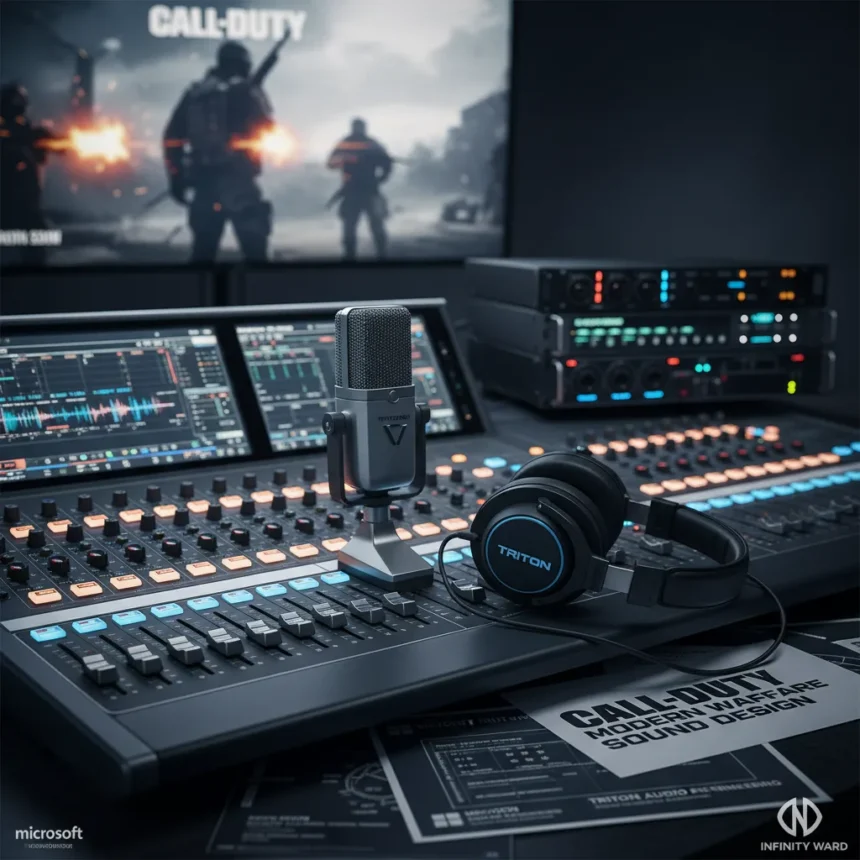
Call of Duty Modern Warfare sound design is no longer an afterthought—it is the centerpiece of how Infinity Ward defines the game’s identity. In a new behind-the-scenes video, the studio revealed that transforming real-world explosions and gunfire into an immersive, cinematic soundscape requires an intricate blend of craft, passion, and latest technology. The approach marks a significant shift in how AAA shooters approach audio, moving beyond simple ambient effects toward geometry-aware, dynamic sound environments that shift as players move through maps.
Key Takeaways
- Infinity Ward uses Microsoft Triton alongside convolution reverb as two complementary reverb engines
- The team captured over 200 impulse responses specifically for Modern Warfare
- The game uses between 90 and 110 channels of audio, mostly mono with stereo mics
- Triton reads map geometry and pre-bakes soundscapes that update as players move
- Audio accounts for footsteps, weapon falloff, occlusion, and reflection timing using the speed of sound
How Microsoft Triton Powers Modern Warfare’s Audio Engine
Microsoft Triton represents a fundamental rethinking of how environmental reverb works in games. Rather than applying generic reverb presets, Triton reads the actual geometry of a map and pre-bakes the acoustic properties into the soundscape. As a player moves through a corridor, across an open plaza, or into a concrete bunker, the reverb characteristics shift dynamically. The system knows where walls are and can reliably play reflection sounds in world space using the speed of sound for all delays. This means a gunshot in a narrow alley sounds acoustically different from the same shot fired in an open courtyard—not through artificial EQ tricks, but through simulated physics.
The Triton system picks new positions in its pre-baked acoustic map as the player moves a certain distance, ensuring the soundscape evolves rather than loops repetitively. This prevents the jarring effect of hearing identical reverb patterns as you circle back to a familiar area. Convolution reverb, the second reverb engine in the mix, operates differently. It relies on actively recorded impulse responses—over 200 captured for Modern Warfare alone—that capture the acoustic character of real spaces. By combining both systems, Infinity Ward gains the flexibility of Triton’s geometry awareness plus the tactile realism of convolution reverb.
The Technical Architecture Behind Call of Duty Modern Warfare Sound Design
The audio team is using between 90 and 110 channels of audio, with the majority being mono channels and some stereo microphone feeds. This density of channels allows the team to isolate and control individual sound elements with surgical precision. Footsteps, weapon fire, explosions, and ambient elements can each occupy their own channel or group of channels, enabling real-time mixing adjustments based on gameplay context.


The Call of Duty Modern Warfare sound design also accounts for occlusion—the acoustic impact of buildings or walls blocking direct sound paths. If a player hears gunfire from behind a concrete wall, the audio system dampens high frequencies and reduces volume, simulating how sound travels through solid barriers. The team checks for reverb behavior, footstep audibility at varying distances, and the falloff of weapon sounds as distance increases. A rifle shot 50 meters away sounds distinctly different from the same shot at 500 meters, with natural attenuation and frequency loss built into the audio model.
Beyond the technical infrastructure, Infinity Ward created audio presets that adjust the mix based on player equipment. Headphone users, console speakers, and surround-sound setups each receive a tailored audio profile. Compression is applied to reduce the loudest sounds and amplify the softest ones, ensuring that quiet footsteps remain audible even when explosions occur nearby. This prevents the common problem where dynamic range is so wide that players must constantly adjust volume or miss critical audio cues.



Why Sound Design Matters as Much as Graphics
The developer’s stated goal is to create its own realism for the game, and this is what is defining what is Modern Warfare by its sound signatures. In competitive shooters, audio is often the difference between hearing an enemy approach and being caught off-guard. A wide spectrum of sounds—from quiet footsteps to the crack of bullets whizzing by—creates a cohesive acoustic world that pulls players deeper into immersion. When reverb, occlusion, and distance attenuation all work in concert, the brain accepts the soundscape as authentic, even if the player cannot consciously articulate why.
This approach contrasts with older shooter audio design, where reverb was often a static effect applied uniformly across a map. Modern Warfare’s geometry-aware system means each location has its own acoustic signature. A warehouse sounds like a warehouse. A subway tunnel sounds like a subway tunnel. The system does not just apply EQ or reverb—it simulates how sound actually behaves in those spaces. For esports players and competitive streamers, this audio clarity becomes a tactical advantage. For casual players, it deepens immersion.
Is Call of Duty Modern Warfare sound design industry-leading?
Infinity Ward’s approach using Triton and convolution reverb represents a meaningful step forward in game audio, though that the studio is combining two different technologies rather than relying on a single solution. Other engines and middleware exist for audio simulation, but the specific pairing of pre-baked geometry awareness with recorded impulse responses gives Modern Warfare a hybrid advantage. The 200+ impulse responses captured for this game alone demonstrate the level of detail the team invested in acoustic authenticity.
How does the speed of sound factor into Modern Warfare’s audio?
Triton uses the speed of sound to calculate accurate delays for reflection sounds in world space. This means if a sound reflects off a distant wall, the reflection arrives at the player’s ear with the correct time delay based on distance. A reflection from 100 meters away arrives noticeably later than one from 10 meters away, creating spatial realism that the ear recognizes subconsciously. Without this timing accuracy, reflections would feel unnatural or disorienting.


What is the difference between Triton and convolution reverb in Modern Warfare?
Triton reads map geometry and pre-bakes acoustic properties so reverb changes dynamically as players move. Convolution reverb relies on over 200 recorded impulse responses that capture the acoustic character of real spaces. Triton excels at adapting to player position; convolution excels at raw acoustic authenticity. Infinity Ward uses both systems simultaneously, gaining the strengths of each approach without sacrificing either.
Call of Duty Modern Warfare sound design represents a maturation of how shooters approach audio. By treating sound as a core pillar of the game’s identity rather than an afterthought, Infinity Ward has created a blueprint for how next-generation audio can enhance gameplay, immersion, and competitive clarity. The 90-110 channels of audio, the 200+ impulse responses, and the geometry-aware Triton engine all work in service of a single goal: making players believe they are in a real, acoustically authentic space. That commitment to audio realism is what separates Modern Warfare from competitors that treat sound as background noise.
Where to Buy
Call of Duty: Modern Warfare 4 Vault Edition:
Edited by the All Things Geek team.
Source: Windows Central