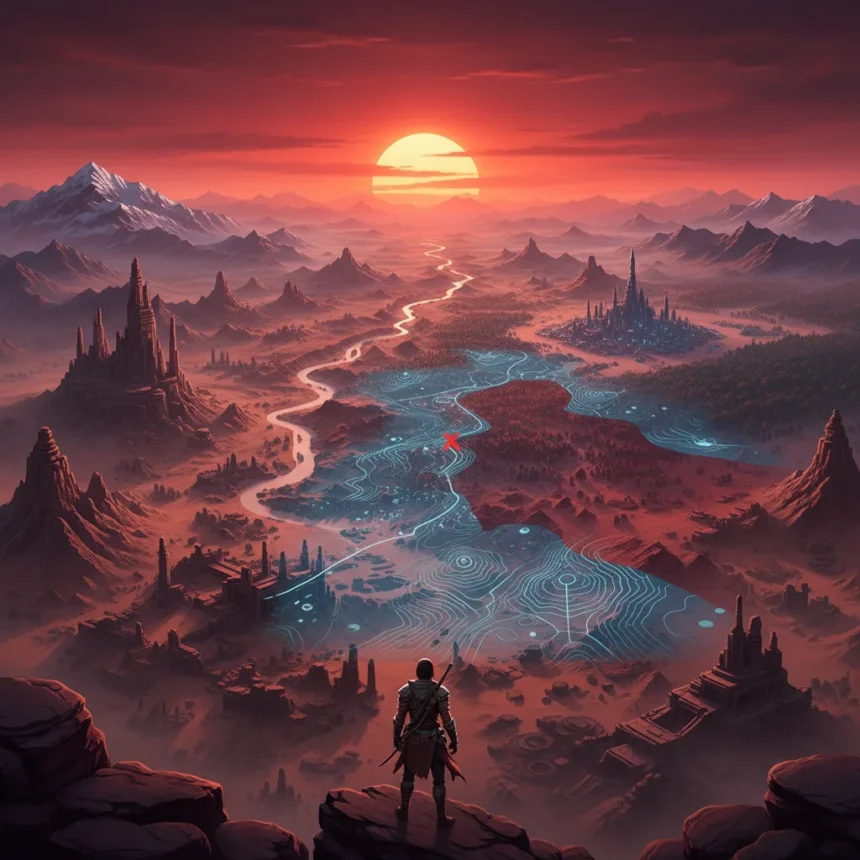
Crimson Desert’s map is the kind of open world that punishes the completionist urge and rewards the explorer willing to get lost. After 160 hours of continuous play, one reviewer has covered less than half of the available terrain—and rather than complain about the grind, they’re praising Pearl Abyss for building a world that sustains engagement at that scale.
Key Takeaways
- A reviewer invested 160 hours and covered less than 50 percent of Crimson Desert’s map.
- The game improves with extended playtime, encouraging long-term engagement.
- Pearl Abyss designed the map to sustain exploration well beyond typical open-world standards.
- Map size directly translates to fresh content and discovery across hundreds of hours.
- The game’s depth rewards patience rather than rushing toward a finish line.
Why Crimson Desert’s Map Design Defies Open-World Convention
Most open-world games front-load their best content into the first 40 to 60 hours, then rely on side quests and collectibles to stretch playtime. Crimson Desert inverts that formula. The sheer acreage means that even at 160 hours, a player can still stumble into entirely new regions, encounter fresh enemies, and discover quest lines they’ve never seen. This is not padding—it’s architectural ambition. The map is so large that the game naturally unfolds at a slower pace, forcing players to choose where to go next rather than checking off a predetermined route.
The design philosophy here matters. Rather than cramming a thousand markers onto a minimap, Pearl Abyss created a world where exploration itself becomes the reward. You don’t know what’s around the next ridge. You can’t see the quest giver from three zones away. This uncertainty, which modern game design usually treats as a flaw, becomes Crimson Desert’s greatest strength. After 160 hours, the reviewer still had half a map to explore—not because they were slow, but because the world is genuinely vast enough to sustain that kind of engagement.
Crimson Desert Map Quality Improves Over Extended Play
The critical insight from this extended playthrough is that Crimson Desert gets better the longer you stay in it. This is unusual. Most games peak early, then settle into repetition. But here, regions accessed after dozens of hours of play contain more refined quest design, tougher enemy encounters, and more intricate environmental storytelling than the opening zones. Pearl Abyss clearly built this world with the assumption that serious players would invest hundreds of hours, and it shows in the craftsmanship of late-game content.


This progression curve means that the map’s size is not just a numbers game. It’s a design choice that allows the developer to introduce complexity gradually. Early zones teach you the basics. Mid-game regions add nuance. By the time you’ve sunk 160 hours and are exploring the second half of the map, you’re engaging with Crimson Desert at its most sophisticated. The world doesn’t feel bloated or padded—it feels intentional, layered, and rewarding for those patient enough to see it all.
How Crimson Desert Compares to Typical Open-World Games
Most modern open-world titles aim for 80 to 120 hours of content for completionists. Elden Ring, which redefined open-world design, can be finished in 60 to 80 hours for skilled players, though exploration extends that significantly. Crimson Desert’s 160-hour checkpoint with half the map still unexplored places it in a different category entirely. It’s closer to the ambition of games like The Elder Scrolls Online, which prioritizes breadth and long-term engagement over narrative density.



The difference is execution. A large map means nothing if it feels empty. Crimson Desert’s size works because Pearl Abyss filled it with meaningful content—not just filler. The game respects the player’s time investment by ensuring that every region offers something worth discovering. This is harder to achieve than it sounds, which is why so many massive open worlds feel hollow after 40 hours. Crimson Desert’s 160-hour-plus playtime suggests that Pearl Abyss succeeded where many others have failed.
Why Game Length Should Not Be Mistaken for Value
There’s a temptation to dismiss any game over 100 hours as unnecessarily padded. That criticism has merit for games that stretch thin content across vast maps. But Crimson Desert appears to have avoided that trap. The reviewer’s experience suggests that the game’s scale serves a purpose: it allows players to experience discovery and exploration in a way that smaller, more tightly designed worlds cannot. You can ignore entire regions if you want. You can follow a main quest line and miss 70 percent of the map. Or you can spend 160 hours and still find new things.
This design philosophy appeals to a specific player—someone who values exploration, environmental storytelling, and the freedom to chart their own course. It’s not for everyone. Players who prefer narrative-driven experiences or tightly paced progression might find Crimson Desert’s vastness exhausting. But for those who love getting lost in a world, the map’s size is not a flaw—it’s the entire point. Pearl Abyss understood this and built accordingly.
Is Crimson Desert Worth 160+ Hours of Your Time?
If you’re the kind of player who enjoys open-world exploration without the pressure to complete everything, yes. The game’s design explicitly supports long-term engagement, with new content and improved quest design waiting in regions you haven’t yet discovered. The fact that a reviewer at 160 hours still hadn’t seen half the map speaks to the depth of what Pearl Abyss has built.


How Much of Crimson Desert’s Map Can Most Players Explore?
That depends entirely on your playstyle. Speedrunners might see the main story in 30 to 40 hours. Completionists could spend 200+ hours and still find hidden content. The reviewer’s 160-hour checkpoint with half the map uncovered suggests that a typical engaged player can expect 150 to 200+ hours of meaningful exploration before exhausting the world.
Does Crimson Desert Require Multiplayer to Enjoy the Full Map?
The research brief does not specify multiplayer requirements or restrictions on map exploration. Based on the reviewer’s solo experience reaching 160 hours with half the map remaining, it appears the game supports extensive single-player exploration and discovery without mandatory multiplayer content.
The real takeaway from 160 hours in Crimson Desert is this: Pearl Abyss built a world that respects the player’s time investment by ensuring that time spent exploring yields genuine discovery. In an era of bloated open worlds and checklist game design, that’s increasingly rare. The map’s size is not a marketing gimmick—it’s a commitment to a specific vision of what an open world should be.
Edited by the All Things Geek team.
Source: TechRadar