





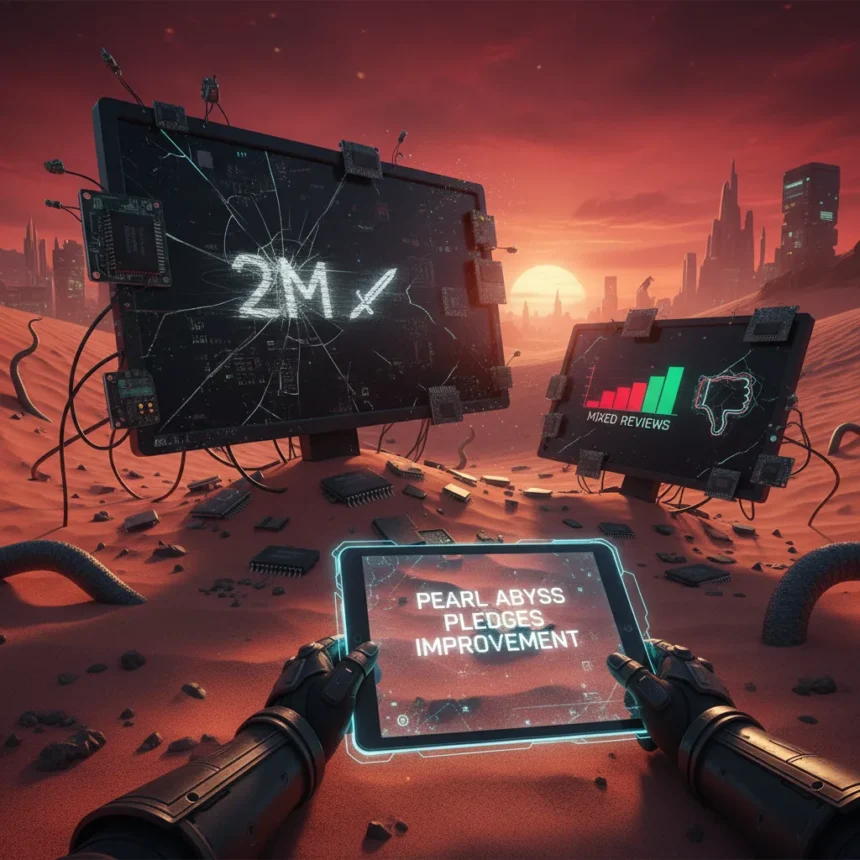
Crimson Desert reviews have turned mixed shortly after the game’s March 2026 global launch, even as Pearl Abyss’ colossal new action game crossed 2 million copies sold across all platforms. The gap between pre-launch hype and post-release reception has forced the developer to issue a direct message to players: we will listen closely and work to make improvements quickly.
Key Takeaways
- Crimson Desert reached 2 million sales copies across Steam, PS5, and Xbox Series X|S.
- Steam reviews rated the game as Mixed, signaling player dissatisfaction despite strong early sales.
- Pre-launch Steam sales hit approximately 400,000 copies with over $20 million in gross revenue.
- Pearl Abyss committed to listening to feedback and delivering rapid post-launch improvements.
- Game launched globally around March 20, 2026, after months of pre-order momentum.
How Crimson Desert reviews reveal a launch disconnect
The mixed Steam reviews underscore a common pattern in modern game launches: blockbuster pre-order numbers do not guarantee a smooth critical or player reception. Crimson Desert pre-orders on Steam alone generated over $20 million in gross revenue from roughly 400,000 copies sold before launch. That momentum suggested a potential heavyweight contender for 2026, yet the actual game experience disappointed enough players to trigger the mixed rating. This disconnect matters because it signals that Pearl Abyss either misjudged what players expected from Crimson Desert reviews, or the developer shipped with unfinished systems that required day-one patches.
The developer’s public response—promising to listen closely and work quickly—is a tacit acknowledgment that something in the launch experience fell short. Whether that involves combat balance, performance issues, progression systems, or narrative pacing remains unspecified, but the commitment to rapid iteration is the only concrete signal players have received so far. For a game that cost players roughly $50 per copy on average, based on pre-order revenue data, that promise needs to translate into visible changes within weeks, not months.
Why pre-launch momentum did not carry through to reviews
Crimson Desert benefited from extraordinary pre-launch interest. Steam wishlists exceeded 2.2 million before release, and the game accounted for roughly 10 percent of all Steam pre-orders in a single 24-hour window. That level of anticipation typically signals a title with genuine appeal, yet Crimson Desert reviews suggest the final product did not match the promise. One possible explanation: pre-orders reward hype and marketing, not finished games. Players who committed money before launch had no way to verify whether Pearl Abyss could deliver on the action gameplay, story quality, and technical polish they expected.


The competitive context makes the mixed reception more striking. Crimson Desert’s pre-launch Steam sales exceeded those of Kingdom Come: Deliverance 2 and Clair Obscur: Expedition 33, both strong releases in the same window. Yet neither of those games triggered the same wave of mixed reviews, suggesting Pearl Abyss either overpromised or failed to meet a higher bar set by its own marketing. A game with stronger pre-order numbers than competitors should theoretically have stronger launch reviews if it delivers comparable quality—the fact that it does not raises questions about execution.
What Crimson Desert reviews mean for post-launch support
Pearl Abyss’ commitment to listening and making quick improvements is the only narrative available right now. The developer has not detailed specific fixes, timelines, or which systems require overhaul. That silence is understandable—admitting what broke is bad PR—but it also leaves players uncertain whether the game will improve in days, weeks, or months. For a title with 2 million copies sold, even a modest improvement in player experience could shift Crimson Desert reviews from mixed to positive, but only if the changes address the core complaints driving the current rating.

Post-launch support has become table stakes for action games. Players expect patches, balance adjustments, and content updates as standard. The question is whether Pearl Abyss will move fast enough to prevent the player base from fragmenting. A mixed review rating compounds over time as word spreads; every day without visible improvement makes it harder to convince skeptical players to give Crimson Desert a second look.
Does Crimson Desert’s sales milestone matter if reviews stay mixed?
Two million copies sold is a genuine commercial success, even if Crimson Desert reviews remain mixed. The game has already recouped its development costs many times over, and the 2 million figure likely includes full-price sales across multiple platforms at launch. From a business standpoint, Pearl Abyss has won the opening weekend. From a cultural and community standpoint, however, mixed reviews create long-term friction. Players who feel burned by a $50 purchase tell friends, post negative videos, and abandon the game for competitors. That word-of-mouth damage is harder to reverse than a slow sales start.
The real test for Crimson Desert reviews will come in April and May 2026. If Pearl Abyss delivers meaningful improvements and players see the mixed rating shift toward mostly positive, the game survives as a franchise. If the reviews stagnate or worsen, the 2 million sales figure becomes a footnote—proof that marketing and pre-orders can drive sales, but they cannot substitute for a finished, polished product.
What should players expect from Pearl Abyss next?
Pearl Abyss has committed to listening and working quickly, but specifics remain sparse. Players should expect an official roadmap or patch notes within the next 1-2 weeks that detail what the developer identified as problematic and how it plans to fix those issues. Without that transparency, the promise to improve feels hollow. The developer should also clarify whether fixes will address gameplay balance, technical performance, server stability, or all three.


Is Crimson Desert worth buying despite mixed reviews?
That depends on your tolerance for rough launches and your faith in post-launch support. If you enjoyed Pearl Abyss’ previous work and can tolerate a few weeks of potential bugs or balance issues, Crimson Desert offers a colossal action experience that has sold 2 million copies for a reason. If you prefer polished, finished games on day one, wait for the first major patch and check updated Crimson Desert reviews before committing $50. The game is not going anywhere, and the developer has publicly committed to rapid improvements.
Will Crimson Desert reviews improve after patches?
Possibly, but improvement depends entirely on execution. Mixed reviews often reflect fixable issues—poor performance optimization, unbalanced difficulty spikes, or clunky progression systems. If Pearl Abyss addresses those problems in the first month, Crimson Desert reviews could shift noticeably higher. However, if the mixed rating stems from fundamental design decisions players dislike, patches alone will not fix the perception. Only time and actual patch notes will tell.
Crimson Desert’s 2 million sales prove that marketing and anticipation can drive initial success, but Crimson Desert reviews reveal the gap between hype and delivery. Pearl Abyss has the resources and the player base to turn this around—the only question is whether the developer moves fast enough to seize that opportunity before momentum fades. The next four weeks will define whether this launch becomes a cautionary tale or a redemption story.
Where to Buy
Edited by the All Things Geek team.
Source: Windows Central




