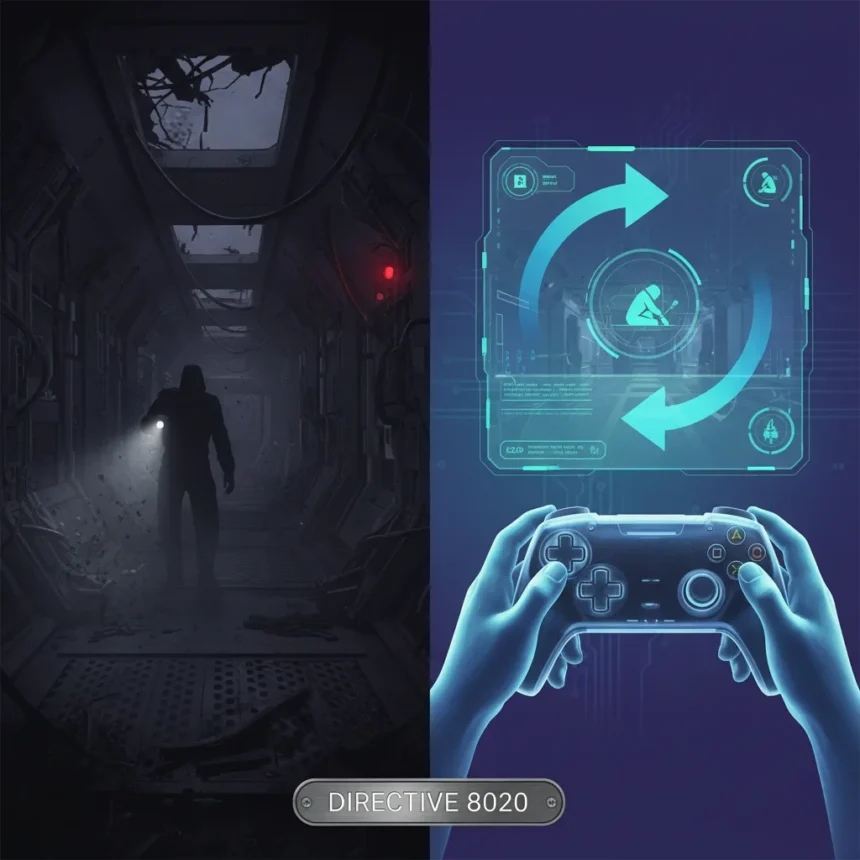
Directive 8020 Dark Pictures represents Supermassive Games’ boldest reinvention of the anthology yet—and its most compromised. Launching May 12, 2026, across PS5, Xbox Series X|S, and PC, this fifth installment abandons the studio’s trademark locked-choice philosophy in favor of a rewind system that lets players undo decisions mid-narrative. The shift signals a fundamental question: can horror survive when failure becomes optional?
Key Takeaways
- Directive 8020 Dark Pictures introduces Turning Points, allowing players to rewind story decisions without restarting.
- Real-time threats replace quick-time events, demanding active player response during gameplay.
- First Dark Pictures game set in space, marking a three-year gap since Switchback VR.
- PS5 Pro features PSSR upscaling, advanced ray tracing, and dynamic shadows for enhanced horror atmosphere.
- Movie Night mode supports up to five players in local couch co-op gameplay.
The Turning Points System: Accessibility or Compromise?
The Turning Points rewind mechanic is Directive 8020 Dark Pictures’ most significant departure from series tradition. Players can now rewind critical narrative moments and explore alternate outcomes without permanently locking themselves into one story branch. This directly addresses a persistent complaint from the previous five Dark Pictures games: once you made a choice, it was final. No save scumming. No second chances.
Executive Producer Dan McDonald framed the feature as serving two distinct audiences. First, there are players who want to keep every character alive—a goal that previous entries made nearly impossible without replaying from the beginning. Second, there are hardcore fans who want to unlock every ending and collect all narrative variations in a single playthrough. The system caters to both without forcing either group into an unwanted experience.
Yet here lies the tension. Horror thrives on consequence. When players know they can rewind a bad decision, does the weight of choice disappear? Life is Strange proved that rewind mechanics can work in narrative-driven games, but that series never positioned itself as horror. Directive 8020 Dark Pictures is attempting something riskier: maintaining dread while removing permanent failure.


Real-Time Threats Push Action Beyond Quick-Time Events
If Turning Points softens the narrative stakes, the game’s real-time threat system attempts to compensate with kinetic intensity. Creative Director Will Doyle emphasized that this mechanic represents one of two critical changes reshaping the formula. Rather than reactive quick-time prompts, players now face dynamic threats that demand active response during exploration and movement.
The DualSense controller integration underscores this shift. Reaching for a flashlight, scanning a room before entering a hatch, grabbing a wedge tool at the last second—these interactions are designed to make the controller feel like a survival tool rather than a passive input device. The goal is visceral: keep your heart pounding.



This approach echoes Alien: Isolation’s stealth-based tension, where player agency and active threat management drive fear rather than scripted scares. Whether Directive 8020 Dark Pictures achieves that same dread is the critical question reviewers will answer on launch day.
Space as Setting: Ambition Over Innovation
Directive 8020 Dark Pictures marks the first time the anthology has ventured into space. After three years since Switchback VR, Supermassive Games chose to move the series away from grounded settings—haunted houses, isolated islands, cursed villages—into the void. Executive Producer Dan McDonald’s explanation was refreshingly honest: the reason was simply that it’s fun.
This candor is welcome, but it also reveals the creative logic: novelty over narrative necessity. Space settings have powered some of horror’s greatest works, from Alien to Dead Space. Directive 8020 Dark Pictures inherits that pedigree but must prove it earned the setting rather than simply borrowed it.
PS5 Pro Enhancement and Couch Co-Op Return
Supermassive Games designed Directive 8020 Dark Pictures with PS5 hardware in mind from the ground up. On PS5 Pro, the game leverages PSSR upscaling technology alongside advanced ray tracing and dynamic shadows to intensify the horror atmosphere. These are not cosmetic upgrades; lighting and shadow detail are foundational to horror pacing.


The return of Movie Night mode rounds out the package. Up to five players can experience the story together in local couch co-op, transforming a single-player horror game into a shared narrative event. This mode has always been Supermassive’s secret weapon for accessibility—horror is less terrifying when you have allies on the couch.
How Does Directive 8020 Dark Pictures Compare to Until Dawn?
Until Dawn established Supermassive’s locked-choice formula over a decade ago. Directive 8020 Dark Pictures deliberately dismantles that legacy. Until Dawn punished bad decisions with permanent character death and branching consequences. Directive 8020 Dark Pictures lets you undo those decisions. This is not an evolution—it is a philosophical reversal.
Whether that reversal strengthens or weakens the experience depends on how the real-time threat system compensates. If Turning Points removes tension from narrative choices but real-time threats inject tension into moment-to-moment gameplay, the trade might balance. If both systems feel disconnected, players may find themselves in a game that is neither fully consequential nor fully intense.
Will Directive 8020 Dark Pictures Be Worth Playing?
Directive 8020 Dark Pictures is unquestionably ambitious. It takes a series known for locked choices and introduces the very mechanic that series fans have debated for years. It moves from horror staples into space. It emphasizes active threat response over passive cinematic moments. These are not incremental changes.
The question is whether ambition translates to cohesion. A rewind system designed for accessibility could flatten narrative stakes. A space setting chosen for novelty might lack thematic grounding. Real-time threats could feel bolted onto a game fundamentally built for branching narrative rather than action-horror fusion. Or Supermassive Games could have cracked the code: a horror game that is simultaneously forgiving and tense, innovative and focused. Only May 12 will tell.
Can You Play Directive 8020 Dark Pictures Without Turning Points?
Yes. Supermassive Games includes a traditional Dark Pictures mode for players who want the original locked-choice experience. This is crucial—the studio is not forcing the new system on veteran players. If you want consequences to stick, you can opt out of Turning Points and play the game the way Until Dawn worked.
What Platforms Will Directive 8020 Dark Pictures Launch On?
Directive 8020 Dark Pictures releases on PS5, Xbox Series X|S, and PC on May 12, 2026. PS5 Pro owners get enhanced visuals via PSSR and advanced ray tracing. All versions support Movie Night mode for local multiplayer.
How Long Is the Gap Between Directive 8020 Dark Pictures and the Previous Dark Pictures Game?
Three years separate Directive 8020 Dark Pictures from Switchback VR, the longest wait between anthology entries. That gap suggests substantial development investment, though whether the result justifies the wait depends on execution rather than intention.
Directive 8020 Dark Pictures arrives as a series at a crossroads. Supermassive Games has spent over a decade refining the formula Until Dawn pioneered. Now it is dismantling that formula to chase something new. That takes courage. Whether it pays off is the only question that matters when the game launches this May.
Where to Buy
Edited by the All Things Geek team.
Source: TechRadar