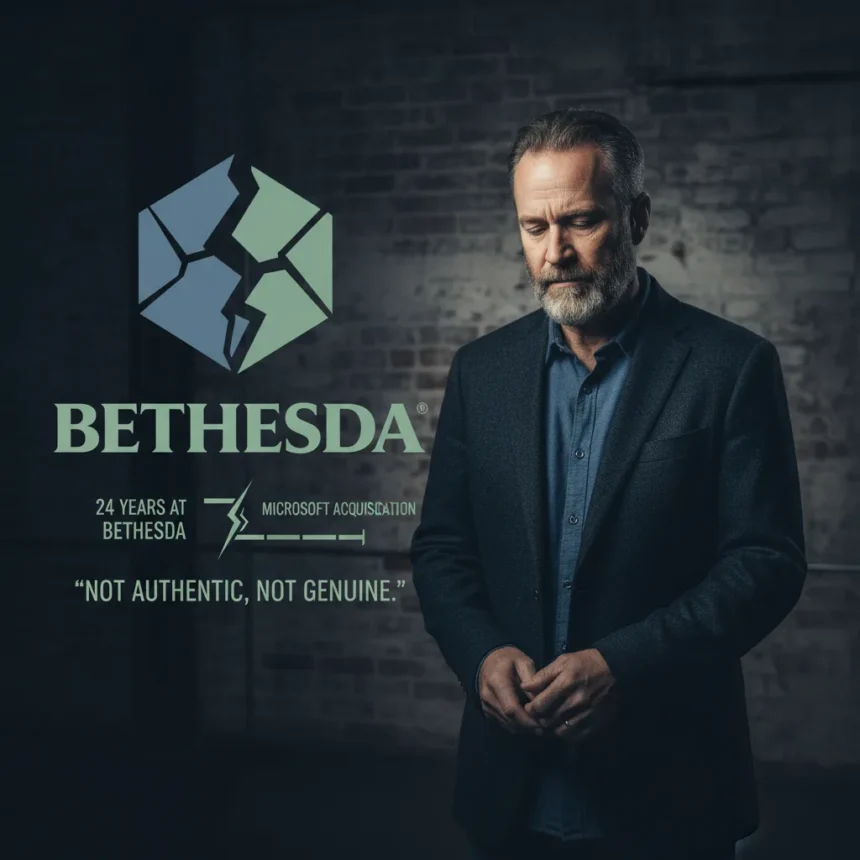
Pete Hines spent 24 years building Bethesda’s publishing division into one of gaming’s most recognizable brands. Then Microsoft acquired ZeniMax—Bethesda’s parent company—in 2021, and Hines watched the studio he loved transform into something he no longer recognized. In a recent interview, the former publishing head explained why he ultimately retired, describing Bethesda Microsoft acquisition culture as fundamentally broken.
Key Takeaways
- Pete Hines served as head of Bethesda’s publishing for 24 years before retiring post-acquisition.
- Microsoft’s 2021 acquisition of ZeniMax triggered cultural shifts that frustrated Hines and affected his mental health.
- Hines believes Bethesda is now part of something “not authentic and not genuine” under Microsoft ownership.
- His departure highlights ongoing tensions in gaming industry consolidations and corporate integration.
- Major titles like The Elder Scrolls 6 continue development under Microsoft’s ownership structure.
Why Hines Left After Two Decades at Bethesda
Staying at Bethesda after the Microsoft acquisition seemed logical for Hines initially. He had invested nearly a quarter-century in the studio, knew its systems, and understood its people. But the post-acquisition environment deteriorated faster than he anticipated. Hines describes growing frustration with the new corporate structure, declining mental health, and an overwhelming sense that the independent studio he knew was gone. The decision to retire came not from burnout alone, but from a fundamental philosophical disagreement with what Bethesda had become.
Hines’ departure represents a rare window into the human cost of mega-acquisitions in gaming. Unlike public statements from corporate communications teams, his reflections expose the cultural friction that emerges when a creative independent studio gets absorbed into a massive technology conglomerate. The clash between Bethesda’s legacy identity and Microsoft‘s operational culture proved irreconcilable for him.
Bethesda Microsoft Acquisition Culture: Authenticity vs. Corporate Integration
The core of Hines’ criticism cuts to the heart of what happens when independent game studios lose autonomy. He states plainly: “Truthfully, I still think Bethesda is just part of something that is not authentic and is not genuine.” This is not a complaint about budget cuts or missed opportunities—it is a judgment about institutional integrity. Hines saw the studio’s values, decision-making processes, and creative independence erode under Microsoft’s corporate framework.


Before the acquisition, Bethesda operated as a self-directed publisher with its own culture and priorities. Post-acquisition, those decisions now flow through Microsoft’s broader gaming strategy, Game Pass integration requirements, and corporate governance structures. For Hines, this represented a loss of something intangible but essential: the authenticity that defined Bethesda’s identity. Whether that perception is universally shared among remaining Bethesda staff remains unclear, but his 24-year tenure gives his critique substantial weight.
The timing of Hines’ departure also matters. Major projects like The Elder Scrolls 6 remain in development under Microsoft’s stewardship. His exit signals that even senior figures with deep institutional knowledge found the new environment untenable, raising questions about whether Microsoft’s acquisition strategy prioritizes cultural integration over creative independence.

What Hines’ Departure Reveals About Gaming Industry Consolidation
Hines’ decision to retire rather than adapt reflects a broader challenge facing the gaming industry as consolidation accelerates. When major publishers acquire independent studios, executives face a choice: adapt to the new corporate culture or leave. Hines chose to leave, but his public reflection on why matters more than the departure itself. He articulated something many industry veterans think privately—that size and corporate structure can hollow out the creative authenticity that made a studio valuable in the first place.
His experience contrasts sharply with the optimistic rhetoric that typically surrounds major acquisitions. Microsoft has publicly stated that acquiring Bethesda strengthens its gaming portfolio and Game Pass offerings. That may be true from a business perspective. But Hines’ testimony suggests that the human and cultural dimensions of integration were underestimated or deprioritized. A 24-year veteran does not walk away lightly unless the gap between expectation and reality becomes unbearable.
Does Bethesda Still Matter Under Microsoft?
Bethesda continues developing major franchises like The Elder Scrolls 6 under Microsoft ownership, so the studio has not disappeared. But Hines’ critique raises a legitimate question: can a studio produce authentic, creatively independent work within a corporate structure it finds inauthentic? The answer depends partly on whether “authenticity” requires independence or whether it can survive within larger organizations. For Hines, the answer was clear—it could not survive the Microsoft transition.
Future Bethesda releases will likely prove whether his concerns were prescient or overstated. If The Elder Scrolls 6 feels creatively compromised or designed primarily to serve Game Pass metrics rather than player experience, Hines’ critique gains credibility. If it represents Bethesda’s best work to date, the narrative shifts. Either way, his departure marks a symbolic end to an era—the era when Bethesda was truly independent.


Did Microsoft’s acquisition fundamentally change Bethesda’s creative direction?
According to Hines, yes—though the change is cultural rather than immediately visible in released games. He argues that the acquisition introduced corporate structures and decision-making processes that conflict with authentic creative work. Whether this manifests in future game design remains to be seen, but Hines believes the damage is already done at an institutional level.
Why did Pete Hines stay at Bethesda after the Microsoft acquisition initially?
Hines stayed because he hoped the transition could work and believed in giving the new structure a chance. His 24-year investment in Bethesda made leaving difficult. But as the post-acquisition environment unfolded, his mental health deteriorated and his conviction that Bethesda had lost its authenticity solidified, prompting his eventual retirement.
What does Pete Hines’ retirement mean for Bethesda’s future?
His departure signals that senior figures with deep institutional knowledge found the post-acquisition environment untenable. This raises questions about whether Microsoft’s integration approach is sustainable for creative talent and whether other long-time Bethesda executives might follow. For players, it suggests that the studio’s future direction will be shaped by leaders who are more aligned with Microsoft’s corporate culture than Hines was willing to be.
Pete Hines’ 24-year tenure at Bethesda gave him credibility to make a judgment that most industry observers cannot: he saw the studio before, during, and after Microsoft’s acquisition. His conclusion—that Bethesda is now part of something inauthentic—will likely haunt Microsoft’s gaming division as it navigates future acquisitions. The message is clear: size and corporate integration can destroy the very qualities that made an acquisition valuable in the first place.
Edited by the All Things Geek team.
Source: Windows Central