





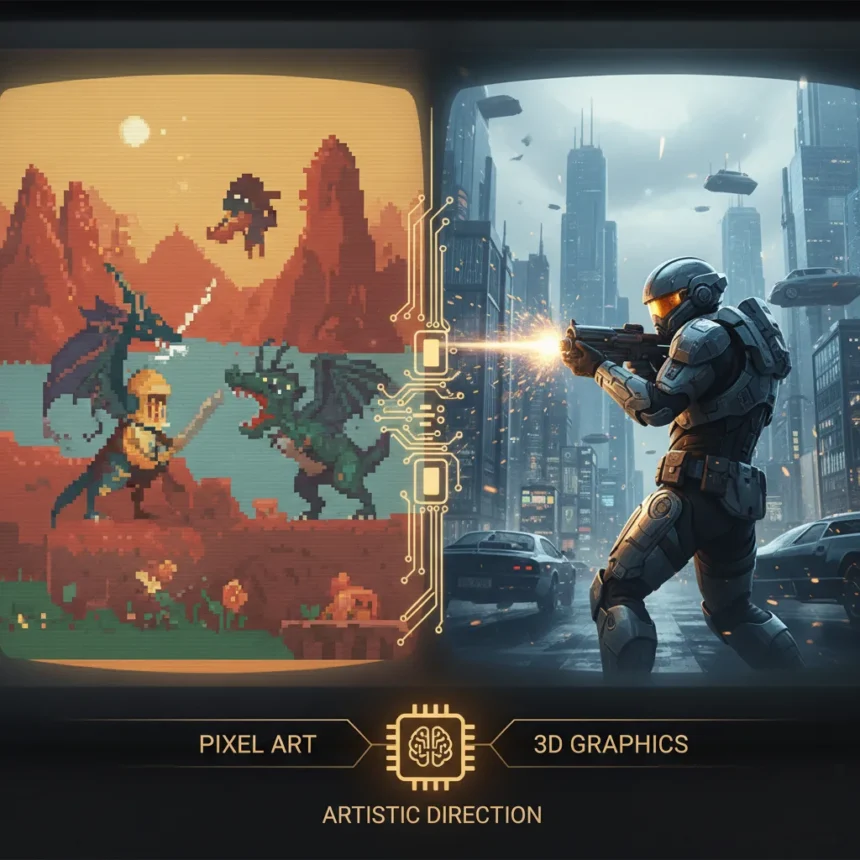
Pixel art visual design has become the defining proof that a game’s longevity depends on artistic direction, not hardware horsepower. While modern 3D engines promise photorealism and latest rendering, classic 2D pixel art games continue to captivate players with a clarity, charm, and intentionality that many contemporary titles struggle to match.
Key Takeaways
- Pixel art visual design prioritizes artistic intent over technical specifications, creating timeless appeal.
- Retro games like Metal Slug demonstrate that careful animation and sprite work outlast graphical trends.
- Modern cloud gaming services include classic pixel art titles, showing sustained player demand.
- Neo Geo hardware constraints forced developers to maximize visual impact through creative limitation.
- Contemporary game design often sacrifices artistic cohesion for graphics processing power.
Why Pixel Art Visual Design Transcends Technical Limitations
Pixel art visual design succeeds because it treats every frame as intentional artwork rather than a byproduct of rendering calculations. Developers working within strict hardware constraints had no choice but to perfect animation cycles, color palettes, and character silhouettes. Each sprite required deliberate design choices—how many pixels for a sword swing, which colors convey emotion, whether a jump arc reads clearly on a CRT screen. This discipline created games that remain visually striking three decades later.
Modern games often rely on polygon counts and shader complexity to convey visual richness. A character model might contain millions of polygons, yet feel less expressive than a 16-frame sprite animation carefully crafted for a specific pose. The pixel art visual design approach forced developers to communicate character personality through posture, timing, and subtle color shifts rather than microscopic facial details.
The Neo Geo Standard: How Constraints Built Excellence
The Neo Geo arcade hardware became the proving ground for pixel art visual design mastery. Developers working on the system understood its limitations and turned them into advantages. Rather than chase raw processing power, they focused on animation quality, sprite variety, and visual feedback that made every action feel weighty and responsive.


This constraint-driven approach produced games that feel more polished than many modern titles despite using a fraction of the memory and processing power. A character’s walk cycle in a Neo Geo game contains more personality than a motion-captured walk in a current-generation 3D game because every frame was hand-crafted to read clearly and feel satisfying. Pixel art visual design demanded this level of craft—there was no way to fake it with post-processing effects or particle systems.
Pixel Art Visual Design in the Cloud Gaming Era
The resurgence of pixel art visual design appears directly in how cloud gaming services curate their libraries. Services now offer access to classic 2D games alongside modern AAA titles, and player engagement data tells a clear story: people actively choose the pixel art games. These aren’t nostalgia plays—younger players discovering these games for the first time recognize that pixel art visual design delivers visual clarity and character readability that modern games often obscure with motion blur, depth of field, and post-processing filters.



Retro handheld consoles and re-releases continue to sell because pixel art visual design has aged better than early 3D graphics. A game rendered in 640×480 pixels with hand-drawn sprites remains visually coherent and intentional. A game rendered in 480p with early polygon models and flat textures looks dated by comparison. The pixel art visual design approach created art that transcends its technical era.
Animation Craft Over Raw Rendering Power
The real gap between pixel art visual design and modern graphics comes down to animation intentionality. A classic arcade game might have 20 frames of animation for a character’s attack sequence. Every frame communicates something—anticipation, impact, recovery. A modern game might use motion capture to generate hundreds of animation frames, yet the character’s attack feels less impactful because the motion capture data lacks the exaggerated timing that makes action feel responsive.
Pixel art visual design forced developers to master the fundamentals of animation: squash and stretch, anticipation, staging. These principles, established by Disney animators in the 1930s, created visual language that modern game developers often overlook in pursuit of technical fidelity. The result is that a carefully animated pixel sprite reads more clearly and feels more satisfying than a photorealistic model performing a generic motion-captured action.
Why Modern Games Struggle With Visual Cohesion
Modern game development splits visual responsibility across multiple systems: rendering engines handle lighting, physics engines handle movement, animation systems handle character motion, post-processing handles effects. This fragmentation often results in visually incoherent games where characters move through environments that feel disconnected from their actions. A character’s footstep sounds don’t sync with the animation, lighting doesn’t respond to character movement, particle effects float independently from the action.


Pixel art visual design required everything to work together because everything was created by the same artist or small team. A character’s shadow was drawn as part of the sprite. Dust clouds were timed to match footsteps. Every visual element reinforced the action. This unified approach created games that feel more responsive and satisfying, even with vastly less technical power.
The Lasting Appeal of Intentional Visual Direction
Games designed with pixel art visual design remain playable and visually appealing because they prioritized visual clarity and artistic intent over technical specifications. A player can instantly read what is happening on screen, understand character capabilities from their stance and animation, and feel the impact of their actions through visual feedback. These principles matter more than polygon counts or shader complexity.
The fact that retro games continue to appear in modern gaming libraries, on new hardware, and in player preferences suggests that pixel art visual design solved a fundamental problem that modern graphics have made more complicated: how to make a game feel responsive, clear, and visually satisfying. Modern technology offers more tools, but pixel art visual design proves that limitations often force better creative decisions.
Does pixel art visual design still matter in modern gaming?
Yes. Pixel art visual design remains relevant because it demonstrates that artistic direction and animation craft create lasting visual appeal. Modern indie games continue to use pixel art not out of nostalgia but because it solves real design problems: clarity on small screens, faster asset production, and timeless aesthetics that don’t rely on rendering trends.
Why do retro games look better than some modern games?
Retro games prioritized every pixel through intentional animation and color work. Modern games often rely on rendering power to compensate for less careful artistic direction. Pixel art visual design forced developers to master fundamentals like timing, staging, and character readability—skills that modern teams sometimes overlook.
Can pixel art visual design compete with 3D graphics?
In terms of raw technical capability, no. But in terms of visual clarity, character appeal, and lasting aesthetic value, pixel art visual design often wins. Players continue choosing retro games over modern alternatives, proving that artistic intent matters more than processing power in creating games that feel good to play and watch.
Pixel art visual design isn’t a relic of technical limitation—it’s a proven artistic approach that modern game development has largely abandoned in favor of pursuing graphical fidelity. The enduring popularity of retro games suggests the industry made a trade-off that didn’t pay off. Clarity, responsiveness, and intentional animation created games that remain visually striking decades later. Modern graphics technology has given developers more power but hasn’t given them better tools for creating games that feel as satisfying to play or as timeless to look at.
Edited by the All Things Geek team.
Source: Creativebloq




