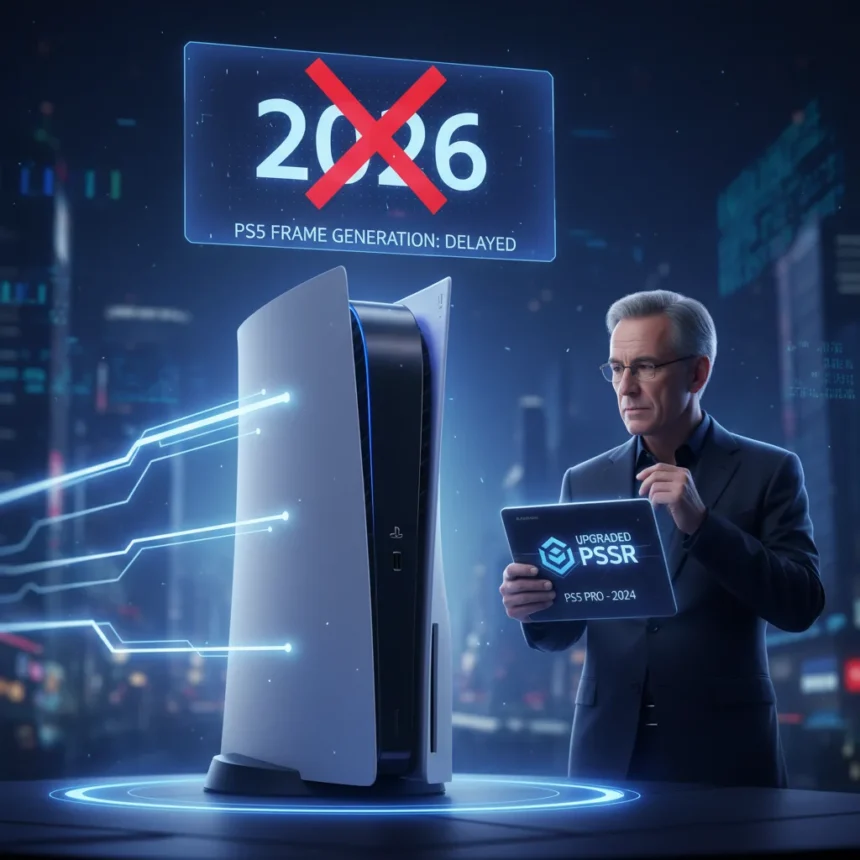
Mark Cerny, lead system architect for PlayStation, confirmed in a recent Digital Foundry interview that PS5 frame generation based on AMD’s FSR technology is coming to PlayStation consoles—but gamers will have to wait until 2027 or beyond. When asked about upcoming releases, Cerny stated: “All I can say is that we have no more releases planned for this year,” signaling that frame generation remains years away despite the feature’s proven success on PC.
Key Takeaways
- PS5 frame generation won’t arrive in 2026; 2027 or later is more likely
- Upgraded PSSR, derived from AMD’s FSR 4, is rolling out to PS5 Pro in March 2026
- Mark Cerny confirmed AMD and Sony are partnering on next-generation PlayStation development
- PSSR 2.0 uses the full-fat co-developed algorithm, not a cut-down version
- Resident Evil Requiem will be the first PS5 Pro title showcasing upgraded PSSR
The Frame Generation Gap: Why PlayStation Lags Behind PC
AMD’s FSR Frame Generation has been available on PC since 2023, delivering substantial frame rate boosts on compatible graphics cards. PlayStation remains conspicuously absent from that ecosystem, even as Nvidia’s DLSS 4.5 and Multi Frame Generation continue advancing on competing hardware. The delay matters because frame generation—an AI-driven technology that synthesizes intermediate frames—represents one of the fastest ways to boost performance on aging silicon. PS5, launched in 2020, desperately needs such tools as developers push its aging RDNA architecture to breaking point.
Cerny’s confirmation that frame generation is coming “at some point” but explicitly not in 2026 suggests Sony is prioritizing stability over speed. The company cannot afford another PS5 Pro launch fumble like the initial PSSR rollout, which shipped with mixed results across titles. Building a robust, hardware-agnostic frame generation pipeline takes time—especially when partnering with AMD to ensure the technology works across both current-gen PS5 and the upcoming PS6.
PSSR 2.0 Arrives First: A Consolation Prize in March 2026
While PS5 frame generation remains stuck in development limbo, Sony is pushing out a significant PSSR upgrade to PS5 Pro this year. Cerny revealed that the upgraded PSSR is “the full-fat version of the co-developed super resolution” with AMD, not a cut-down variant. This matters because it means PlayStation is getting the same algorithmic improvements AMD deployed in FSR 4 on PC, but optimized for PlayStation’s specific hardware constraints.


The upgrade rolls out via free system software update in March 2026, with a new “Enhance PSSR Image Quality” setting available to players. Resident Evil Requiem will launch as the flagship title demonstrating the upgraded upscaler’s capabilities. Over 50 PS5 Pro titles already use the original PSSR, so this refresh will retroactively improve image quality across a substantial library without requiring developer intervention.
Cerny emphasized that this collaboration is “not for proprietary technology” but rather “trying to move the industry forward,” signaling that Sony views AMD partnership as a shared bet on AI upscaling as the future of console performance. The Project Amethyst partnership between AMD and Sony, which began in 2023, has progressed “faster than expected,” according to Cerny.

When Will PS5 Frame Generation Actually Launch?
Cerny’s cautious language—”at some point” rather than “in 2027” or “next year”—suggests even Sony does not have a firm timeline. PS6 is expected around 2027, though some analysts speculate potential delays to 2028-2029 due to chip shortages. Frame generation may arrive as a launch feature for PS6 rather than a retrofit for PS5 Pro, which would make business sense: new hardware can be engineered from day one to support the feature, whereas retrofitting it to five-year-old silicon introduces unpredictable performance quirks.
The competitive pressure is real. Nvidia’s DLSS ecosystem and AMD’s FSR 4 have normalized frame generation on PC. PlayStation’s absence from that conversation is becoming conspicuous. Waiting until 2027 or later risks ceding another year of performance-per-watt advantage to competitors, even if PS5 Pro’s PSSR 2.0 upgrade partially closes the gap.
Is PS5 frame generation worth the wait?
Yes, but only if Sony executes flawlessly. Frame generation can deliver 50-100% frame rate improvements on compatible titles, which transforms 30fps games into playable 60fps experiences. However, the technology is prone to artifacts and ghosting if poorly implemented. Sony’s cautious timeline suggests they are prioritizing stability over speed, which is the right call after the rocky PSSR launch.
Will PS5 Pro get frame generation in 2026?
No. Mark Cerny explicitly stated that PS5 Pro has no new releases planned for 2026, and frame generation is not coming this year. PS5 Pro is receiving the PSSR 2.0 upgrade instead, which improves upscaling quality but is not the same as frame generation.


How does PSSR 2.0 differ from frame generation?
PSSR 2.0 is a super-resolution upscaler that reconstructs high-resolution images from lower-resolution renders. Frame generation synthesizes entirely new frames between rendered frames, boosting frame rate. Both are AI-driven, but PSSR 2.0 improves visual clarity while frame generation improves smoothness.
PlayStation’s frame generation delay is frustrating but unsurprising. Sony is betting that PSSR 2.0 will hold the line until PS6 arrives with native frame generation support. Whether that strategy pays off depends on how aggressively developers adopt the upgraded upscaler and whether the performance gains feel substantial enough to justify another year of waiting. For now, PS5 Pro owners get a March 2026 gift in the form of better upscaling—not quite frame generation, but a meaningful step forward.
Edited by the All Things Geek team.
Source: TechRadar