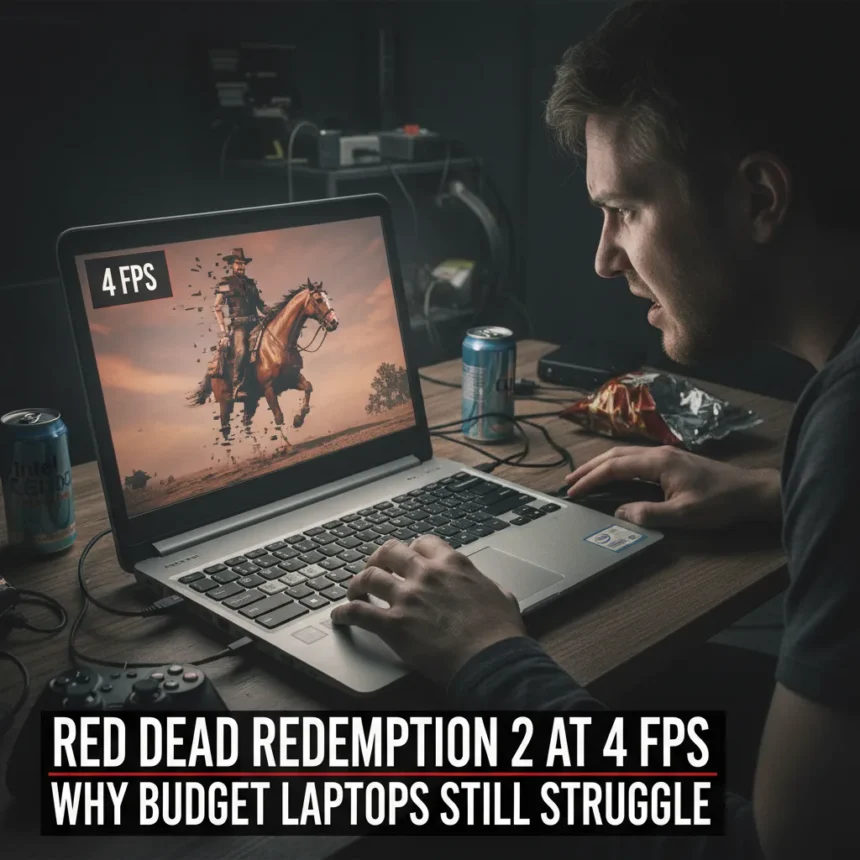
Red Dead Redemption 2 performance on budget hardware remains brutally unforgiving, as Danish streamer Mongo TV discovered when attempting to play Rockstar’s sprawling western epic on an Intel Core i5-8300H laptop paired with a GeForce GTX 1050 Ti 4GB graphics card. The result was catastrophic: a mere 4 frames per second, turning the opening chapter into a 12-hour endurance test and projecting a full playthrough at an estimated 471 hours.
Key Takeaways
- Mongo TV’s i5-8300H and GTX 1050 Ti setup averaged 4 FPS on Red Dead Redemption 2, making the game nearly unplayable.
- Chapter 1 alone consumed 12 hours of playtime at this frame rate, suggesting a 471-hour completion time for the full campaign.
- The viral video highlights Red Dead Redemption 2’s demanding optimization even years after launch on older laptop hardware.
- Budget players can achieve 60 FPS at 1080p using a GTX 1660 Ti or Vega 56 with proper settings adjustment.
- Low-end tweaks like reducing resolution scale to 0.8-0.9x and disabling MSAA can boost FPS significantly without severe visual degradation.
Why Red Dead Redemption 2 Performance Tanks on Budget Hardware
Red Dead Redemption 2 performance remains one of gaming’s most notorious optimization challenges, demanding far more from systems than competitors of similar scale. Rockstar’s 2018 open-world masterpiece was engineered with high-end PC hardware in mind, and the gap between minimum and recommended specs is vast. An i5-8300H processor, released in 2017 as a mid-range mobile chip, simply cannot keep pace with the game’s CPU-intensive physics, AI, and rendering demands. Pair that with a GTX 1050 Ti—a budget mobile GPU from the same era—and the result is catastrophic frame rates that render the game nearly unplayable.
Mongo TV’s viral playthrough exposed this gap in brutal detail. At 4 FPS, every action becomes a slideshow: looting a corpse, riding a horse, or navigating a menu all move in slow motion. The streamer’s persistence became the story itself, turning a technical disaster into content that resonated with viewers frustrated by Red Dead Redemption 2 performance issues on their own aging rigs. The projection of 471 hours for a full playthrough—assuming Chapter 1’s pace holds across the entire campaign—underscores just how unforgiving Rockstar’s engine can be when hardware falls short.
Red Dead Redemption 2 Performance: What Actually Works
Not all budget setups fail as spectacularly as Mongo TV’s. A GTX 1660 Ti or AMD Vega 56 can deliver smooth 60 FPS gameplay at 1080p with moderate settings, proving that Red Dead Redemption 2 performance is achievable without flagship hardware. Older systems like an i7-3770 paired with 16GB RAM and a GTX 1070 can even push ultra settings above 60 FPS when properly optimized, delivering a 65 percent FPS boost over default presets through targeted tweaking. The difference between unplayable and smooth, it turns out, is not always about raw hardware—it is about understanding which settings destroy frame rates and which can be safely adjusted.


For players stuck with truly budget setups, aggressive optimization remains possible. Reducing the resolution scale from 1.0 to 0.8 or 0.9 yields noticeable FPS gains with minimal perceived blur. Disabling MSAA anti-aliasing and setting reflection quality to low or medium can add 10 to 20 frames per second. Water refraction and physics effects, when set to medium or lower, contribute another significant boost. These tweaks do not require new hardware—they require knowledge of which settings matter most. Red Dead Redemption 2 performance can improve dramatically when players stop treating the graphics menu as an all-or-nothing proposition and instead pick their battles.
The Larger Question: Should Games Demand This Much?
Mongo TV’s viral moment raises a legitimate question about Red Dead Redemption 2 performance expectations. Five years after launch, the game remains one of the most demanding titles available, yet millions of players own hardware that cannot run it smoothly. This is not a case of ancient hardware—the i5-8300H and GTX 1050 Ti represent machines that are still actively used by students, travelers, and budget gamers worldwide. Should a game released in 2018 still be this punishing on 2017-era mobile hardware?



Rockstar’s answer has been silence. No major optimization patch has arrived to improve Red Dead Redemption 2 performance on budget systems, no scaled-down graphics presets designed specifically for older GPUs. The studio’s focus has remained on Red Dead Online and its monetization, not on making the single-player campaign accessible to players on aging laptops. This stands in contrast to other demanding titles that have received significant performance updates over time, allowing older hardware to play at acceptable frame rates. For budget players, Red Dead Redemption 2 remains a locked door, and Mongo TV’s 4 FPS stream is a reminder of exactly how locked.
Is Red Dead Redemption 2 unplayable on older laptops?
Yes, on truly budget setups like Mongo TV’s i5-8300H and GTX 1050 Ti combination, Red Dead Redemption 2 performance drops below acceptable thresholds. At 4 FPS, the game is effectively unplayable. However, older but more capable hardware—such as an i7-3770 with GTX 1070—can achieve 60+ FPS with optimization, so the verdict depends on your specific system’s specs.
Can I improve Red Dead Redemption 2 performance without upgrading?
Yes. Reducing resolution scale to 0.8-0.9x, disabling MSAA, and setting reflection quality to low or medium can significantly boost frame rates. Water refraction and physics effects set to medium or lower add another 10-20 FPS. These tweaks do not require new hardware, only careful adjustment of the graphics menu.
What GPU do I need for smooth Red Dead Redemption 2 performance?
A GTX 1660 Ti or AMD Vega 56 can deliver 60 FPS at 1080p with moderate settings. For higher frame rates or ultra settings, more powerful GPUs are required, but these represent the minimum threshold for smooth, playable Red Dead Redemption 2 performance on modern systems.


Mongo TV’s viral stream serves as both a cautionary tale and a reality check. Red Dead Redemption 2 performance remains brutally demanding, and budget hardware will struggle—sometimes catastrophically. Yet the story is not entirely bleak. Players willing to optimize settings intelligently can squeeze far more performance from aging systems than default presets allow. The gap between 4 FPS and 60 FPS is not always measured in hardware dollars; sometimes it is measured in knowledge and patience. For those with truly budget rigs, however, Red Dead Redemption 2 may simply remain a game to watch others play.
Edited by the All Things Geek team.
Source: Tom's Hardware