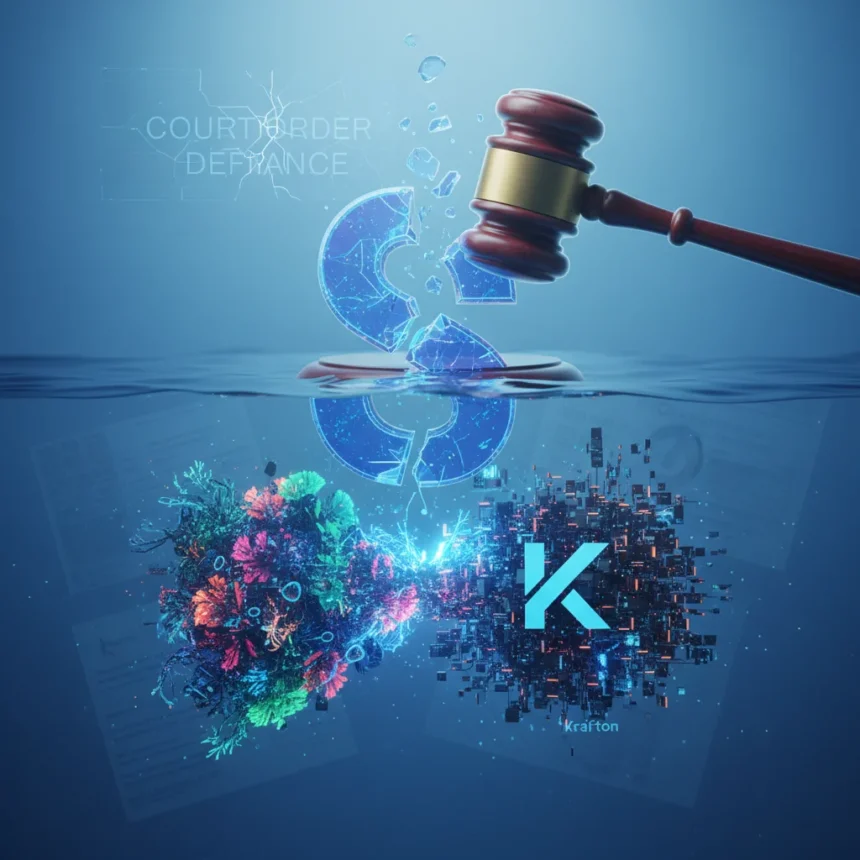
The Subnautica 2 publisher dispute has taken another sharp turn, with Unknown Worlds founders accusing Krafton of defying a court order by unilaterally announcing the game’s Early Access launch — an act their legal team describes as “self-serving” and directly contrary to the ruling that reinstated CEO Ted Gill’s operational control. This is not a minor procedural squabble. It is a high-stakes legal battle with a $250 million earnout bonus and the fate of one of gaming’s most anticipated sequels hanging in the balance.
Key Takeaways
- Delaware Chancery Court ruled Krafton breached its agreement with Unknown Worlds founders by firing key employees without valid cause.
- CEO Ted Gill has been reinstated with full operational control over Subnautica 2’s Early Access launch on Steam, Epic Games Store, Xbox, and Xbox Game Pass.
- Founders accused Krafton of announcing Early Access despite the court order giving Gill exclusive authority over that decision.
- The earnout Testing Period — tied to a $250 million performance bonus — has been extended to at least September 15, 2026.
- Phase two of litigation is ongoing and will assess monetary damages from the firings.
What the Delaware Court Actually Ruled
Vice Chancellor Lori W. Will of the Delaware Chancery Court ruled decisively in favor of the founders following a three-day trial in November 2025 and oral arguments in January 2026. The ruling found that Krafton breached the Equity Purchase Agreement by terminating key employees without valid cause and seizing operational control of Unknown Worlds. Ted Gill was ordered reinstated as CEO with immediate effect, and Krafton was required to restore his access to the Steam platform without delay.
The court’s language was pointed. Will wrote that the founders “did not loot the company to enrich themselves, steal data to form a competing venture, or sell secrets to a rival” — directly dismissing Krafton’s claims of negligence, data theft, and abandonment. Data downloads by the founders were characterized as “protective measures” driven by a “good faith, defensive motive,” not theft. The court also declared the July 1, 2025 board resolution ineffective to the extent it infringed on Gill’s operational control rights.
Perhaps most damning for Krafton, the ruling stated that the company, “frustrated by the key employees’ refusal to forfeit operational control and facing a nine-figure liability, went searching for pretext” — and that the court of equity would not permit use of after-acquired evidence to fabricate cause.

The Subnautica 2 Publisher Dispute Over Early Access Timing
The core of the Subnautica 2 publisher dispute has always been about timing — and money. Founders Ted Gill, Charlie Cleveland, and Max McGuire filed suit in July 2025, alleging that Krafton delayed the Early Access release from 2025 to 2026 in a deliberate attempt to avoid paying a $250 million performance-based earnout bonus tied to the game’s commercial success. The court’s response was to extend the earnout Testing Period by 258 days, pushing the base deadline to September 15, 2026, with the Fortis law firm retaining the right to extend it further to March 15, 2027.
Now, in what the founders’ legal team is treating as a fresh violation, Krafton appears to have announced the Early Access launch date without Gill’s authorization — precisely the kind of unilateral action the court order was designed to prevent. Whether this constitutes contempt of court or simply aggressive corporate maneuvering will likely be tested in the ongoing second phase of litigation, which is focused on monetary damages.
Why This Case Matters Beyond Subnautica 2
It’s easy to frame this as a gaming drama, but the implications stretch further. The Unknown Worlds situation is a case study in what can go wrong when a beloved independent studio is acquired by a larger publisher under an earnout structure — where founders retain a financial stake contingent on hitting performance targets after acquisition. These structures are common in tech and gaming acquisitions, and the Subnautica 2 case illustrates how badly they can fracture when the acquiring party allegedly moves to undermine the very conditions that would trigger the payout.
There is no direct equivalent case in gaming that has been litigated this publicly and at this scale. The $250 million figure dwarfs typical indie studio earnouts, and the fact that it went to trial — rather than settling quietly — suggests both sides believe their position is strong. Krafton has stated it “respectfully disagrees” with the ruling and is “evaluating options,” while maintaining its focus on delivering the best possible game. That is standard post-ruling corporate language, but the founders’ claim that Krafton then immediately violated the order suggests the dispute is far from resolved.
Is Subnautica 2 still coming to Early Access?
Yes. The court has ordered that the Early Access launch on Steam, Epic Games Store, Microsoft Store, Xbox Series X|S, and Xbox Game Pass proceed under reinstated CEO Ted Gill’s authority. The founders have consistently maintained the game was ready for Early Access, and the court found no credible evidence of abandonment or negligence on their part.
What happens if Krafton keeps defying the court order?
That is exactly what the founders’ legal team is now arguing before the Delaware Chancery Court. If Krafton is found to have violated the order by announcing Early Access without Gill’s authorization, it could face contempt proceedings and further judicial sanctions. Phase two of the litigation, currently assessing monetary damages, would likely factor in any ongoing non-compliance.


What is the $250 million earnout and why does it matter?
The earnout is a performance-based bonus written into the Equity Purchase Agreement when Krafton acquired Unknown Worlds. It pays out if Subnautica 2 hits specified commercial targets during a defined Testing Period. The court extended that period by 258 days to September 15, 2026, after finding Krafton’s actions had eaten into the founders’ window to earn it. At $250 million, it is the single biggest financial stake in this dispute and the most plausible explanation for why both sides are fighting this hard.
The Subnautica 2 publisher dispute is no longer just a story about a studio and its publisher falling out — it is a live legal test of whether earnout agreements in gaming acquisitions can be enforced when a publisher decides the payout is too expensive to honor. The Delaware court has drawn a clear line. Whether Krafton respects it will define both the game’s future and the precedent this case sets for every studio founder negotiating an acquisition deal.
Where to Buy
Edited by the All Things Geek team.
Source: Windows Central