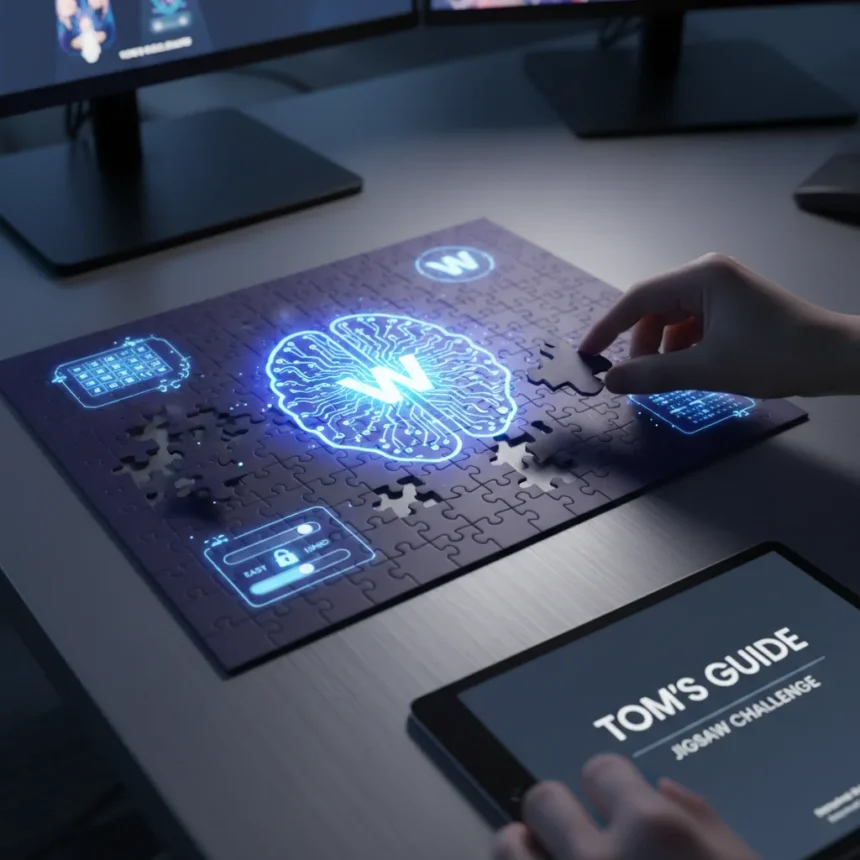
Tom’s Guide jigsaw puzzles are virtual brain-teasers with adjustable difficulty levels, launched to offer readers a fresh way to spend time between daily word games. The puzzles feature a custom difficulty system, including a hard mode that the publication claims is genuinely challenging enough to stump experienced players.
Key Takeaways
- Tom’s Guide launched virtual jigsaw puzzles with three adjustable difficulty levels.
- Hard mode is designed for advanced players and reportedly stumps experienced solvers.
- Puzzles serve as a time-killer alternative to daily word games like Wordle.
- Competitors like Ravensburger and Puzzlefolk offer physical puzzles with varying quality standards.
- Virtual puzzles eliminate the need for table space and physical storage.
What Makes Tom’s Guide Jigsaw Puzzles Stand Out
Tom’s Guide positions its new jigsaw puzzles as a direct challenge to readers: beat the publication at its own game. The core appeal lies in the custom difficulty framework, which allows players to adjust complexity based on skill level. This tiered approach contrasts with traditional physical puzzles, which offer a fixed challenge regardless of experience. The hard difficulty tier is explicitly marketed toward what Tom’s Guide calls elite minds, suggesting the puzzles are designed with competitive appeal in mind.
The timing of this launch aligns with broader 2026 trends emphasizing premium puzzle experiences and brain-teaser games as alternatives to word-based daily challenges. Unlike Wordle, which offers one puzzle per day, Tom’s Guide puzzles provide on-demand entertainment without time constraints, making them ideal for extended play sessions or quick mental breaks.
How Tom’s Guide Jigsaw Puzzles Compare to Physical Alternatives
Virtual puzzles eliminate logistical friction that physical jigsaws demand. Ravensburger’s New York Skyline puzzle, for example, requires substantial table space and features 2,000 pieces with anti-glare surfaces and extra-thick cardboard that interlock securely, but demands a dedicated workspace. The Ravensburger Zodiac variant with 3,000 pieces requires a table measuring 48 by 32 inches—a constraint that makes it impractical for many homes.

Tom’s Guide’s digital format sidesteps storage and space issues entirely. However, physical puzzles offer tactile satisfaction and a finished product suitable for framing. For players seeking challenging color-blend difficulty, BetterCo’s Modern Art and Gradient puzzles deliver genuinely tricky visual assembly, though they present accessibility challenges for visually impaired solvers. Sunsout puzzles feature odd shapes and color blends in browns and whites that complicate assembly, yet deliver solid cut quality and enjoyable piece design.
Brands like Puzzlefolk emphasize family-friendly appeal with vibrant art themes, thick pieces, and minimal dust, while Birdie puzzles feature random ribbon cuts and matte finishes with quirky cityscapes. None of these traditional options match the instant accessibility and adjustable difficulty of a digital platform, though they provide physical completion rewards that virtual puzzles cannot replicate.
Is the Hard Difficulty Actually Hard?
Tom’s Guide’s claim that hard mode stumps the publication’s own team is a bold marketing statement, but the brief lacks independent verification of actual difficulty. No piece counts, image complexity ratings, or user completion data are provided to substantiate whether the hard tier genuinely outpaces established premium brands. The assertion that it challenges elite minds reads as promotional positioning rather than measured difficulty assessment.
Without comparative testing against Ravensburger’s most complex offerings or detailed metrics on color gradation and piece cut randomness, the hard mode’s true challenge level remains unverified. Readers accustomed to Sunsout’s tricky color blends or BetterCo’s gradient challenges may find the difficulty assessment subjective. The publication’s internal stumbling is anecdotal evidence at best.
Why Virtual Puzzles Work as Wordle Alternatives
Wordle’s single daily puzzle creates artificial scarcity—once solved, players must wait 24 hours for the next challenge. Tom’s Guide jigsaw puzzles remove this friction by offering unlimited on-demand gameplay. For players who exhaust Wordle in minutes, a puzzle system with adjustable difficulty provides extended engagement without waiting.
The brain-teaser appeal overlaps but differs from word games. Jigsaw solving emphasizes spatial reasoning and pattern recognition, while Wordle demands vocabulary and deduction. Offering both satisfies different cognitive preferences within the same audience. The time-killer positioning acknowledges that many players seek low-stakes entertainment during work breaks or commutes—a use case where physical puzzles become impractical but digital alternatives shine.

Are Tom’s Guide Jigsaw Puzzles Worth Your Time?
If you’re already a Wordle devotee seeking a complementary brain-teaser, Tom’s Guide puzzles offer zero friction entry—no purchase, no storage, no setup. The adjustable difficulty means casual and experienced players can both find suitable challenges. However, if you prefer physical completion, tactile satisfaction, or puzzle display, traditional brands like Ravensburger remain superior despite their logistical demands.
The real test is whether the hard mode delivers genuine stumping power. Until independent players report completion times and difficulty comparisons, Tom’s Guide’s claim remains marketing assertion rather than verified fact. For time-killing between Wordles, the puzzles serve their stated purpose effectively. For serious puzzle enthusiasts, physical alternatives with proven quality standards like Ravensburger and Puzzlefolk may still hold appeal.
Can you actually beat Tom’s Guide at their own game?
Tom’s Guide frames this as a challenge, but the publication hasn’t disclosed completion rates, average solving times, or user success metrics. Without this data, claiming victory against the hard mode is more about personal satisfaction than measurable achievement. The puzzles appear designed to challenge, yet the marketing language outpaces the available evidence.
How do Tom’s Guide jigsaw puzzles compare to Wordle?
Both are daily brain-teaser alternatives, but they engage different cognitive skills. Wordle focuses on vocabulary and deductive reasoning within a 5-letter constraint, while jigsaw puzzles emphasize spatial reasoning and pattern matching. Tom’s Guide puzzles offer unlimited plays per day, whereas Wordle restricts users to one daily puzzle, making jigsaws better for extended sessions.
What difficulty level should I choose for Tom’s Guide jigsaw puzzles?
The publication offers custom difficulty settings, allowing you to match your skill level. Casual players should start with lower tiers to learn the interface and mechanics. If you regularly solve Wordle without hints, the hard mode may provide appropriate challenge, though Tom’s Guide’s own stumbling suggests it genuinely tests experienced solvers. Start lower and escalate if you find early levels too simple.
Tom’s Guide’s jigsaw puzzles represent a smart expansion into brain-teaser entertainment, filling the gap between daily word games and time-consuming physical puzzles. The hard difficulty’s credibility hinges on independent user feedback and completion data that the publication hasn’t yet released. For now, they’re a frictionless alternative to Wordle, though their true challenge level remains unverified by external testing.
Where to Buy
Shop Amazon's entire early spring sale | 5% OFF1000 Piece 3D Puzzle Cave Forest Jigsaw Puzzle$21.84$22.99shop now | 47% OFF1000 Piece Mosaic Tree of Life Jigsaw Puzzle$15.99$29.99shop now | 15% OFF1000 Piece US National Parks Jigsaw Puzzle$15.29$17.99shop now | 10% OFFPortable Roll-Up Jigsaw Puzzle Mat with 4 Sorting Trays$35.99$39.99shop now
Edited by the All Things Geek team.
Source: Tom's Guide