





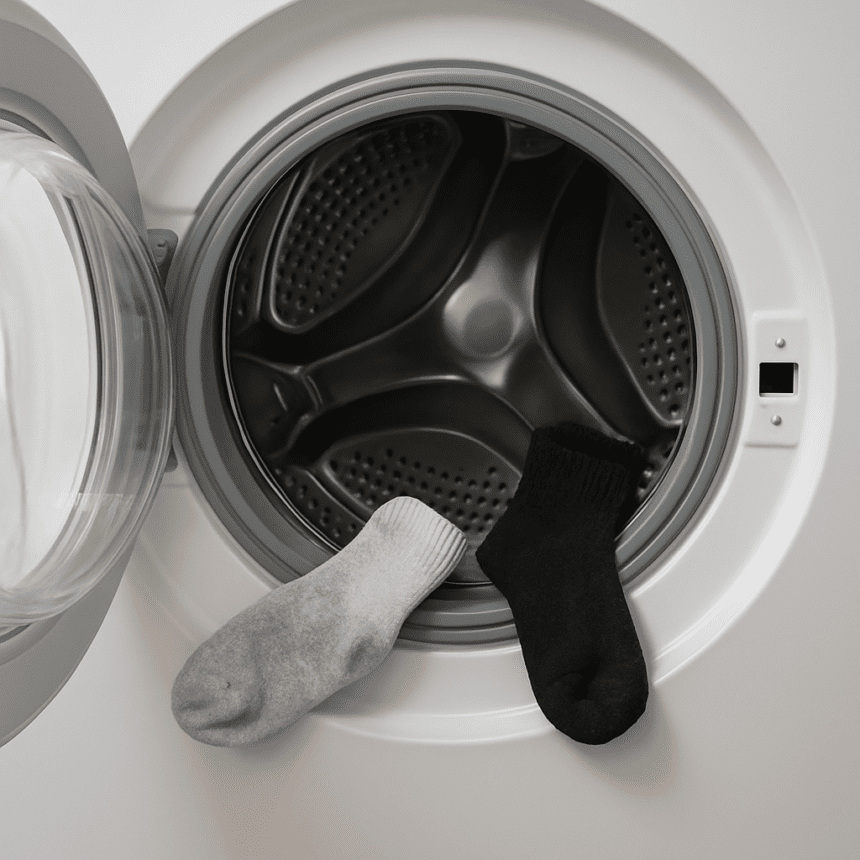
The missing socks mystery has frustrated households for generations, but it turns out the answer was hiding inside the washing machine itself all along. A gap between the inner drum and the outer walls of the washer acts as a mechanical trap, silently collecting socks during every cycle. Real estate student Gillimar Alves, 26, from Katy, Texas, confirmed this in a video posted on May 28, 2021, after watching a sock fall into the gap while unloading laundry and then dismantling a side panel to investigate.
Where exactly do missing socks go in a washing machine?
Alves described the culprit precisely: a space between the inner drum, which he called the “little tub,” and the actual outer walls of the washer. His words for it were “a little black hole” and “an abyss.” When he removed an external panel using screwdrivers, he found multiple missing socks inside, including matching pairs that had vanished over time. The gap is not a manufacturing defect or a design flaw unique to one brand — it is a structural reality of how washing machines are built, present in machines across different types.
The spin cycle creates enough turbulence to push lightweight items like socks toward the edge of the drum. Once a sock reaches that outer rim, it can slip through the narrow gap and fall into the cavity between the drum and the machine’s outer casing. From there, it is effectively gone until someone opens a panel to look.
How to retrieve socks from your washing machine
Recovering trapped socks requires a bit of mechanical confidence but no specialist tools. Start by locating your washing machine’s model number, which is often printed on the machine itself or on the dryer nearby. Search that model number online for panel removal instructions specific to your unit, since panel attachment methods vary. Some panels are held in place with screws that you remove with a standard screwdriver. Others use small clips that need to be pushed back — you may need to dig under them before the panel releases. Pull the panel away from one side, then repeat the process on the other side. Once the panels are off, the gap between the drum and the outer walls becomes accessible and trapped socks can be pulled out by hand.


Front-loaders and the missing socks mystery
Front-loading washing machines have an additional failure point that top-loaders do not share in the same way. Appliance technician Tyler Murphy of Appliance Service by Paul explained that the rubber door boot — the seal around the front opening — can develop crevices where socks slip through. From there, Murphy noted, a sock goes “straight down into your drain pump.” Socks that reach the drain pump are not always retrievable without more significant disassembly, and Murphy found no socks in the filter or pump of the front-loader he inspected during a KSL investigation published on June 9, 2021. That does not mean the drain route never claims socks — it means the drum gap is the more common and more accessible hiding spot.
The drum gap issue affects both front-loaders and top-loaders, making it the more universal explanation for the missing socks mystery. The door boot crevice is specific to front-loading machines and represents a secondary risk rather than the primary one.



How to stop socks from disappearing in future washes
The simplest prevention method is a mesh laundry bag. Placing socks inside a mesh bag before loading the machine keeps them contained throughout the wash and spin cycles, removing any chance of them migrating toward the drum edge. This approach requires no tools, no panel removal, and no knowledge of your machine’s model number. It works for both front-loaders and top-loaders and eliminates the door boot crevice risk at the same time.
Beyond mesh bags, being attentive while unloading laundry helps catch the problem before it happens. Alves noticed a sock falling into the gap during a routine unload — that moment of observation led to his entire discovery. Watching for items near the drum rim as you pull clothes out gives you a chance to intercept socks before they disappear into the abyss.
Is the sock monster a real thing?
One viewer responding to coverage of this topic commented that she still believed in a “sock monster,” and while the sentiment is understandable, the mechanical explanation is far less dramatic. The gap between the drum and the outer tub is the primary culprit. Some socks do end up behind the machine rather than inside it, and others simply go missing elsewhere in the house. But for the socks that vanish during a wash cycle and never return, the drum gap is the most likely answer — and now it is one you can actually do something about.
Can I check my washing machine for trapped socks without a technician?
Yes. Gillimar Alves retrieved his missing socks by removing external panels himself using only screwdrivers. The key step is finding your machine’s model number first and looking up the specific panel removal method for that model, since clip and screw configurations differ between machines.



Do front-loading washing machines lose more socks than top-loaders?
Both machine types share the drum-to-outer-wall gap that traps socks. Front-loaders have an additional risk point in the door boot seal, which can channel socks toward the drain pump. However, technician Tyler Murphy found no socks in the drain pump of the front-loader he inspected, suggesting the drum gap remains the more common trap regardless of machine type.
The missing socks mystery turns out to be less supernatural and more structural than anyone suspected. A screwdriver, your machine’s model number, and a few minutes of patience are all it takes to solve a laundry puzzle that has baffled households for years — and a mesh bag is all it takes to make sure it never happens again.
Edited by the All Things Geek team.
Source: Tom's Guide


