





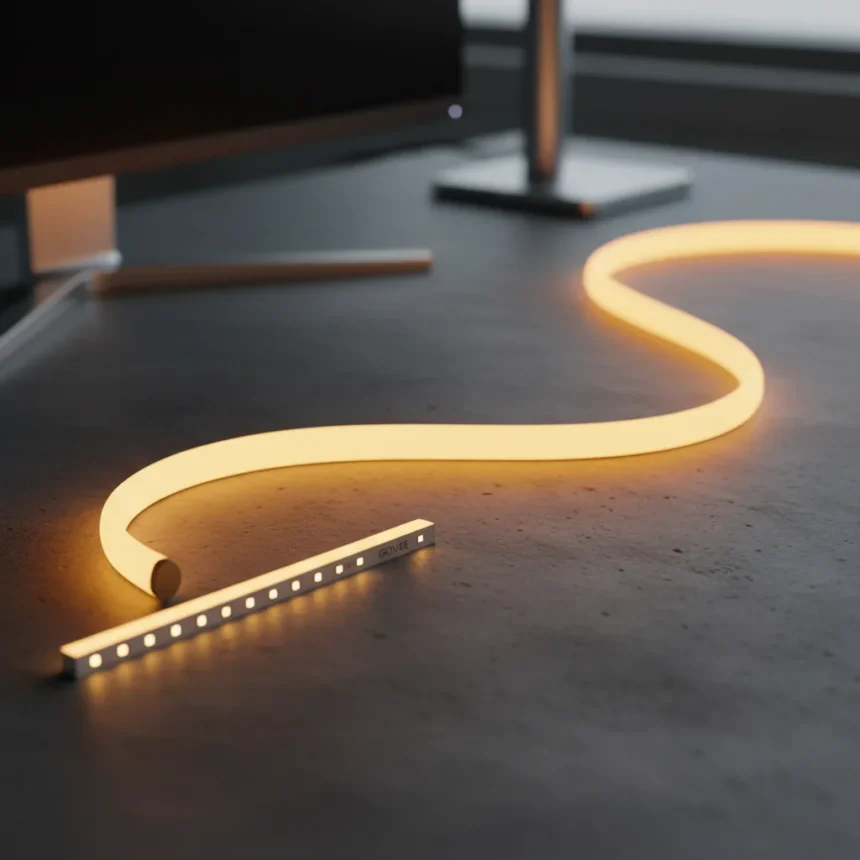
The Philips Hue OmniGlow lightstrip is a premium smart lightstrip made by Philips, available in 3m, 5m, and 10m lengths, priced from $139.99 to €349.99, and now rolling out across US and European markets. For years, every smart lightstrip has had the same visual compromise: visible LED dots marring what should be seamless color. The Philips Hue OmniGlow lightstrip finally fixes this, using CSP (Chip-Scale Package) micro-LED technology to deliver uniform light that reads more like neon than traditional LEDs.
Key Takeaways
- OmniGlow technology with 840 micro-LEDs per meter eliminates visible LED spots entirely
- 900 lumens per meter brightness—double Govee COB Pro’s 450 lumens per meter
- Supports RGBWW color, tunable white, and gradient effects across the strip
- Weak adhesive for TV mounting; protective film peels every 20cm during installation
- 3m version costs $139.99; non-extendable after cutting
The OmniGlow Technology That Changes Everything
The Philips Hue OmniGlow lightstrip delivers seamless, ultra-bright color and true white light with no visible LED spots—all thanks to its latest OmniGlow technology. The strip packs 840 LEDs per meter using CSP packaging, which spaces micro-LEDs so densely that light diffuses uniformly across the entire surface. This is not a minor tweak. Stand a meter away and you see pure color, not a string of individual dots struggling to blend. The 3m version outputs 2,700 lumens at 40W maximum, while the 5m and 10m versions hit 4,500 lumens at 60W—making it twice as bright as Govee’s premium COB Pro strip, which manages only 450 lumens per meter. At minimum brightness, the OmniGlow dims to 1%, achieving 10 times deeper dimming than Govee’s offering, giving you genuine ambient lighting control.
What matters here is the real-world experience. Brightness specs are one thing; uniform light distribution is another. The OmniGlow achieves both because CSP micro-LEDs spread light more evenly across the silicone diffuser than traditional COB (Chip-on-Board) designs. Govee’s higher LED density (1,260 per meter) sounds impressive on paper but translates to worse practical brightness and dimming performance—a reminder that more LEDs do not automatically mean better light.
Installation and Mounting Reality Check
The Philips Hue OmniGlow lightstrip is cuttable but non-extendable, measuring 17mm wide and 8.7mm tall with a white silicone sleeve. This thickness makes it heavier and chunkier than older Hue strips, which creates a real installation problem: the integrated adhesive is too weak for TV mounting, especially where heat and weight stress the back of a display. Philips wraps the strip in a protective film that peels every 20cm—meaning a 10-meter install requires removing and discarding 44 separate film pieces. This feels clunky for a premium product, and the interrupted adhesive surface makes mounting on vertical surfaces risky without additional brackets. For kitchen cabinets, stairwells, or ceiling coves where gravity helps, the adhesive works fine. Behind a TV, plan to reinforce it.


One advantage over older Hue strips: you can cut the OmniGlow to fit your space precisely, unlike the Hue Flux which allows extension post-installation. If you need flexibility after mounting, the Flux remains the better choice. For fixed installations like a 10-meter stairwell run, the OmniGlow’s non-extendable design is irrelevant—you buy the exact length you need.
Control and Color Gradients in the Hue App
The Philips Hue OmniGlow lightstrip supports RGBWW (full color plus tunable white), Bluetooth, and Zigbee connectivity, meaning it works standalone via Bluetooth or integrates fully into your Hue Bridge ecosystem. The standout control feature is gradient creation: move three points around the color wheel in the Hue app, and the strip automatically distributes those colors across its length in smooth transitions. This is simpler than older Hue strips and beats Govee’s approach, which lacks this intuitive three-point gradient interface. The strip also supports Hue Sync TV app integration with three color zones, though this is broader and less precise than the seven-zone Play Gradient Lightstrip, which maps colors to specific screen edges more finely.


Voice control works via Alexa and Google Home integration through the Hue ecosystem. If you already own other Hue products, the OmniGlow slots smoothly into your setup. If you are starting fresh, Bluetooth control means you do not need a Hue Bridge, though a Bridge Pro unlocks advanced automations and remote access.
The Govee Comparison: Why the Premium Matters
Govee’s COB Pro premium strip costs roughly 40 percent less than the OmniGlow. So why choose Philips? Brightness and dimming are the clearest wins: 900 lumens per meter versus 450, and a 1% minimum versus Govee’s 10% floor. Light distribution is visibly superior on the OmniGlow—Govee’s higher LED density does not compensate for its weaker optical design. The Hue app’s three-point gradient tool is also faster than Govee’s interface for creating color effects. Govee’s ecosystem is larger, but if you value Philips’ Hue integration and want the absolute best light quality, the extra cost is justified.
What the OmniGlow Cannot Do (Yet)
The strip lacks running light effects and animated patterns—you get static colors and smooth gradients, but not chase or pulse modes. This is a software limitation, not a hardware one, so future updates could add these effects. For now, if you want dynamic animations, older Hue strips or Govee offer more variety.
Is the Philips Hue OmniGlow lightstrip worth buying?
Yes, if you want the best light quality and do not need post-installation extension. The seamless glow, brightness, and dimming depth justify the premium price. For TV mounting, reinforce the adhesive. For stairwells, cabinets, and ceilings, it is a no-compromise choice.


How does the OmniGlow compare to the older Hue Play Gradient Lightstrip?
The OmniGlow is brighter, dimmer, and has seamless glow with no visible LED dots. The Play Gradient has seven zones for finer TV sync mapping versus OmniGlow’s three broader zones. If TV color accuracy is your priority, Play Gradient wins; for overall light quality and brightness, OmniGlow dominates.
Can you extend the Philips Hue OmniGlow after cutting it?
No. Unlike the Hue Flux, the OmniGlow is non-extendable after cutting. Measure twice and cut once—there is no way to add length later.
The Philips Hue OmniGlow lightstrip is the best Hue lightstrip ever made, not because of flashy new features but because it finally solves the one problem that has plagued smart lightstrips for a decade: visible LED dots. If you have ever stared at a lightstrip and seen a string of individual points instead of seamless color, you understand why this matters. The CSP micro-LED design, 900 lumens per meter brightness, and 1% dimming depth make it a genuinely premium product that outperforms Govee in the ways that matter most—light quality, uniformity, and control. The weak adhesive and interrupted protective film are real frustrations, but they are installation issues, not product failures. For long runs like stairwells, kitchen islands, or feature walls, the OmniGlow is worth the investment.
Where to Buy
Edited by the All Things Geek team.
Source: TechRadar




