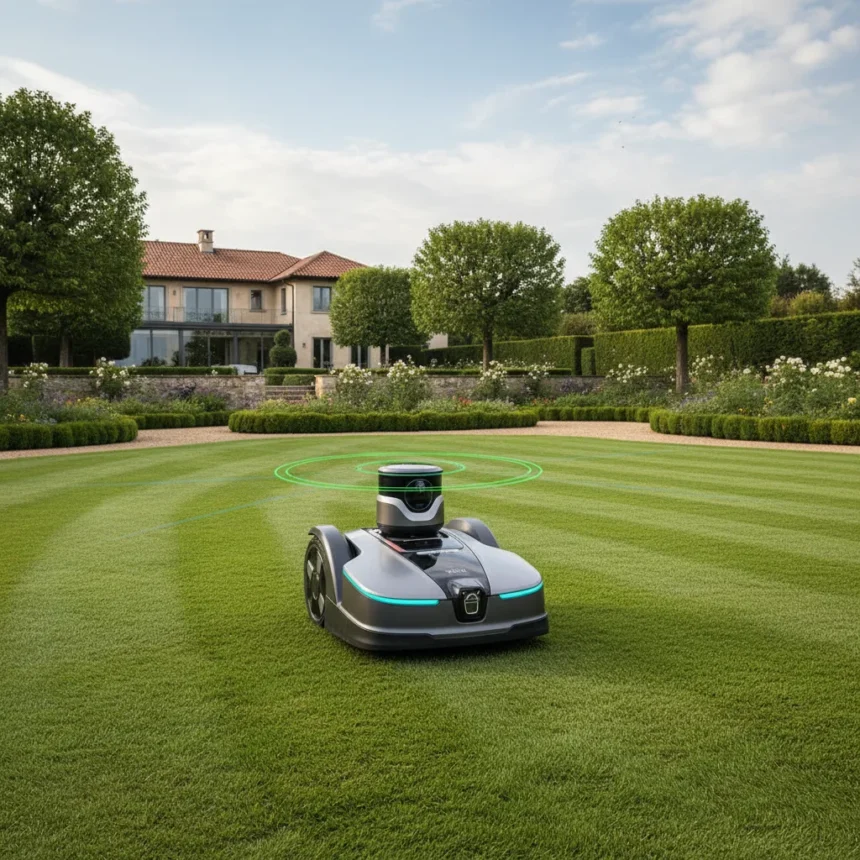
The Segway Navimow i208 LiDAR is a wire-free robot lawn mower that uses LiDAR navigation to map and maintain your garden without requiring perimeter wires. This represents a genuine shift in how robot mowers operate—eliminating the tedious boundary wire installation that has defined the category for years. For owners of larger, more complex gardens, it’s one of the smartest robot mowers available. For anyone with a modest lawn, it’s overkill.
Key Takeaways
- Wire-free setup eliminates perimeter wire installation entirely, saving setup time and effort.
- LiDAR navigation provides precise mapping and obstacle avoidance for complex garden layouts.
- Best suited to larger gardens; unnecessary complexity for smaller lawns.
- Represents a significant step forward in robot mower intelligence and autonomy.
- Solves a real problem for gardeners tired of wire-based boundary systems.
What Makes the Segway Navimow i208 LiDAR Different
Most robot mowers rely on perimeter wires buried or laid around your garden’s edges. You install these wires, the mower follows them, and it stays within bounds. It works, but it’s fussy—wires break, get exposed, require maintenance, and take hours to install properly. The Segway Navimow i208 LiDAR abandons this approach entirely. Instead, it uses LiDAR (Light Detection and Ranging) to scan your garden, build a detailed map, and navigate autonomously without any physical boundary markers.
This architectural difference matters more than it sounds. LiDAR navigation allows the mower to understand the precise layout of your garden—where trees are, where flower beds sit, where the fence runs. It can avoid obstacles dynamically rather than relying on preset boundaries. For gardens with irregular shapes, multiple levels, or dense planting, this precision is genuinely valuable. For a rectangular suburban lawn, it’s solving a problem you don’t have.
Is Wire-Free Navigation Worth the Complexity?
The appeal of eliminating perimeter wires is obvious: no installation hassle, no wire maintenance, no replacement when cables degrade. The Segway Navimow i208 LiDAR handles boundary detection automatically through its mapping system. This is a real convenience gain, particularly if your garden changes seasonally or you like rearranging planting areas.


But wire-free comes with a trade-off. The mower needs to be smarter, which means more processing power, more sensors, and a higher price point than basic wire-guided models. The complexity also means more can go wrong—sensor calibration, mapping errors, software updates. For a small garden where a simple wire-based mower would do the job perfectly, you’re paying for intelligence you’ll never fully use. The Segway Navimow i208 LiDAR is best suited to bigger gardens where its capabilities justify the investment.
How LiDAR Navigation Compares to Traditional Wire Systems
Wire-based robot mowers are proven, reliable, and cheaper. They follow a simple rule: stay inside the boundary. The downside is inflexibility—if you want to change where the mower can go, you have to move the wire. LiDAR-equipped mowers like the Segway Navimow i208 LiDAR learn your garden’s layout and adapt. They can identify obstacles in real time, plan more efficient mowing patterns, and handle complex terrain.



This makes the Segway Navimow i208 LiDAR superior for gardens with multiple zones, slopes, or frequent layout changes. A wire-based mower might struggle with these scenarios or require multiple boundary loops. The LiDAR approach is smarter, more flexible, and less dependent on physical infrastructure. For owners of larger properties with varied layouts, this advantage is substantial. For owners of standard rectangular lawns, it’s a nice-to-have rather than a must-have.
Who Should Actually Buy This Mower
If your garden is large, has irregular edges, includes multiple planting areas, or features obstacles like trees scattered throughout, the Segway Navimow i208 LiDAR is worth serious consideration. It removes the friction of wire installation and maintenance while delivering smarter navigation. The wire-free setup is a genuine quality-of-life improvement for gardeners who value convenience.
If your garden is small or straightforward, save your money. A traditional wire-based robot mower will handle the job just as effectively at a lower cost and without the added complexity. The Segway Navimow i208 LiDAR is clever, but cleverness is only valuable if it solves a real problem in your garden.
Is the Segway Navimow i208 LiDAR truly wire-free?
Yes, it requires no perimeter wires. The mower uses LiDAR to map your garden and navigate autonomously without physical boundary markers. You still need to charge it, but setup is dramatically simpler than traditional robot mowers.



Can the Segway Navimow i208 LiDAR handle slopes or uneven terrain?
The research brief does not specify the mower’s terrain handling capabilities or slope tolerance. Consult the manufacturer’s specifications for details on gradient performance and ground conditions.
What size garden is the Segway Navimow i208 LiDAR designed for?
It’s best suited to bigger gardens. Smaller lawns do not require its advanced LiDAR navigation and wire-free setup, making simpler, cheaper models a better choice for modest properties.
The Segway Navimow i208 LiDAR is a genuinely clever piece of garden technology that solves a real problem—the tedium of wire-based boundaries—for a specific audience. If you own a larger garden and value convenience over cost, it’s worth the investment. If you mow a small lawn and just want the job done, you’re better off elsewhere.
Where to Buy
40 Amazon customer reviews | £199.99
Edited by the All Things Geek team.
Source: T3