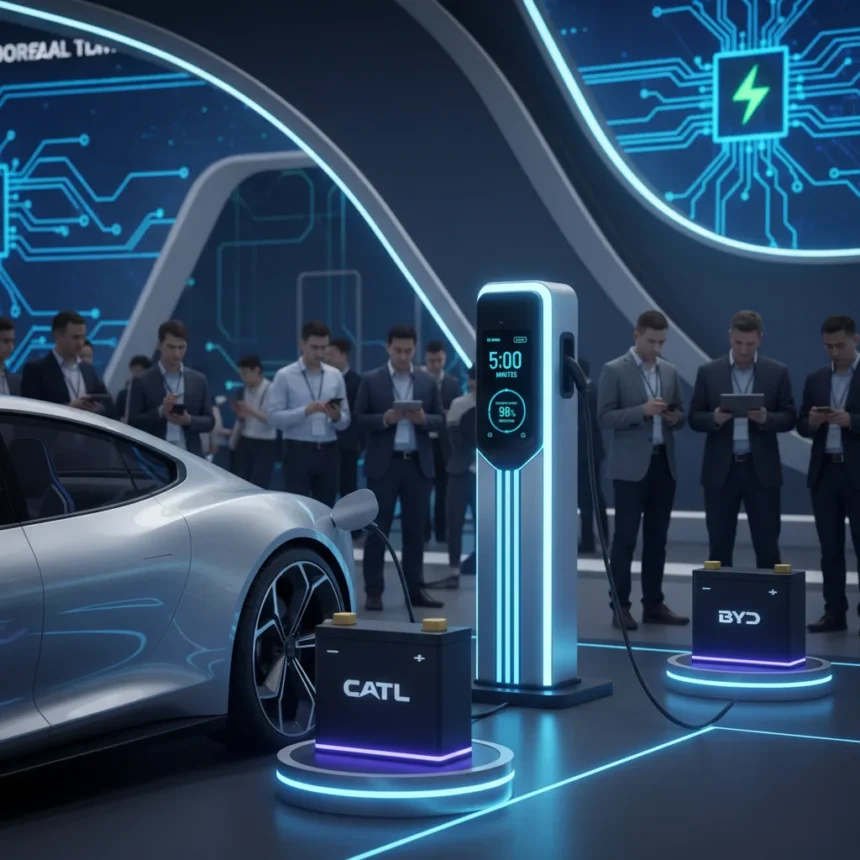
EV battery charging times have become the final frontier where electric vehicles have yet to fully surpass petrol cars in China, and the Beijing Auto Show is proving that the gap is closing fast. The 10-day event, running through May 3, has positioned rapid-charging technology as the dominant theme, with CATL and BYD leading a fierce competition to deliver 400 to 520 kilometers of range in just five minutes.
Key Takeaways
- CATL’s second-generation Shenxing battery delivers 520 km range from five minutes of charging, outperforming BYD’s 400 km capability.
- BYD’s latest battery achieves 10% to 97% charge in under 10 minutes using a refrigerant cooling system that prevents degradation.
- Second-tier suppliers including CALB Group, EVE Energy, and Sunwoda are charging 10% to 70% in under 10 minutes.
- Nio offers an alternative approach: full battery swaps in three minutes instead of ultra-fast charging.
- China is positioned as light years ahead of global competitors in EV battery charging technology.
CATL’s Shenxing battery sets new EV battery charging times standard
CATL unveiled its second-generation Shenxing battery ahead of the Shanghai Auto Show, and the numbers are genuinely impressive. The battery delivers 520 kilometers of range from just five minutes of charging, compatible with the latest superfast charging stations. This represents a clear leap over BYD’s competing system, which offers 400 kilometers in roughly the same timeframe. The Shenxing is not a one-trick pony either—CATL also demonstrated a dual power battery combining a fast-charging pack with an auxiliary system to achieve 1,500 kilometers of total range, addressing range anxiety without sacrificing charging speed.
What makes this achievement significant is not merely the headline number. The battery is engineered to work with existing infrastructure, meaning early adopters won’t need to wait for an entirely new charging network to materialize. That practical compatibility matters more than theoretical specs that require nonexistent technology.
BYD’s refrigerant cooling breakthrough changes the charging equation
BYD took a different engineering approach, focusing on thermal management rather than raw speed alone. The company launched a battery claiming 10% to 97% charge in less than 10 minutes, triggering an industry-wide race. More importantly, BYD’s latest refrigerant cooling system delivers a 35% gain in high-temperature lifespan for megawatt charging without degradation, according to internal testing. This matters because previous ultra-fast charging approaches often came with a hidden cost: reduced battery longevity.

The refrigerant innovation is the kind of engineering detail that separates genuine breakthroughs from marketing stunts. A battery that charges quickly but dies after two years is useless. BYD appears to have solved the tradeoff that plagued earlier attempts.
Second-tier suppliers push EV battery charging times lower across the market
While CATL and BYD dominate headlines, second-tier suppliers are quietly reshaping expectations. CALB Group, EVE Energy, and Sunwoda have all unveiled batteries capable of charging from 10% to 70% in under 10 minutes. Sunwoda went further, demonstrating a battery for electric bicycles that charges 10% to 80% in 20 minutes and lasts 2,000 cycles, proving that rapid charging is scaling across vehicle categories, not just cars.



According to Li Xianyang, a battery specialist at Sunwoda, the competitive intensity reflects a fundamental market reality: everyone has to compete on charging time because it remains the psychological barrier preventing mass EV adoption in China. When petrol cars can refuel in five minutes and EVs required 30 to 45 minutes just two years ago, closing that gap becomes existential for the industry.
Alternative strategies: Nio’s three-minute battery swap
Not every manufacturer believes ultra-fast charging is the only solution. Nio demonstrated full battery swaps in three minutes, sidestepping the charging bottleneck entirely. This approach trades charging infrastructure for battery-swap stations and adds complexity to vehicle design, but it eliminates the thermal and electrical constraints that make five-minute charging so challenging. Whether swapping becomes mainstream depends on whether manufacturers can standardize battery form factors—a problem Nio has solved for its own vehicles but the industry has not.
Why China’s EV battery charging times matter globally
China’s dominance in this space is not accidental. The country controls roughly 60% of global battery production and has invested heavily in charging infrastructure to support it. CATL and BYD are not competing in isolation—they are racing to set the standard that the rest of the world will eventually adopt. When a Chinese battery maker solves a problem at scale, global automakers take notice because they cannot afford to be left behind.
The gap between China’s EV battery charging times and those available elsewhere is widening, not narrowing. Western manufacturers are still focused on incremental improvements to existing chemistries, while Chinese makers are fundamentally rethinking thermal management, electrode design, and charging protocols. This is not a temporary lead that can be closed with one clever engineering decision.



What remains unsolved in EV battery charging times
The Beijing Auto Show reveals genuine progress, but also exposes what remains unproven. Range claims of 520 kilometers after five minutes are based on company demonstrations under ideal conditions. Real-world performance in cold weather, after thousands of charge cycles, or with older vehicles remains uncertain. Battery lifespan claims like Sunwoda’s 2,000-cycle estimate lack independent verification.
The infrastructure question is equally critical. Five-minute charging requires megawatt-level power delivery, and most grids cannot support widespread simultaneous charging at that scale. The technology is advancing faster than the electrical infrastructure required to use it.
Does five-minute EV battery charging time actually solve range anxiety?
Five-minute charging is impressive, but it does not eliminate the psychological barrier entirely. A petrol car refuels in five minutes anywhere. An EV with five-minute charging still requires access to a megawatt charging station, which are rare outside major cities. For rural drivers or those without home charging, the experience remains fundamentally different from petrol vehicles.
How does Nio’s battery swap compare to ultra-fast charging?
Nio’s three-minute swap is faster than five-minute charging, but it requires standardized battery packs and dedicated swap stations. Ultra-fast charging works with any charger that supports the protocol, making it more flexible. Nio’s approach is elegant for fleet operators but harder to scale globally unless competitors adopt the same standard.
Which EV battery charging times are realistic for production vehicles?
CATL’s 520-kilometer range in five minutes and BYD’s 10% to 97% charge in under 10 minutes are both production-ready technologies unveiled at a major auto show, not laboratory concepts. However, real-world results will depend on charging station availability, grid capacity, and how these batteries perform after thousands of cycles. Early adopters should expect the headline speeds in optimal conditions, with more modest results in daily use.
China’s EV battery charging times race is reshaping what the global industry considers possible. Whether five minutes becomes the standard or remains a premium feature depends less on engineering and more on whether charging infrastructure can catch up to the technology. For now, CATL and BYD have delivered the hardware. The world needs to build the grid to match it.
Edited by the All Things Geek team.
Source: TechRadar