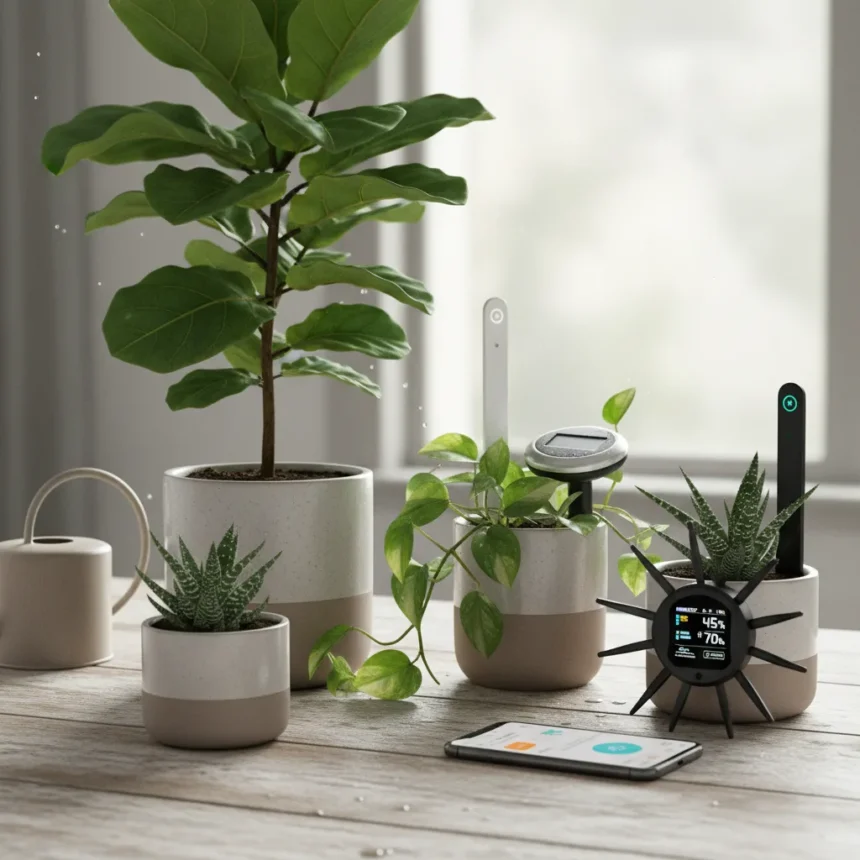
Smart plant sensors are devices that monitor soil moisture, light levels, and other environmental conditions to help keep your houseplants alive. The premise is simple: stick a sensor in your plant pot, connect it to an app, and receive alerts when your plant needs water or light. But do these gadgets actually work, or are they just another piece of smart home clutter gathering dust on a shelf?
Key Takeaways
- Smart plant sensors monitor soil moisture, light, and temperature to track plant health in real time.
- Most sensors connect via Bluetooth or WiFi and send alerts to your phone when plants need water.
- Setup typically takes minutes, but requires consistent app engagement to be effective.
- Smart plant sensors work best for people who travel frequently or struggle with plant care routines.
- Budget models start under fifty dollars, while premium options cost significantly more.
How smart plant sensors actually work
Smart plant sensors operate by measuring soil moisture content and ambient light conditions around your houseplants. When moisture drops below a preset threshold or light becomes insufficient, the sensor sends a notification to your phone via a companion app. Some models also track temperature and humidity, giving you a complete picture of your plant’s environment. The real value proposition is accountability—you cannot ignore a push notification the way you can ignore a drooping plant you see every day.
Most smart plant sensors use Bluetooth to communicate with your smartphone, which means they work best within a reasonable distance of your phone. Setup involves downloading an app, creating an account, inserting the sensor into the soil, and calibrating it for your specific plant type. The calibration step is crucial because different plants have wildly different watering needs. A succulent wants bone-dry soil, while a fern demands constant moisture. Get this wrong and the sensor becomes useless.
Smart plant sensors versus traditional plant care
The core difference between smart plant sensors and traditional plant care boils down to consistency and memory. A sensor never forgets to check your plant’s moisture level. You, however, almost certainly will. If you travel frequently or maintain a large plant collection, smart plant sensors eliminate the guesswork. Traditional methods—the finger-in-soil test, observing leaf droop, or remembering a watering schedule—rely entirely on your attention and memory, both of which are finite resources.


That said, smart plant sensors introduce their own friction. You must keep the app installed and notifications enabled. The sensor requires a battery, which eventually dies. The Bluetooth connection can drop. None of these problems exist with the low-tech approach of simply watering your plants when they look thirsty. For casual plant owners with a handful of low-maintenance specimens, a sensor might be overkill. For someone with fifty plants or a tendency to forget watering for weeks, a sensor becomes genuinely useful.
Who actually benefits from smart plant sensors
Smart plant sensors make the most sense for specific use cases. Frequent travelers who leave their plants unattended for days or weeks get real value from constant monitoring. People with plant collections large enough to make manual checking impractical benefit from the overview an app provides. Beginners learning which plants need how much water can use sensor data as a training tool, building intuition over time.


The devices struggle for casual plant owners who keep a few hardy specimens on a windowsill. These people already have low expectations and generally succeed through benign neglect. Adding a sensor and an app to that equation creates unnecessary complexity. The sensor works best when it solves an actual problem—forgetfulness, travel, scale, or learning—rather than when it is used simply because the technology exists.
Setup and daily use of smart plant sensors
Most smart plant sensors take under five minutes to set up. You download the app, create an account, insert the sensor into the soil near the plant’s roots, and specify which plant you own. The app then tailors watering recommendations based on that plant’s needs. From that point forward, you receive notifications when action is required. Some apps also let you manually check your plant’s status whenever you want, providing real-time feedback without waiting for an alert.
Daily use is genuinely minimal once setup is complete. You glance at notifications, water when instructed, and that is it. The app handles all the monitoring. The friction comes only if the sensor’s recommendations conflict with your plant’s actual appearance—for instance, if the app says your plant is fine but the leaves look pale anyway. In those moments you must decide whether to trust the sensor or your eyes, which somewhat defeats the purpose of buying the device in the first place.
Are smart plant sensors worth the investment?
The answer depends entirely on your plant care habits and lifestyle. If you travel regularly or maintain a large plant collection, a smart plant sensor pays for itself by keeping plants alive that would otherwise die from neglect. If you have a stable routine and plants that thrive on minimal attention, the sensor adds cost and complexity without solving a real problem. Price matters less than use case. A fifty-dollar sensor you actually use is far better value than a two-hundred-dollar sensor that sits in a drawer because you do not need it.



The technology itself is sound. Soil moisture sensors have been reliable for years. The app ecosystem around them has matured. The real test is whether you will consistently engage with the notifications and act on them. A sensor that sends alerts you ignore is worse than no sensor at all—it creates false confidence that your plants are being monitored when they are actually being neglected. Before buying, ask yourself honestly whether you will use this device regularly or whether it will become another abandoned gadget.
Do smart plant sensors actually keep plants alive?
Smart plant sensors are tools, not magic. They keep plants alive only if you respond to their alerts and act on the information they provide. A sensor that sits silent while your plant dries out has failed. A sensor whose notifications you ignore has also failed. The device succeeds only when it closes the gap between your plant’s needs and your ability to meet them consistently. For people who struggle with that gap—who travel, forget, or maintain too many plants—smart plant sensors absolutely work. For people whose current methods already keep their plants healthy, the sensor changes nothing.
What happens if you ignore the sensor’s alerts?
Your plant dies. The sensor cannot water your plant for you. It only tells you when watering is needed. If you ignore those alerts because you are busy, traveling, or simply do not feel like checking your phone, the sensor provides no protection. This is the critical limitation that marketing often glosses over. A smart plant sensor is not a plant care solution—it is a notification system. The actual care still falls entirely on you.
Can smart plant sensors work without WiFi?
Most smart plant sensors use Bluetooth, which requires only that your phone be nearby. They do not need WiFi or internet connectivity to function. This is actually an advantage because it means the sensor works even if your home internet goes down. The tradeoff is that Bluetooth has limited range, typically thirty to fifty feet depending on the model and environment. If you place a sensor in a greenhouse or outdoor garden far from where you keep your phone, Bluetooth becomes impractical and you would need a WiFi-connected model instead.
Smart plant sensors solve a real problem for a specific audience: people who want to keep their plants alive but struggle with the consistency required. They do not work for everyone, and they are not a substitute for actually caring about your plants. But for frequent travelers, large plant collections, and beginners learning plant care, they offer genuine value. The key is honest self-assessment about whether you will actually use the device or whether it will become another piece of smart home hardware you regret buying.
Where to Buy
Edited by the All Things Geek team.
Source: TechRadar